
Latin name
Saccopharynx ampullaceus
Other Name
Taillight gulper
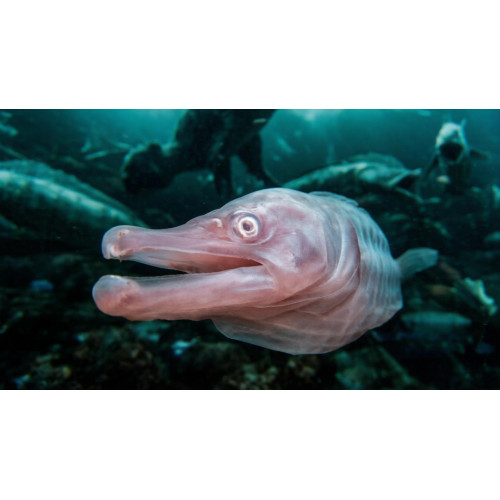
Pelican-fish
Identification
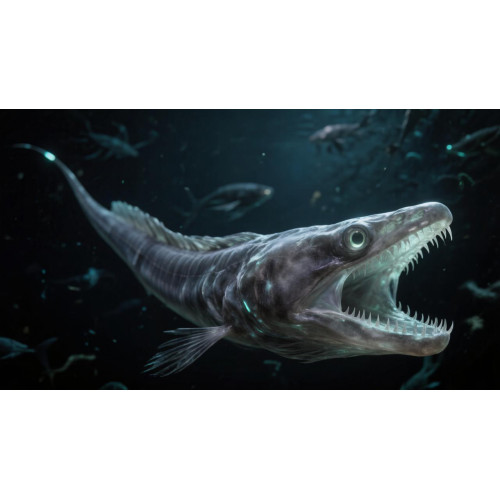
The gulper eel has a long, slender body and a disproportionately large mouth, with jaws that make up a significant portion of its length. Its skull is very small compared to its massive jaws. The body is covered in black, velvety skin, and scales are absent. A key feature is the long, whip-like tail that ends in a complex, bioluminescent organ. The species is fragile and specimens are rarely recovered intact.
Features of Fish Fins
It lacks pelvic fins and a swim bladder. The dorsal fin is long and low, running along the back, while the anal fin is also present. The pectoral fins are small and reduced, located low on the body just behind the gill opening. The dorsal fin contains 155–196 rays, and the anal fin contains 118–147 rays.
Fish Colouring
The eel’s body is black or dark brown, with some specimens having a thin, white stripe along the dorsal fin. The end of the tail bears a complex organ with numerous tentacles that can glow pink and occasionally give off bright-red flashes. The dark pigmentation is an adaptation for ultra-black camouflage, reflecting less than 0.5% of light to help it remain hidden in the deep sea.
Distribution
This species is found in the North Atlantic Ocean, from scattered records near Greenland to Cape Verde. It is also known from the Western Atlantic.
Habitat
The gulper eel is a bathypelagic (deep-water) species, found at depths ranging from 0 to 3,000 meters (9,800 ft). Adults are most abundant between 1,000 and 3,000 meters.
Size
The species can reach a maximum length of 161 cm (approximately 5.3 feet) total length.
Behavior
This fish is a poor swimmer, moving by undulating its long, slender tail. Because its large mouth creates drag, it is not an effective hunter in the traditional sense. It is believed to use its bioluminescent tail as a lure to attract prey. Males also undergo a significant transformation when they mature, developing enlarged olfactory organs, likely to help them find a mate in the dark depths.
Food and Feeding Habits
The gulper eel primarily feeds on fishes and crustaceans. Its hunting strategy is likely one of luring prey with its glowing tail tip or simply swimming with its enormous mouth open to engulf any food it encounters. Sexually mature individuals of both sexes experience a reduction of their jaws and a complete loss of teeth, suggesting they may not feed once they reach maturity.
Reproduction
The species is oviparous (egg-laying) with pelagic leptocephalus larvae that live in the upper layers of the ocean. As they mature, they descend to deeper waters. The dramatic changes in the jaws and teeth of mature adults suggest a semelparous life cycle, where they may reproduce once and then die.
Fishing
The gulper eel is of no commercial interest to fisheries and is rarely encountered in fishing nets.
Relationship with a Person
This species poses no threat to humans and is listed as "Least Concern" on the IUCN Red List. Due to its deep-sea habitat, it is rarely seen and is not affected by human activities.
| Classification | |
| Phylum | Chordata |
| Class | Actinopterygii |
| Squad | Saccopharyngiformes |
| Family | Saccopharyngidae |
| Genus | Saccopharynx |
| Species | Saccopharynx ampullaceus |
| Features | |
| Conservation status | Least Concern |
| Habitat | Bathypelagic |
| Life span, years | No information |
| Maximum body weight, kg | No information |
| Maximum length, cm | 161 |
| Sailing speed, m/s | No information |
| Threat to people | Not edible |
| Way of eating | Predator |
Gulper eel
Tags: gulper eel