
Latin name
Brevoortia patronus
Other name
The Gulf menhaden is also widely known as "pogy" or "pogie" in the United States. Other common names include large-scale menhaden and mossbunker in the United Kingdom. In French, it is called menhaden écailleux, in Spanish lacha escamuda, and in Portuguese menhadem-escamudo.
Identification
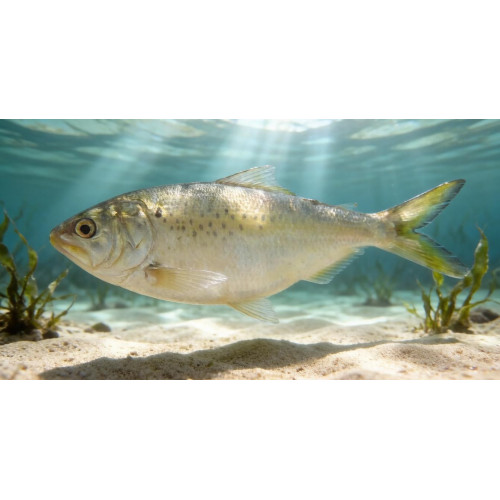
The Gulf menhaden is a small, compressed, and deep-bodied fish with a typical herring-like shape. Its body is fusiform and compressed laterally. The mouth is typical of herrings, with a short, deep lower jaw hidden by the wide, rounded upper jaw. A distinctive feature is the presence of a median notch in the upper jaw. The belly has a serrated keel, and there are two rows of enlarged, modified scales on the back in front of the dorsal fin. A black spot is present behind the gill opening, often followed by a series of smaller, diffused spots along the flank.
Features of fish fins
The dorsal fin has no spines and contains 17–21 soft rays. The anal fin is also spineless with 20–23 soft rays. The pelvic fin has a rounded hind margin, and its inner fin rays are equal or nearly equal in length to the outer rays when the fin is folded back. The caudal fin is deeply forked. The Gulf menhaden is a pelagic-neritic species, swimming in the water column over the continental shelf. It forms dense schools and is a filter feeder.
Fish colouring
The back is bluish-gray to green, while the sides and belly are silvery with a brassy green sheen. The fins are generally yellowish, with dusky tips on the caudal fin. A distinctive dark shoulder spot is always present, usually with smaller spots behind it. This spotting appears on fish larger than 50–75 mm.
Distribution
This species is found exclusively in the western central Atlantic Ocean, within the Gulf of Mexico. Its range extends from Florida Bay in the United States to the Gulf of Campeche in Mexico. It is not known to occur in the Caribbean Sea. The Gulf of Mexico population is distinct from the Atlantic menhaden (Brevoortia tyrannus), which is found along the US Atlantic coast.
Habitat
The Gulf menhaden inhabits coastal, pelagic-neritic waters at depths from 0 to 50 meters, occasionally down to 70 meters. It is a euryhaline species, tolerating a wide salinity range from 0.1 to 60 parts per thousand (ppt). The commercial catch is typically made in waters with salinity between 5 and 24 ppt. It tolerates temperatures from 5 to 35°C. Seasonal migrations are pronounced: in summer, fish are found inshore in shallow, low-salinity areas, while in winter, they move into deeper, offshore waters of the Gulf. Juveniles settle in very shallow (0–2 m) marsh-edge habitats in late winter to spring.
Size
The maximum recorded standard length for the Gulf menhaden is 35 cm. The common length is around 20 cm, though fish up to 27 cm are regularly caught. Length at first maturity is approximately 183 mm fork length, at about 2 years of age.
Behavior
The Gulf menhaden is a highly schooling fish that feeds in dense aggregations. It is a filter feeder, straining plankton from the water . Adults are found in open bay and Gulf waters with non-vegetated bottoms. They exhibit strong seasonal migratory behavior: moving into shallow estuaries and inshore waters in spring and summer and migrating to deeper, high-salinity waters in the fall and winter for spawning. Spawning occurs in open Gulf waters.
Food and feeding habits
Gulf menhaden are omnivorous filter feeders. Their diet consists primarily of phytoplankton, zooplankton, and detritus. Larvae initially feed on microzooplankton. They are also thought to feed at the bottom occasionally. This filter-feeding habit plays a crucial ecological role in maintaining water quality by removing excess nutrients and algae. An isopod parasite has been found in the mouths of some individuals.
Reproduction
Spawning occurs offshore in the Gulf of Mexico from September to May, with peak activity from December through February. The preferred spawning habitat is characterized by high salinity (15–36 ppt) and temperatures between 14 and 25°C. Most spawning takes place near the Mississippi Delta area, from Texas to Alabama. Adults become sexually mature after two growing seasons. Larvae are carried by currents into estuarine nursery areas within 3 to 5 weeks of hatching. Juveniles remain in low-salinity estuarine habitats until fall.
Fishing
The Gulf menhaden fishery is the largest fishery by weight in the United States. The annual catch has averaged over 1 billion pounds in recent years, with most of the harvest coming from the shores of Louisiana. This fishery is primarily a "reduction" fishery, meaning the fish are processed into fishmeal and fish oil rather than sold for direct human consumption. Some catch is also used as bait for other fisheries. Historically, Gulf landings surpassed Atlantic menhaden landings in the 1960s.
Relationship with a person
Despite being unfamiliar to the general public as a food fish, Gulf menhaden are among the most important fish in the sea ecologically and economically. Their products—fish oil and fishmeal—are used in animal feed for poultry, livestock, and farmed fish, as well as in pet food, dietary supplements, cosmetics, and other products. They play a critical ecological role as a major forage fish for predatory species, including mackerel, bluefish, sharks, red drum, spotted seatrout, seabirds (brown pelicans, ospreys), and marine mammals (bottlenose dolphins). Their filter-feeding also helps maintain oxygen levels and prevent the build-up of pollutants in the Gulf. Concerns have been raised about overfishing and bycatch associated with the menhaden fishery, and their decline has been linked to the expansion of "dead zones" in the Gulf of Mexico. Management approaches are shifting towards an ecosystem-based perspective to ensure the sustainability of both the menhaden population and the broader Gulf ecosystem.
Interesting facts
Sometimes Gulf menhaden suddenly begin to fall from the sky along with rain. At first glance, the phenomenon seems inexplicable, and it is no wonder that believers consider fish falling from the sky to be a gift from the gods. But the gods have nothing to do with it. It is simply that during hurricanes, tornadoes scoop up tons of water from the sea and lift it into the air, along with the fish swimming at the surface. The column of water travels many kilometers and finally bursts into a "fish shower.
| Classification | |
| Phylum | Chordata |
| Class | Actinopterygii |
| Squad | Clupeiformes |
| Family | Alosidae |
| Genus | Brevoortia |
| Species | B. patronus |
| Features | |
| Conservation status | Least Concern |
| Habitat | Pelagic |
| Life span, years | No information |
| Maximum body weight, kg | No information |
| Maximum length, cm | 35 |
| Sailing speed, m/s | No information |
| Threat to people | Edible |
| Way of eating | Omnivore |
Gulf menhaden
Tags: gulf menhaden