
Latin name
Ipnops murrayi
Other Names
The grideye fish is also known as Murray's grideye. Its scientific name, Ipnops murrayi, was given by Günther in 1878. The genus name Ipnops comes from the Greek words "hypnos" (sleep) and "ops" (appearance). The species is named in honour of Sir John Murray, a Canadian marine naturalist and naturalist on the HMS Challenger expedition, which collected the type specimens. In other languages, it is known as Netzauge (German), harilik pimekala (Estonian), and 穆氏炉眼鱼 (Chinese).
Identification
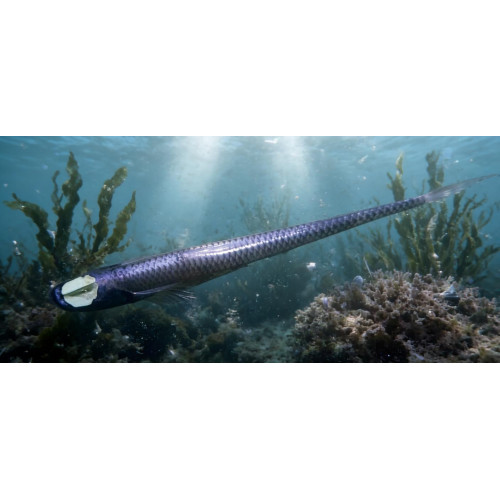
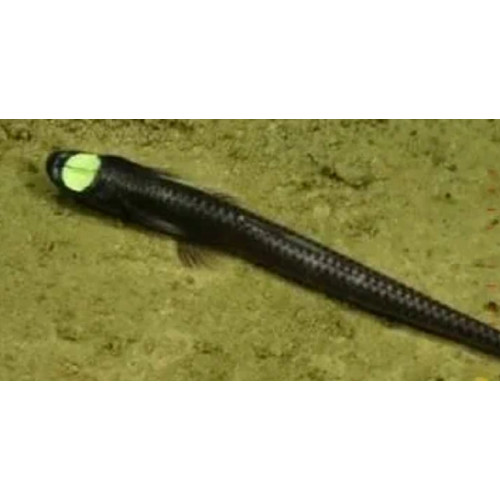
The grideye fish has a slender, black body with a relatively large head and a broad, flattened snout. Its most unusual feature is its eyes, which are modified into large, pale, flattened photosensitive plates on the top of the head. These plate-like structures lack a lens and serve as a light-receiving surface rather than functioning as typical eyes. The vertebrae number 54–58.
Features of Fish Fins
The grideye fish has no spines in its fins. The dorsal fin contains 8–10 soft rays, and the anal fin has 13–16 soft rays. The pectoral and pelvic fins are present, though specific ray counts are not detailed in available sources.
Fish Colouring
The grideye fish is uniformly black in colour. The photosensitive plates on the top of the head are described as large, pale, flattened structures that contrast with the dark body.
Distribution
The grideye fish has a discontinuous distribution across several ocean basins. It is known from the Eastern Indian Ocean (off southern Australia, particularly the Great Australian Bight), the Western Atlantic (Mid Atlantic Bight and Bahamas), the Eastern Atlantic (off northwest Africa), and is also found in the Pacific Oceans. It has also been recorded in the Gulf of Mexico.
Habitat
This species is bathydemersal, living on or near the seafloor at great depths. It inhabits the lower continental slope and abyssal plain, typically over soft sediment areas. The depth range is from 1,239 to 4,539 meters, though most records indicate depths between 1,789 and 3,477 meters.
Size
The grideye fish can reach a maximum length of 13.2 cm (standard length). Some sources report a maximum total length of 17 cm. The maximum published weight is not specified in available sources.
Behavior
The grideye fish is a slow-moving, bottom-dwelling species that inhabits the deep seafloor. Its most remarkable behavioral adaptation is its unique visual system: the modified eyes on the top of the head allow it to detect light from above in the perpetual darkness of the deep ocean. The species is a hermaphrodite, meaning individuals possess both male and female reproductive organs.
Food and Feeding Habits
Specific dietary information for Ipnops murrayi is not available in the search results. Based on the biology of other members of the family Ipnopidae, it likely feeds on small benthic invertebrates.
Reproduction
The grideye fish reproduces through sexual reproduction. It is a hermaphrodite, with individuals having both male and female reproductive organs. Specific details on spawning behaviour or fecundity are not documented in available sources.
Fishing
The grideye fish has no commercial value and is not targeted by fisheries. It is known only from scientific deep-sea trawling surveys.
Relationship with a Person
The grideye fish is not considered a threat to humans and is classified as harmless. It lives at depths of 1,239–4,539 metres and is never encountered by swimmers or recreational divers. The species is of significant scientific interest due to its unique eye structure and deep-sea adaptations. The species is listed as Least Concern (LC) on the IUCN Red List, assessed on 11 October 2018.
| Classification | |
| Phylum | Chordata |
| Class | Actinopterygii |
| Squad | Aulopiformes |
| Family | Ipnopidae |
| Genus | Ipnops |
| Species | Ipnops murrayi |
| Features | |
| Conservation status | Least Concern |
| Habitat | Bathydemersal |
| Life span, years | No information |
| Maximum body weight, kg | No information |
| Maximum length, cm | 13,2 |
| Sailing speed, m/s | No information |
| Threat to people | Not edible |
| Way of eating | Bentophage |
Grideye fish
Tags: grideye fish