
Latin name
Balistes capriscus
Other name
Gray triggerfish
Identification
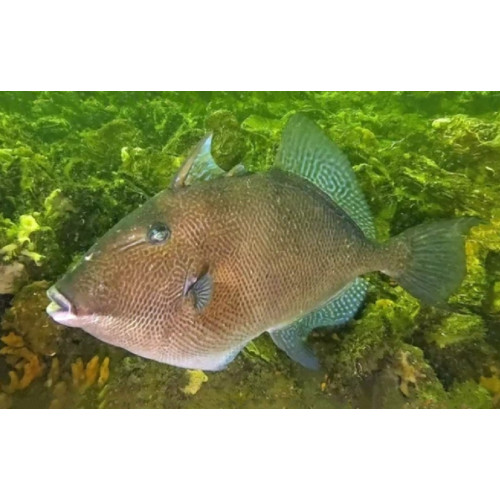
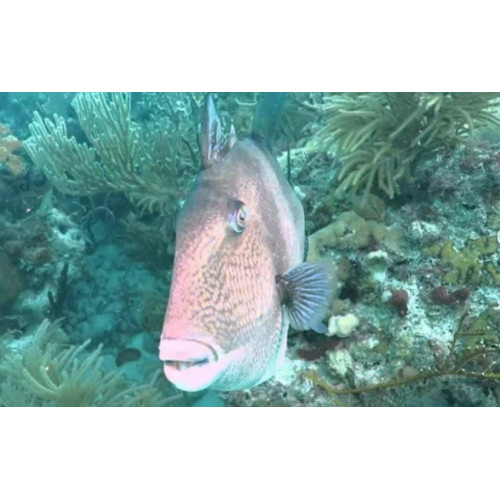
The body of the grey triggerfish is oval in shape, deep due to a very lowered abdomen, strongly compressed laterally, and covered with regular rows of large, dense, smooth scales (without tubercles or spines), which form a sturdy armor. There are 56–64 transverse rows of scales. Behind the gill opening there are usually 2–3 enlarged bony plates. The small nasal openings are located directly in front of the eyes. The lateral line is complete, extending to the caudal fin, making a large zigzag in the middle of the body.
Features of fish fins
Dorsal spines (total): 3; dorsal soft rays (total): 26–29; anal spines: 0; anal soft rays: 23–26.
The first dorsal fin consists of three spiny bony spines connected by leathery membranes; the first spine is the longest and strongest, with a serrated rear edge, and is locked in the raised position by the second spine, which fits tightly against it; the third spine is set some distance apart from the first two. The second dorsal fin is high, with 2–3 spiny and 25–26 soft rays. The pelvic fins have one short, rough, granular, movable spine, followed by a series of flexible, thin spines. The anal fin has two spiny and 22–23 soft rays. The caudal fin is long, with the outer rays significantly elongated in adults.
Fish coloring
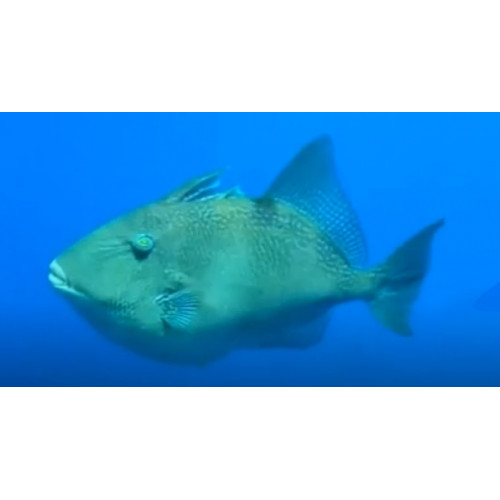
The general background color is greenish or grayish-brown, sometimes with a purple tint on the back. On the anal and dorsal fins, and sometimes on the sides, there are often blue stripes and yellow or black spots.
Distribution
They are distributed along both coasts of the Atlantic: from Ireland to Angola in the east, including the Azores, Canary Islands, and Madeira; and from Nova Scotia to Argentina in the west. They are also found in the Mediterranean and Black Seas.
Habitat
The grey triggerfish primarily stays in coastal waters and usually lives near or among rocks and large boulders at depths of 10–100 meters (33–328 feet). It is a reef-associated fish species that inhabits bays, harbors, and lagoons.
Size
The maximum body length of these fish is 60–61 cm (24 inches). Total length is 44.0 cm (17.3 inches). The maximum reported weight is 6.2 kg (13.7 lbs). The maximum reported age is 15 years.
Behavior
A marine sedentary fish. It stays alone or in small groups. Juveniles lead a pelagic lifestyle and are often found among detached, floating algae, with which they travel great distances due to currents and winds.
As soon as the grey triggerfish senses danger, it raises its spines, with the second spine propping up the first so that it sticks out like an awl.
Food and feeding habits
It feeds on small invertebrates, including mollusks and crustaceans. Because grey triggerfish are resilient to capture, they reproduce quickly and compete for food with other species.
Reproduction
Oviparous (egg-laying). Adults guard the embryos deposited in the sand, which hatch approximately two days later.
Fishing
The grey triggerfish is a target of both recreational and commercial fishing. They are also caught for sale to aquariums.
Relationship with a person
Reports of ciguatera poisoning. It is eaten mainly fresh, smoked, or dried and salted. The flesh is of excellent quality.
| Classification | |
| Phylum | Chordata |
| Class | Actinopterygii |
| Squad | Tetraodontiformes |
| Family | Balistidae |
| Genus | Balistes |
| Species | B. capriscus |
| Features | |
| Conservation status | Vulnerable |
| Habitat | Reef |
| Life span, years | 15 |
| Maximum body weight, kg | 6,2 |
| Maximum length, cm | 61 |
| Sailing speed, m/s | No information |
| Threat to people | Edible |
| Way of eating | Planktonophage |
Grey triggerfish
Tags: grey triggerfish