
Latin name
Periophthalmus chrysospilos
Identification
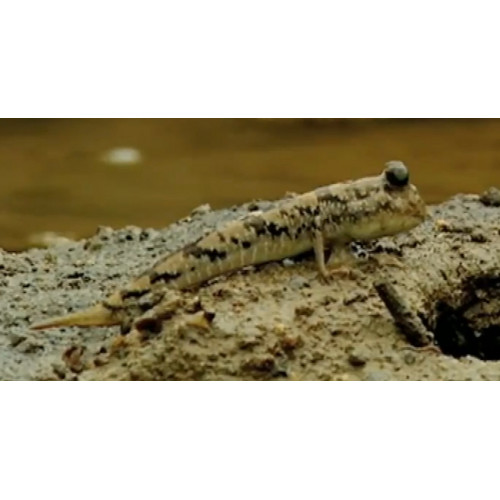
The body shape of the gold-spotted mudskipper is elongated, almost cylindrical in the anterior part, and slightly compressed laterally. The head is large, with a convex snout, on which stand out huge, mobile eyes located high on the crown. These eyes work independently of each other and can protrude like a frog's, providing almost a 360-degree field of view on land.
This species is one of the most adapted to terrestrial existence among fish. It doesn't just survive out of water; it leads an active life.
The mudskipper is capable of breathing atmospheric air. Its gill chambers are enlarged and constantly filled with water, which is retained by special valves. Skin rich in capillaries, as well as the mucous membranes of the mouth and pharynx, also participate in gas exchange. The fish "gulps" air, and oxygen dissolves in this moisture.
On mudflats, the mudskipper moves using its powerful pectoral fins, with which it leans on the substrate, lifting the front part of its body. In case of danger or when needing to move quickly, the fish uses its tail: it bends its body into an arc and then sharply straightens, pushing off the surface and making a jump of 30–60 cm (12–24 inches).
Mudskippers live in burrows that they dig in viscous mud. These burrows go deep into the substrate and are filled with water, allowing the fish to wait out the low tide and escape from heat and predators.
Features of fish fins
The main distinguishing features of this species are its fins.
First dorsal fin: a true "sail" — very high, with 7–10 spiny rays. In males, the first two rays are noticeably elongated; in females, only the first ray is elongated.
Second dorsal and anal fins: shifted far back, closer to the tail, and are not connected to the first dorsal fin.
Pectoral fins: powerful, muscular, with thickened rays, resembling short legs. They serve as the main organ of locomotion on land — the fish uses them to "walk" or crawl through the mud.
Pelvic fins: fused into a single suction cup, located directly behind the pectoral fins. This suction cup allows the fish to firmly attach to vertical surfaces — roots and trunks of mangrove trees.
Caudal fin: rounded or lanceolate, serves as an additional lever during movement.
Fish coloring
The body of the gold-spotted mudskipper is covered with small golden or yellow spots on a dark, olive-brown or grayish-brown background. This coloration provides excellent camouflage against the backdrop of muddy bottoms and mangrove roots. The belly is usually light. The first dorsal fin has no spots or stripes; it is often brightly colored.
Distribution
They are found in the eastern Indian Ocean — from eastern India and Sri Lanka to Indonesia. They are common in the coastal waters of Malaysia, Singapore, Thailand, and Vietnam.
Habitat
This is a demersal species. A typical inhabitant of mangrove forests and adjacent mudflats. It prefers soft muddy and sandy-muddy substrates, areas protected from strong waves in river estuaries. It can tolerate a wide range of salinity but prefers brackish waters.
Size
According to a Malaysian study, mudskippers of this species form two main size groups in the population: small individuals around 5.3 cm (2.1 inches) and large individuals around 8.3 cm (3.3 inches). The maximum (asymptotic) length is estimated at 13.2 cm (5.2 inches).
Behavior
It leads a diurnal, solitary, or territorial lifestyle. Each adult defends its territory around its burrow. Mudskippers are very skittish and, at the slightest danger, hide in their burrows with lightning speed. In good weather, they like to "sunbathe," sitting on tree roots or rocks protruding from the water.
Food and feeding habits
It is an omnivorous predator that feeds mainly during low tide. The diet consists primarily of small crabs, gastropods, various insects and their larvae, which the mudskipper collects from the mud surface.
It hunts by waiting for prey from an elevated position or actively explores the muddy surface. Algae also add variety to its diet.
Reproduction
This aspect of mudskipper biology has not been fully studied, but key details are known. Spawning occurs throughout the year, with a peak during the rainy season (July to October). For reproduction, the fish use their deep burrows. The male attracts the female with courtship jumps and displays of his bright dorsal fin. The eggs are laid on the walls of the burrow underwater. The male guards the clutch. The eggs contain a supply of nutrients necessary for development. Males become capable of reproduction at a length of 6.2–8.6 cm (2.4–3.4 inches), females at 6.4–7.3 cm (2.5–2.9 inches).
Fishing
Despite their small size, in some regions of Southeast Asia, these mudskippers are caught and eaten as a local delicacy, especially during family ceremonies. They are also used in folk medicine to treat muscle pain and migraines — a massage oil is prepared from their meat mixed with local herbs.
Relationship with a person
This species is completely safe for humans.
The species has a wide range and is currently not under threat of extinction (IUCN status — Least Concern). However, in certain regions (e.g., the Mekong Delta), populations are declining due to massive capture for the aquarium fish trade and for human consumption. The level of exploitation of this species in some areas is assessed as low.
| Classification | |
| Phylum | Chordata |
| Class | Actinopterygii |
| Squad | Gobiiformes |
| Family | Oxudercidae |
| Genus | Periophthalmus |
| Species | P. chrysospilos |
| Features | |
| Conservation status | Least Concern |
| Habitat | Edible |
| Life span, years | No information |
| Maximum body weight, kg | No information |
| Maximum length, cm | 13,2 |
| Sailing speed, m/s | No information |
| Threat to people | Demersal |
| Way of eating | Predator |
Gold-spotted mudskipper
Tags: gold spotted mudskipper