
Latin name
Gigantactis macronema
Other Names
The longpole whipnose is known as Enaga-shida-ankou in Japanese. This name translates to "long handle fern angler", referencing its most distinctive feature — the extraordinarily long fishing rod. Its scientific name was given by Regan in 1925. The genus name Gigantactis comes from the Greek words "gigas" (gigantic) and "aktis" (ray), referring to the unusually long first dorsal-fin spine that functions as a lure.
Identification
The metamorphosed females of Gigantactis macronema are distinguished by several key characteristics:
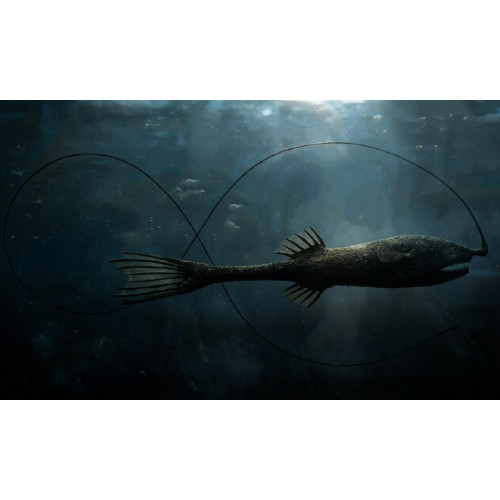
Illcium length: The illicium (fishing rod) is exceptionally long, measuring 340–447% of standard length (SL) — more than three times the length of the fish's body.
Esca structure: The escal bulb has a lightly pigmented truncated distal prolongation with 6–20 long distal filaments; escal papillae are absent.
Teeth: Dentary teeth are short (longest 1.3–3.4% SL, average 2.3% SL) and arranged posteriorly in two longitudinal series.
Caudal fin: The caudal fin rays are less than 45% SL and are free nearly to the base, with weakly developed skin coverage of the proximal part.
The first dorsal-fin spine (illicium) emerges from the extreme tip of the snout and bears a conspicuous terminal bioluminescent bait (esca).
Features of Fish Fins
The longpole whipnose has a single dorsal fin with 0 spines and 5–6 soft rays, and a single anal fin with 0 spines and 5–6 soft rays. The pectoral fins have 17–20 soft rays. There is no adipose fin. The caudal fin rays are free nearly to the base, meaning they are not fully enclosed by fin membrane.
Fish Colouring
The esca (bioluminescent bait) at the end of the illicium is lightly pigmented with a truncated distal prolongation. The body of the fish, like many deep-sea anglerfishes, is generally darkly pigmented, though specific colouration details for this species are not extensively documented in available sources.
Distribution
Gigantactis macronema has a wide distribution across the world's oceans:
Atlantic Ocean: Found in both the western and eastern Atlantic.
Pacific Ocean: Found in the eastern North Pacific from central California south to Baja California, and also recorded in Hawaiian waters.
Brazil: Recorded off the coast of Brazil in the East Brazil Shelf, North Brazil Shelf, and South Brazil Shelf ecosystems.
Habitat
This species is marine and bathypelagic, inhabiting deep waters from 650 to 2,500 meters (2,132–8,202 feet). It occupies the mesopelagic to bathypelagic zones of the open ocean.
Size
Gigantactis macronema exhibits significant sexual dimorphism in size: Maximum size for females: 35.4 cm SL (about 13.9 inches). Maximum size for males: 11.65 cm SL. One recorded gravid female measured 530 mm (53 cm) total length and weighed 543 grams, with an illicium length of 1020 mm (over 1 meter). There is no precise data on the maximum age for this particular species. However, it is known that some species of the genus Gigantactis can live from 10 to 18 years.
Behavior
The longpole whipnose is an active predator in the deep sea. It uses its extraordinarily long illicium — which can be over three times the length of its body — as a fishing rod to attract prey. The esca at the tip emits light through bioluminescence, drawing curious midwater organisms toward the waiting mouth of the anglerfish.
Food and Feeding Habits
Gigantactis macronema feeds on a variety of midwater organisms:
Fishes: Midwater fishes including Cyclothone acclinidens, Triphoturus mexicanus, and Bathylagus stilbius.
Cephalopods: Including the vampire squid Vampyroteuthis.
Invertebrates: Amphipods, natant decapod crustaceans, and coelenterates.
Reproduction
Gigantactis macronema reproduces through sexual reproduction. The species shows extreme sexual dimorphism, with males being significantly smaller than females (11.65 cm SL vs 35.4 cm SL). One recorded specimen was a gravid female weighing 543 grams with a gonad weight of 103.5 grams.
Fishing
Gigantactis macronema is not a commercial species and is not targeted by fisheries. It is primarily known from scientific deep-sea trawling surveys, such as those conducted off Suriname and French Guiana. The species is occasionally collected as bycatch in deep-sea research expeditions.
Relationship with a Person
Gigantactis macronema is not considered a threat to humans and is classified as harmless. It is a deep-sea anglerfish that lives at depths of 650–2,500 meters and is never encountered by swimmers or recreational divers. The species is of scientific interest due to its remarkable bioluminescent lure and extreme morphology. The species is listed as Least Concern (LC) on the IUCN Red List, assessed on 11 October 2018.
| Classification | |
| Phylum | Chordata |
| Class | Actinopterygii |
| Squad | Lophiiformes |
| Family | Gigantactinidae |
| Genus | Gigantactis |
| Species | Gigantactis macronema |
| Features | |
| Conservation status | Least Concern |
| Habitat | Bathypelagic |
| Life span, years | 18 |
| Maximum body weight, kg | 0,543 |
| Maximum length, cm | 35,4 |
| Sailing speed, m/s | No information |
| Threat to people | Not edible |
| Way of eating | Predator |
Gigantactis macronema
Tags: gigantactis macronema