
Latin name
Regalecus glesne
Other Names
The giant oarfish is known by several alternative names, including king of herrings, king-of-the-herrings, Pacific oarfish, ribbonfish, and streamer fish. Its scientific name, Regalecus glesne, was given by Ascanius in 1772. The genus name Regalecus comes from the Latin regalis, meaning "royal". The species is named after the type locality, Glesvaer near Bergen, Norway. The common name "oarfish" is thought to refer either to its highly compressed body or to the old belief that it "rows" itself through the water with its pelvic fins.
Identification
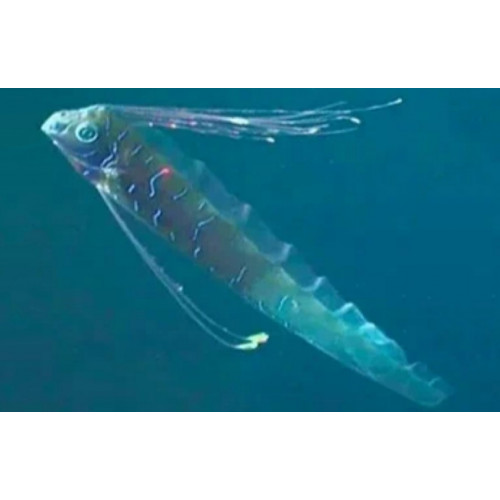
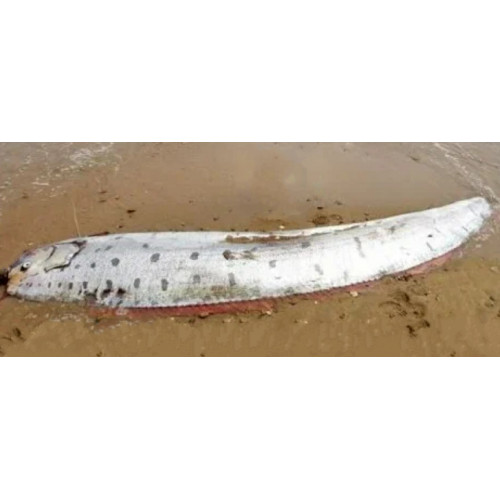
The giant oarfish has an extremely long, ribbon-like, strongly compressed body that tapers to a point. It is the longest bony fish in the world. The head is small with a protrusible, toothless mouth. The eyes are relatively large and situated high on the head. The lateral line descends from above the eye to the lower part of the body. A key distinguishing feature is the absence of scales; the skin is covered with silvery guanine. The body is marked with oblique dark bars, blue streaks, and spots that fade quickly after death. The species has no swim bladder.
Features of Fish Fins
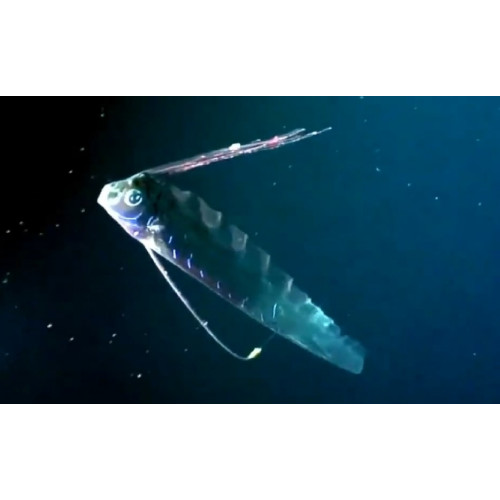
The giant oarfish has a very long, continuous dorsal fin that runs almost the entire length of the body, originating above the eyes. The dorsal fin contains 0 spines and 414–449 soft rays. The first 10–13 rays are elongated into a distinctive red crest, forming two crests on the head: the first with 6–8 rays united by membrane, the second with 5–11 elongated rays not united by membrane. The pelvic fins are reduced to a single, extremely elongate, ribbon-like ray, often ornamented with skin flaps. The pectoral fins are small, with 11–14 rays, and are situated low on the body. The species completely lacks an anal fin, and the caudal fin is reduced or absent in adults; juveniles may have 3–4 rays.
Fish Colouring
The body of the giant oarfish is bright silver to silvery-blue with blue to blackish streaks, blotches, and wavy markings. These markings are more pronounced in some individuals and fade rapidly after death. The long dorsal fin and the pelvic fin are crimson red. The head is blue to blackish. The skin has no scales and is covered with silvery guanine.
Distribution
The giant oarfish has a circumglobal distribution in tropical, subtropical, and warm temperate waters, excluding polar regions. In the Atlantic, it is widely distributed, including the Mediterranean Sea. In the eastern Pacific, it ranges from southern California to Chile. It is also found in the Indo-Pacific. Records in Australia are scattered off the northern Great Barrier Reef to South Australia.
Habitat
This species is pelagic-oceanic and inhabits the mesopelagic zone, typically at depths of 200–1,000 meters. It is rarely seen near the surface, except when sick, injured, or dying, and occasionally washes up on beaches after storms.
Size
The giant oarfish is the world's longest bony fish. It can reach a maximum total length of 8 meters (26 feet) for well-documented specimens, though unconfirmed reports suggest up to 11 meters (36 feet) or more. The maximum published weight is 272 kg (600 lb). The common length is around 3 meters (10 feet). All large specimens are shortened by autotomy (self-amputation) of the tail.
Behavior
The giant oarfish is a solitary species that rarely forms groups larger than three individuals. It is often observed swimming vertically, head-up, a feeding posture that allows it to spot prey silhouetted against the surface light. The fish swims by undulating its long dorsal fin while keeping the body stiff, using an amiiform mode of locomotion. It has the unique ability of serial autotomy — self-amputation of the tail, which can occur repeatedly during its lifetime and is likely an anti-predator adaptation. The lost tail is never regenerated, and all specimens over 1.5 m show a healed stump.
Food and Feeding Habits
The giant oarfish is a filter feeder that primarily consumes zooplankton, including euphausiid crustaceans (krill), small fishes, and squids. It feeds by swimming with its mouth open, using its toothless, protrusible jaws to suction krill-laden water into its mouth, where long, spiny gill rakers trap the prey. One specimen off California contained over 10,000 individual krill in its stomach.
Reproduction
The giant oarfish is a broadcast spawner with external fertilization. Spawning occurs between July and December, and larvae are found near the surface. The eggs are large, measuring 2–4 mm in diameter, and are pelagic, containing numerous oil droplets. The species produces the largest eggs of any pelagic fish in some regions. Mature individuals spawn in specific areas, including the west coast of Florida, the Straits of Messina, and the Chatham Rise near New Zealand. There is no parental care.
Fishing
The giant oarfish has little commercial value. It is occasionally caught as bycatch in encircling nets and marketed fresh, but its flesh is gelatinous and considered unpalatable. It is sometimes considered a gamefish but is rarely encountered alive.
Relationship with a Person
The giant oarfish is not considered a threat to humans and is classified as harmless. It is rarely seen alive by humans; most encounters are with dead or dying individuals washed ashore. Its size, serpentine appearance, and rare surface sightings have led many to believe it is the source of historical sea serpent legends. In some cultures, it is known as the "earthquake fish" due to a folk belief that it surfaces before earthquakes. The species is listed as Least Concern (LC) on the IUCN Red List, assessed on 7 May 2013.
Interesting facts
The belief that the appearance of this fish heralds disaster is rooted in Japanese folklore, where it is called "Ryugu no tsukai," which translates as "messenger from the palace of the sea god." According to legend, it rises from the depths to warn people of an approaching earthquake or tsunami.
This myth was especially reinforced after 2011, when several oarfish were found off the coast of Japan, and a few months later, the devastating Tohoku earthquake and tsunami occurred. This temporal sequence gave rise to a persistent association.
Modern science finds no link between the appearance of the oarfish and seismic activity.
A major study: In 2019, a study was published in the Bulletin of the Seismological Society of America, analyzing 371 cases of deep-sea fish appearances and 221 earthquakes in Japan over nearly 90 years. Scientists concluded that there is no statistically significant relationship between these events.
Researchers called this belief an "illusory correlation" — when the human brain mistakenly links two random events occurring around the same time.
Why do they appear on the surface?
Unlike mythical abilities, there are quite real and scientifically grounded reasons for the giant oarfish appearing near the surface:
Illness or death: This is the most common cause. They live at depths of 200 to 1,000 meters, and when they are sick, injured (e.g., by sharks), or dying, they are carried to the shore or into shallower waters.
Changes in the ocean: The El Niño phenomenon, which alters water temperature, can affect the distribution of deep-sea species, causing them to appear where they are not usually seen.
How is this reflected in culture today?
Despite the lack of scientific evidence, the myth of the "Doomsday fish" is very persistent. Every new appearance of a giant oarfish, for example off the coast of Taiwan in 2023 or in Tamil Nadu (India) in 2025, sparks viral news and a wave of discussions on social media, fueling the ancient legend.
Thus, although the giant oarfish is not a harbinger of disasters, its unusual appearance and rarity continue to make it one of the most mysterious and legendary fish in the ocean.
| Classification | |
| Phylum | Chordata |
| Class | Actinopterygii |
| Squad | Lampridiformes |
| Family | Regalecidae |
| Genus | Regalecus |
| Species | Regalecus glesne |
| Features | |
| Conservation status | Least Concern |
| Habitat | Pelagic |
| Life span, years | No information |
| Maximum body weight, kg | 272 |
| Maximum length, cm | 110 |
| Sailing speed, m/s | No information |
| Threat to people | Edible |
| Way of eating | Planktonophage |
Giant oarfish
Tags: giant oarfish