
Latin name
Monacanthus ciliatus
Other name
Cuckold, leather-fish, balistes ciliatus, monacanthus davidsonii, monacanthus occidentalis, monacanthus piraaca.
Identification
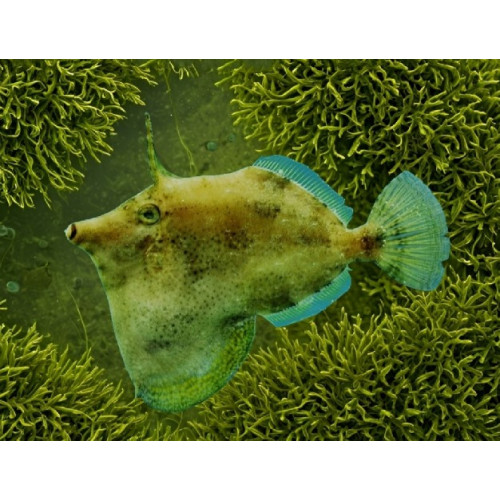
The fringed filefish is a laterally compressed fish with a deeply curved body and a fold on the underside. The eyes are large, the snout is short and pointed, and the mouth is small with strong teeth. The skin is covered with very small scales, giving the fish a leathery appearance. The skin is also dotted with small, pointed, fleshy projections. Adult males have two pairs of enlarged, recurved spines on each side of the caudal peduncle; the spines of females are only slightly larger than the other scaly projections on the caudal peduncle.
Features of fish fins
Dorsal spines (total): 2; Dorsal soft rays (total): 29 - 37; Anal spines: 0; Anal soft rays: 28 - 36.
The dorsal fin in these fish consists of two parts; the anterior part is located just behind the eyes and consists of two spines, the first of which is long and erect, while the second is tiny; the second part begins farther back and consists entirely of soft rays. The pectoral fins are small, and the pelvic fin resembles a spine. The caudal fin is short, fan-shaped, and consists of branched soft rays.
Fish coloring
The coloration of the fringed filefish depends on the environment: in seagrass beds it is greenish, while on reefs or sandy areas it is brown or tan. On the underside there are darker, irregular longitudinal stripes, and there is often a large black spot.
Distribution
The fringed filefish inhabits shallow areas of the western Atlantic Ocean between Newfoundland and Argentina, as well as the Caribbean Sea and the Gulf of Mexico. It is also found along the eastern Atlantic coasts of Europe and Africa.
Habitat
A marine subtropical reef-associated species. It is most commonly found in seagrass beds, but also on coral rubble, sandy, and sometimes rocky areas. It is a demersal fish that lives at depths ranging from 5 to 20 meters (16 to 66 feet).
Size
This fish species typically reaches a length of 10 to 14 cm (4–6 inches), with a maximum length of 20 cm (8 inches). No information is available on its weight. The maximum lifespan is 6 years.
Behavior
With its nose pressed against the bottom, the ringed filefish can remain vertically suspended for hours, waving its fins and tail. It seems as if what's before you is not a fish, but a plant swaying in the current. They can change their color quickly depending on their surroundings. This way, they often hide among algae.
Food and feeding habits
They feed on algae and seagrass, and pick small invertebrates from the seafloor, such as shrimp, amphipods, isopods, ostracods, polychaete worms, and mollusks.
Reproduction
One male is typically associated with several females, which lay eggs in depressions in the sand or in other sheltered places. The eggs are fertilized by the male, and then one of the parents guards them until they hatch. Juvenile fish lead a pelagic lifestyle and can be found among floating masses of sargassum algae.
Fishing
They are wild-caught for the aquarium trade.
Relationship with a person
Reports of ciguatera poisoning. It is rarely eaten.
| Classification | |
| Phylum | Chordata |
| Class | Actinopterygii |
| Squad | Tetraodontiformes |
| Family | Monacanthidae |
| Genus | Monacanthus |
| Species | M. ciliatus |
| Features | |
| Conservation status | Least Concern |
| Habitat | Bottom |
| Life span, years | 6 |
| Maximum body weight, kg | No information |
| Maximum length, cm | 20 |
| Sailing speed, m/s | No information |
| Threat to people | Edible |
| Way of eating | Bentophage |
Fringed filefish
Tags: fringed filefish