
Latin name
Apeltes quadracus
Other name
Bloody stickleback
Identification
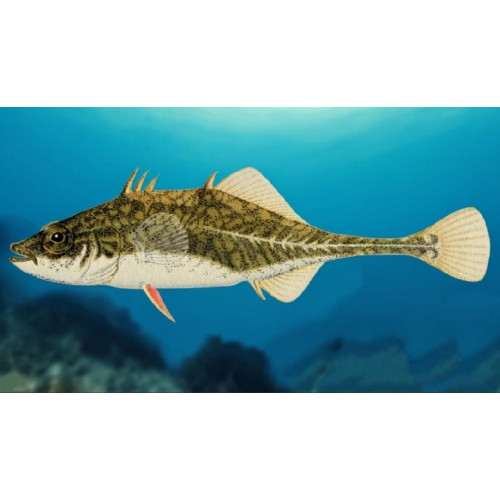
The fourspine stickleback possesses an elongated, fusiform body lacking scales. Typically, it exhibits four or five dorsal spines, though the number can reach up to seven. The first three dorsal spines are closely spaced and project at acute angles, each with a triangular membrane. The fourth spine is straight and connected to the dorsal fin. The lateral line terminates at the base of the second dorsal fin.
Features of Fish Fins
The pelvic fins are positioned almost directly beneath the pectoral fins in the thoracic region.
Fish Coloration
The body of the fourspine stickleback is mottled brown to olive-green, except on the ventral side. The abdomen is silvery-white. Males are generally darker than females and possess red pelvic spines.
Distribution
This species ranges from Newfoundland and Quebec south to North Carolina. It has been introduced into several freshwater bodies in Pennsylvania, Alabama, New Jersey, and into Lake Superior.
Habitat
They inhabit marine, freshwater, brackish, and benthopelagic waters, near freshwater shores in areas with abundant vegetation. The depth range is from 0 to 3 meters. Primarily solitary, they spend most of their time on lake bottoms.
Size
They are the smallest member of the family. They typically grow to about 4 centimeters but can reach 5-6 centimeters in length. The maximum reported age is 3 years.
Behavior
The male fourspine stickleback is an exceptional parent and skilled builder. Prior to spawning, he locates a suitable site and begins constructing a nest. After excavating a pit, he lines it with algae, then erects walls and a roof from stems and roots of aquatic plants, binding them together with adhesive mucus. The completed nest is usually spherical and has two openings: one larger and one smaller. Upon finishing construction, the male seeks out a female. They soon return together. The female enters the nest, deposits her eggs, and departs. After some time, the male invites another female, and this process is repeated multiple times. Once the male determines the nest contains a sufficient number of eggs, he adjusts the nest, seals one opening, and remains guard at the other. When enemies approach, the male fiercely attacks them, jabbing with his spines, nipping, and typically driving away the intruders. The father also tends to the fry: he herds them into the nest, protects them from predators, and abandons them only after ten to twelve days, when the young sticklebacks are capable of fending for themselves.
Food and Feeding Habits
The diet consists of microscopic invertebrates and plankton. They feed on the bottom, primarily on diatoms, worms, and crustaceans, sucking in prey via pipette feeding.
Reproduction
They typically reproduce at one year of age, although some individuals may survive and reproduce again at two years. Their breeding season lasts from April through late July; they often breed concurrently and in the same locations as three other stickleback species (threespine, ninespine, and blackspotted stickleback). Females can deposit multiple clutches of eggs per year.
Fishing
This species is commercially important for fishing.
Relationship with a person
Harmless. Used in aquariums.
| Classification | |
| Phylum | Chordata |
| Class | Actinopterygii |
| Squad | Perciformes |
| Family | Gasterosteidae |
| Genus | Apeltes |
| Species | A. quadracus |
| Features | |
| Conservation status | Least Concern |
| Habitat | Bottom |
| Life span, years | No information |
| Maximum body weight, kg | No information |
| Maximum length, cm | 6 |
| Sailing speed, m/s | No information |
| Threat to people | Edible |
| Way of eating | Planktonophage |
Fourspine stickleback
Tags: fourspine stickleback