
Latin name
Chaetodon capistratus
Other name
Four-eyed butterflyfish, chaetodon bricei
Identification
The foureye butterflyfish has a body that is compressed laterally. The upper part of the head is steep and slightly concave due to the protruding snout.Features of fish fins
Dorsal spines (total): 13; Dorsal soft rays (total): 17 - 20; Anal spines: 3; Anal soft rays: 16 - 17.
Fish Coloration
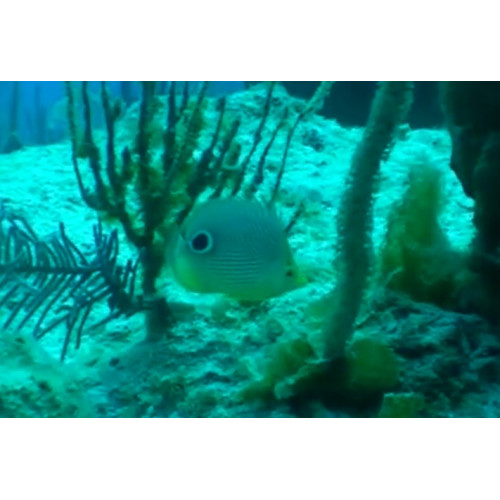
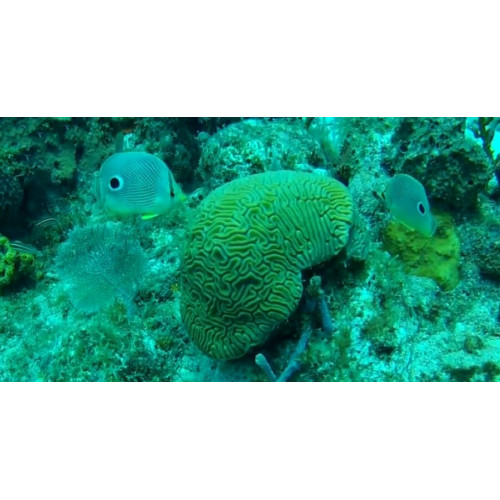
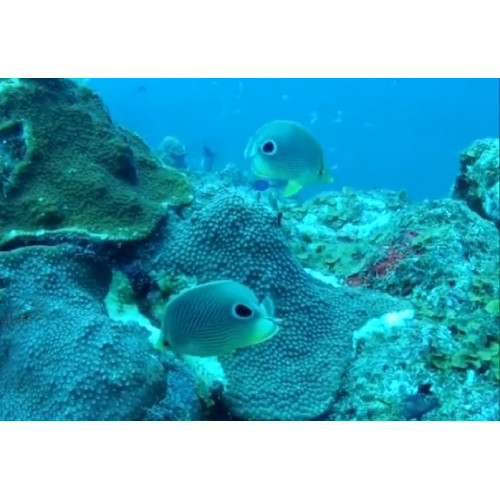
This species has a large black spot surrounded by a white ring on the body below the rear part of the dorsal fin. Narrow dark diagonal lines converge in the middle, forming a series of forward-pointing chevrons. The upper part of the head is light gray, transitioning to pale yellowish on the sides; there is a black stripe on the head; the pelvic fins are yellow. In juveniles up to 3 cm in length, there is an additional "eyespot" in the posterior region of the dorsal fin and three vertical stripes on the body. The black stripe, which fades in adults, masks the eye. The other two stripes are wider and more brownish in color.
Distribution
They are found in the Caribbean Sea, the Gulf of Mexico, and along the eastern coast of the United States, ranging as far north as Massachusetts. In the Caribbean Sea and the West Indies, it is the most common fish of its family.
Habitat
A marine, reef-associated, non-migratory species. The depth range is from 2 to 20 meters. Subtropical; 21°C to 28°C; 37°N to 8°N, 100°W to 58°W.
Size
The foureye butterflyfish reaches a length of up to 15 cm, but more commonly up to 10 cm. There is no direct data on the weight of these fish.
Behavior
There is a black spot edged in white at the base of the tail. This "eyespot" is a defensive adaptation against visually oriented predators. Predatory fish often focus on the eyes of their prey while hunting and are thus misled, mistaking the direction of their escape.
Food and Feeding Habits
The fish feed on algae, polychaete worms, ascidians, stony corals, and other corals.
Reproduction
Juveniles almost always live in small groups, while adults live in pairs. Pairs form during breeding. Monogamous pairing is considered obligatory, both genetically and socially.
Fishing
This species is commercially important for fishing.
Relationship with a person
Used in aquariums.
Reports of ciguatera poisoning.
| Classification | |
| Phylum | Chordata |
| Class | Actinopterygii |
| Squad | Acanthuriformes |
| Family | Chaetodontidae |
| Genus | Chaetodon |
| Species | C. capistratus |
| Features | |
| Conservation status | Least Concern |
| Habitat | Reef fish |
| Life span, years | No information |
| Maximum body weight, kg | No information |
| Maximum length, cm | 15 |
| Sailing speed, m/s | No information |
| Threat to people | Not edible |
| Way of eating | Omnivore |
Foureye butterflyfish
Tags: foureye butterflyfish