
Latin name
Bathysidus pentagrammus
Other Names
The five-lined constellation fish is also known simply as the constellation fish. Its scientific name, Bathysidus pentagrammus, was given by William Beebe in 1934. When translated, it roughly means "five-lined star of the depths".
Identification
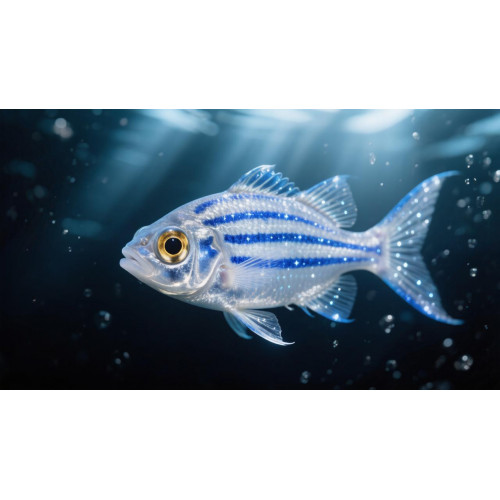
The five-lined constellation fish was described by Beebe as a disc-like fish with a roundish body measuring about 12 cm high and 15 cm across. It had continuous, vertical fins, large eyes, and small pectoral fins. Beebe noted that at the surface, without its lights, he would have called it a butterflyfish (Chaetodon) or surgeonfish (Acanthuris).
Features of Fish Fins
According to Beebe's description, the fish had long, moderately high, continuous, vertical fins. The pectoral fins were described as small. The species' fin arrangement resembled that of shallow-water butterflyfish or surgeonfish.
Fish Colouring
The most striking feature of this fish is its bioluminescence. The skin was described as decidedly brownish. Along the sides of the body ran five lines of light — one equatorial, with two curved lines above and two below. Each line was composed of large, pale yellow lights, and every one was surrounded by a semicircle of very small, but intensely purple photophores.
Distribution
The species was observed once, on 11 August 1934, off the coast of Bermuda in the North Atlantic Ocean. Beebe encountered it at a depth of 580 meters (1,900 feet) during a dive in the bathysphere.
Habitat
The constellation fish was observed in the deep sea at a depth of 580 meters. It was seen in solitude, and Beebe described it as adapted for life at three hundred fathoms.
Size
Beebe described the fish as disc-like, about 12 cm high and 15 cm across. This suggests a relatively small, compact body size.
Behavior
Based solely on Beebe's single observation, the fish appeared to be a solitary creature. It moved slowly, turning to show its narrow profile. Beebe described it as "one of the loveliest things he has ever seen".
Food and Feeding Habits
No information is available regarding the diet of this species, as it was only observed once and never collected.
Reproduction
No information is available regarding the reproduction of this species.
Fishing
Bathysidus pentagrammus has never been caught or fished. It is known only from one visual observation by William Beebe.
Relationship with a Person
The five-lined constellation fish is not considered a threat to humans. However, its existence remains unconfirmed. Of the five new fish described by Beebe during his bathysphere dives, none have been confirmed to exist. His colleague Otis Barton, who descended with him, attested he had also seen them.
Status of Existence
Ichthyologist Carl Hubbs proposed that the creature encountered by Beebe was not a fish at all, but rather a ctenophore (comb jelly). He suggested that distortion caused by the small viewing window could have made the comb jelly appear narrower and intensified its luminous lines. The species remains in taxonomic limbo and is widely considered a hypothetical species or cryptid. The species' status is listed as Uncertain in Eschmeyer's Catalog of Fishes.
| Classification | |
| Phylum | Chordata |
| Class | Uncertain |
| Squad | Uncertain |
| Family | Uncertain |
| Genus | Bathysidus |
| Species | Bathysidus pentagrammus |
| Features | |
| Conservation status | Uncertain |
| Habitat | Pelagic |
| Life span, years | No information |
| Maximum body weight, kg | No information |
| Maximum length, cm | 15 |
| Sailing speed, m/s | No information |
| Threat to people | No information |
| Way of eating | No information |