
Latin name
Photoblepharon palpebratum
Other Names
The eyelight fish is also known as the one-fin flashlightfish and lanterneye fish. Its scientific name, Photoblepharon palpebratum, was given by Boddaert in 1781. The genus name comes from the Greek words "photos" (light) and "blepharon" (eyelash), referring to its light organs, while the species name palpebratum means "eyelid" in Latin, referring to the black membrane that slides up to cover the light organ. In Japan, it is known as オオヒカリキンメ (Ohikarikimme).
Identification
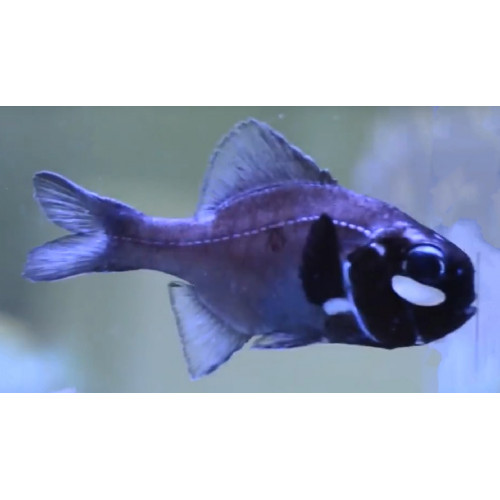
The eyelight fish has a fusiform (spindle-shaped) body that is compressed laterally and more stout than other members of its family. It reaches a maximum length of 12 cm (about 4.7 inches). The head is large, and the eyes are positioned far forward near the top of the head. Its most notable feature is the large, bean-shaped light organ located under each eye. Inside these organs live symbiotic bioluminescent bacteria. The fish supplies them with oxygen and nutrients through its bloodstream, and the bacteria, in turn, provide it with a constant blue-green glow. The lateral line is arched over the pectoral fin.
Features of Fish Fins
The eyelight fish has 2–3 dorsal spines and 16–20 dorsal soft rays. The anal fin contains 2 spines and 13–15 soft rays. The pectoral fin is located laterally on the body. The reduced and discontinuous midventral scutes are present.
Fish Colouring
The body of the eyelight fish is dark brown to black, with a black head and pectoral fins. A distinctive feature is a line of reflective, bluish scales running along the lateral line. There is a distinguishing white spot at the upper corner of the preopercle (gill cover). The most notable feature is the large cream-coloured bean-shaped light organ under each eye, which produces a blue-green bioluminescent glow.
Distribution
The eyelight fish is found in the western and central Pacific Ocean, from the Philippines to the Society Islands, and south to New Caledonia. It is also found in the Coral Sea around Australia and at Christmas Island in the eastern Indian Ocean. It is replaced in the western Indian Ocean by a closely related species, Photoblepharon steinitzi.
Habitat
This species is marine and reef-associated. It occurs along seaward reefs near steep drop-offs with caves, usually at depths of 0 to 50 meters, and is most often found between 0 and 15 meters. The fish spends the day hidden in caves and crevices and emerges at night. It is typically found in tropical waters between 19°N and 24°S.
Size
The eyelight fish reaches a maximum total length of 12.0 cm (about 4.7 inches). The maximum published weight is not specified in available sources.
Behavior
The eyelight fish is a nocturnal species, spending the day hidden in caves and crevices and emerging at night to feed. It generally hunts in large groups away from the reef. Its most remarkable feature is its ability to control its bioluminescence. The light organ is filled with symbiotic bacteria that constantly produce light. To "turn off" the light, the fish uses a black membrane that slides up over the organ like an upside-down eyelid. By rapidly blinking the light on and off, the fish can startle and avoid predators. The light is likely used to attract and find prey, confuse predators, and communicate with other fish.
Food and Feeding Habits
The eyelight fish is a nocturnal predator. Its primary food source is likely crustaceans (such as small shrimp) that it finds or attracts with its light organs. It also feeds on zooplankton and small fishes. The fish feeds in large groups away from the reefs at night.
Reproduction
The eyelight fish is oviparous, meaning it reproduces by laying eggs. Mated pairs spawn near the ocean surface. Each female can lay up to around 1,000 eggs per spawning cycle. The eggs go through a brief planktonic phase before attaching to a nearby surface. Within a day, the eggs turn milky white and sink to the substrate. Spawning has been documented in April and May, though spawning likely occurs at other times during the year as well.
Fishing
The eyelight fish has little commercial value. It is rarely caught for food. Its primary use is as bait for local fishermen, who sometimes cut out the light organs and attach them to hooks. The species has been displayed in public aquariums.
Relationship with a Person
The eyelight fish is not considered a threat to humans and is classified as harmless. It is rarely encountered by divers because it spends the day hidden in rock crevices. The species is of scientific interest due to its remarkable bioluminescent light organs and unique light-controlling mechanism. The species is listed as Least Concern (LC) on the IUCN Red List, assessed on 22 December 2019, due to its extensive distribution and lack of major threats.
| Classification | |
| Phylum | Chordata |
| Class | Actinopterygii |
| Squad | Beryciformes |
| Family | Anomalopidae |
| Genus | Photoblepharon |
| Species | Photoblepharon palpebratum |
| Features | |
| Conservation status | Least Concern |
| Habitat | Reef |
| Life span, years | No information |
| Maximum body weight, kg | No information |
| Maximum length, cm | 12 |
| Sailing speed, m/s | No information |
| Threat to people | Edible |
| Way of eating | Predator |
Eyelight fish
Tags: eyelight fish