
Latin name
Epinephelus marginatus
Other name
Yellowbelly rock cod, yellowbelly grouper.
Identification
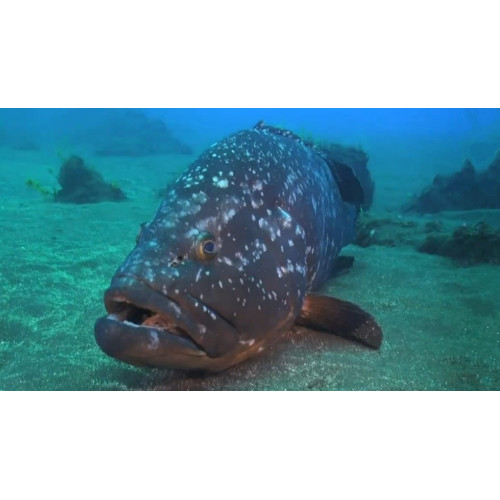
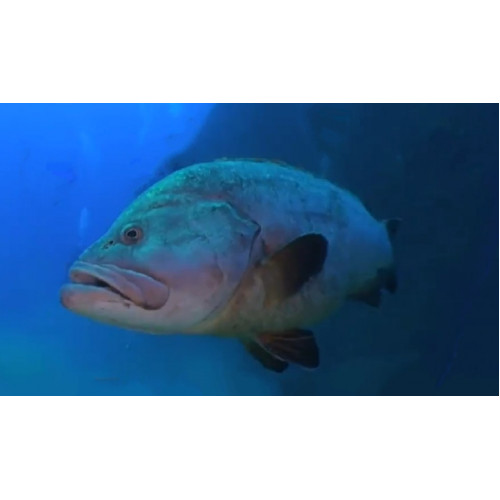
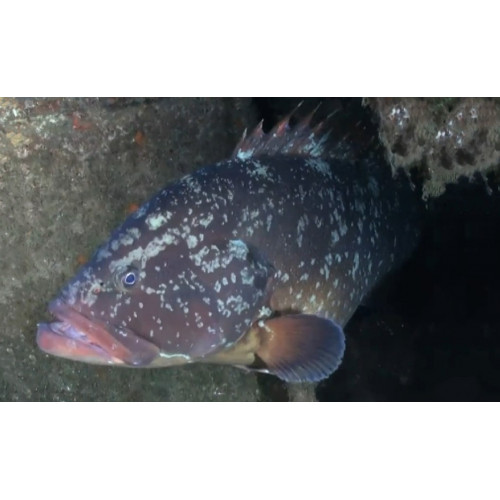
The dusky grouper is a massive fish with a powerful, oval body, a large head, a wide mouth, and a protruding lower jaw. Its body is covered with small scales deeply embedded in thick skin.
Features of fish fins
Dorsal fin: single, with a spiny anterior part and a soft posterior part. It consists of 11 spiny rays (spines) and 14–16 soft rays.
Anal fin: located behind the anal opening. Has 3 spiny and 8–9 soft rays.
Caudal fin: its shape changes with age. In juveniles, it is rounded; in adults, it becomes truncated with rounded corners.
Pectoral fins: large, rounded, located on the sides of the body. They consist of 17–19 soft rays and have no spines.
Pelvic fins: located on the belly below the pectoral fins. Consist of 1 spiny and 5 soft rays.
Fish coloring
Coloration is quite variable and serves as good camouflage against a rocky bottom background. The back is usually dark reddish-brown or gray, while the belly is lighter, often with a yellowish-golden tint, which gave the fish its alternative name "yellowbelly grouper." Irregular white, pale greenish-yellow, or silvery-gray spots are scattered across the body and head, often forming vertical rows. In adults, the fins are dark brown: the margin of the anal and caudal fins, and sometimes the pectoral fins, has a narrow white border, while the pelvic fins darken toward the tip.
Distribution
This species is widely distributed in the eastern Atlantic — from the southern Bay of Biscay to South Africa, including the entire Mediterranean Sea. It is also found in the southwestern Atlantic (off the coasts of Brazil, Uruguay, and Argentina) and in the western Indian Ocean.
Habitat
The dusky grouper is an inhabitant of rocky reefs and prefers to stay near the bottom at depths of 8 to 300 meters (26–984 feet). Adults lead a solitary and territorial lifestyle. Juveniles, on the other hand, stay closer to the shore and can be found in rocky tide pools. They are capable of entering brackish waters.
Size
This is a large and very slow-growing fish, reaching impressive dimensions only by the end of its long life.
The maximum length of this fish can reach 1.5 meters (5 feet), and it can weigh up to 60 kilograms (132 lbs). Typically, catches more often contain individuals around 90 centimeters (35 inches) in length, corresponding to a weight of about 15–20 kilograms (33–44 lbs).
However, the most amazing feature of the dusky grouper is its lifespan and extremely slow growth. This fish is a long-lived species. In the wild, it can live up to 50–60 years.
Behavior
If a cleaner fish is inside the mouth of a dusky grouper and the grouper considers the treatment finished, it gives a special signal, quickly closes its mouth, leaving a small gap under the gill covers, and immediately opens its mouth again.
Food and feeding habits
This massive predator feeds mainly on crabs and octopuses. Larger individuals hunt a greater proportion of fish, especially reef-dwelling species. It is a slow-moving but active fish that prefers to ambush prey from shelters.
Reproduction
One of the most amazing features of this species is its reproductive strategy.
They are protogynous hermaphrodites. All dusky groupers are born as females. Upon reaching a certain age and size, some of them change sex and become males. In Europe, this process occurs when the fish reaches a length of 80–90 cm (31–35 inches) and an age of 14–17 years. In other regions, sex change can occur at a length of 52–77 cm (20–30 inches) at an age of 7 to 17 years. Thus, the largest individuals (longer than 1 meter / 3.3 feet) are almost always males. The fish reaches first sexual maturity (as a female) only at 5 years of age. For reproduction, mature individuals gather in large spawning aggregations during the summer months.
Fishing
A valuable target of both commercial and recreational fishing due to its tasty meat. However, the combination of slow growth, late maturation, and the formation of spawning aggregations makes it extremely vulnerable to overfishing. The fish is easily caught on hook and line and becomes easy prey for spearfishers due to its curious nature.
Relationship with a person
It is classified as a species harmless to humans in the sense that it is not aggressive and does not pose a direct threat when encountered in the water. However, this does not mean that eating it is completely safe. The dusky grouper is a predator high up the food chain. It can accumulate ciguatoxins in its tissues — natural toxins that are not destroyed by cooking and can cause severe food poisoning in humans. Like other large, long-lived predatory fish, the dusky grouper is prone to bioaccumulation of mercury. Studies show that in large individuals (longer than 65 cm / 26 inches and older than 8 years), mercury levels in the muscles can exceed safe limits for human consumption.
Currently, the species has a global conservation status of Vulnerable on the IUCN Red List, and in some regions, such as Europe, its status is assessed as Endangered.
In aquariums, the dusky grouper adapts poorly.
| Classification | |
| Phylum | Chordata |
| Class | Actinopterygii |
| Squad | Perciformes |
| Family | Epinephelidae |
| Genus | Epinephelus |
| Species | E. marginatus |
| Features | |
| Conservation status | Vulnerable |
| Habitat | Demersal |
| Life span, years | 60 |
| Maximum body weight, kg | 60 |
| Maximum length, cm | 150 |
| Sailing speed, m/s | No information |
| Threat to people | Edible |
| Way of eating | Predator |
Dusky grouper
Tags: dusky grouper