
Latin name
Dunkleosteus terrelli
Other Names
Dunkleosteus terrelli is known simply as Dunkleosteus, or informally as Dunk. Its scientific name was given by Newberry in 1873. The genus name Dunkleosteus honors Dr. David Dunkle, a former curator of vertebrate paleontology at the Cleveland Museum of Natural History, while the species name terrelli honors Jay Terrell, the amateur fossil collector who discovered the first specimens in 1867. It belongs to the family Dunkleosteidae, order Arthrodira, class Placodermi, and phylum Chordata.
Identification
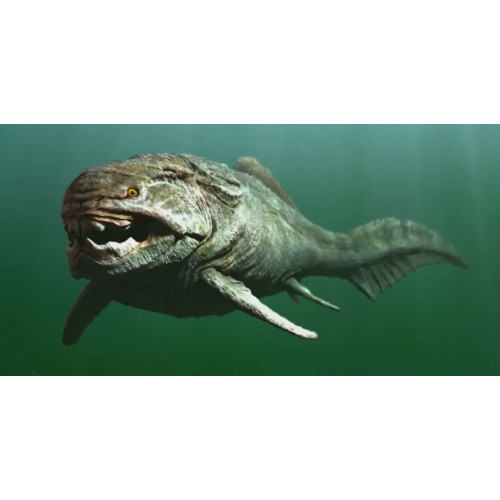
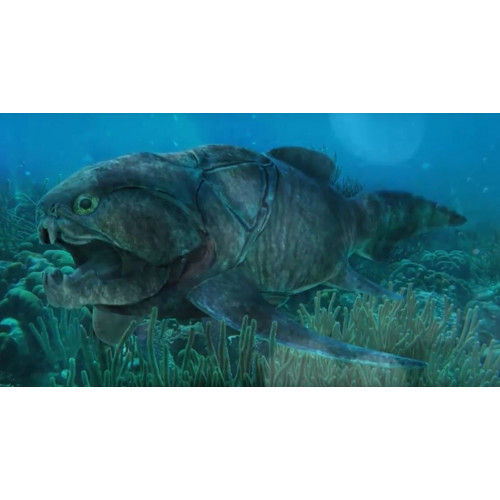
Dunkleosteus terrelli is an extinct species of arthrodire placoderm, a group of ancient armored fish that dominated the Devonian Period. The most distinctive feature of this fish is its massive skull, composed of thick, bony plates that served as armor. Instead of teeth, it possessed two sets of self-sharpening, blade-like jawbones (gnathal plates) that functioned as bony fangs. The jaws could open to an astonishing 45-degree angle. Most of the skull was made of cartilage—nearly half—far more than previously assumed, including major jaw connections and muscle attachment sites.
Features of Fish Fins
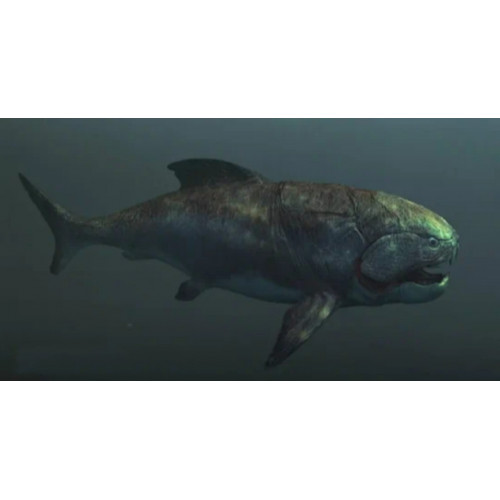
Because Dunkleosteus is known almost exclusively from its armored head and anterior body, the structure of its fins is not well-documented in fossil remains. Like other placoderms, it possessed a bony armor only in the front portion of its body, while the rest of its skeleton, including the fins, was likely composed of cartilage, similar to sharks. This cartilaginous structure rarely fossilizes.
Fish Colouring
The colouration of Dunkleosteus terrelli is unknown, as colour does not preserve in fossils. The fish lived in the shallow, subtropical seas covering what is now Ohio during the Late Devonian.
Distribution
Dunkleosteus likely lived worldwide during the Devonian Period, but the most extensive and best-preserved fossils come from the Cleveland Shale in Ohio, USA. The unique conditions of the ancient seafloor in this region allowed for a remarkable concentration of skeletal remains to be preserved. Fossils have also been found in continental Europe and North Africa, suggesting the fish was an active, far-ranging swimmer.
Habitat
Dunkleosteus terrelli inhabited the subtropical waters of the Late Devonian seas, approximately 375–359 million years ago. It lived near the surface, where there was sufficient oxygen and light to support a complex food chain. It would have been a top predator in the ancient inland sea that covered parts of present-day Ohio.
Size
The size of Dunkleosteus has been a subject of debate. Older estimates gave lengths of up to 33 feet (10 meters) and weights of up to four tons. However, recent scientific studies using more rigorous statistical methods have revised these estimates significantly downward. The typical adult length of Dunkleosteus terrelli is now estimated at about 3.4 meters (11 feet), with the largest known individuals reaching approximately 4.1 meters (13.5 feet). The species is still considered one of the largest arthrodires and a dominant predator of its time.
Behavior
Dunkleosteus was a formidable apex predator with a unique bite mechanism. Its bite force was remarkably powerful, estimated at about 1,100 pounds-force (5,000 Newtons), comparable to the bite of large alligators. This force was focused into a small area, creating incredible pressure of nearly 8,000 pounds per square inch at the fang tips. Even more surprising, it could open its mouth very quickly—in just one fiftieth of a second—creating a strong suction force to pull fast-moving prey into its mouth. This combination of a powerful closing bite and fast jaw opening is unusual among fish. Unlike most fish, Dunkleosteus possessed a highly kinetic skull driven by four rotational joints working in harmony.
Food and Feeding Habits
Dunkleosteus terrelli was a carnivorous apex predator that likely fed on a wide variety of armored prey, including other placoderms, sharks, ammonoids, and large crustaceans. Its self-sharpening, blade-like jawbones allowed it to bite chunks out of large prey and rip apart animals larger than its own mouth, a feature that sharks would only develop 100 million years later. This feeding strategy made it one of the first true apex predators in the vertebrate fossil record.
Reproduction
Specific details about the reproduction of Dunkleosteus are not known from the fossil record. Like other placoderms, it is thought to have reproduced by laying eggs. Some placoderm species are known to have been viviparous (giving birth to live young), but this has not been confirmed for Dunkleosteus.
Fishing
Dunkleosteus terrelli is extinct and has been for nearly 360 million years. It is therefore not a subject of fishing or commercial activity. The species was declared the official state fossil fish of Ohio in 2020 in recognition of its significance to the region.
Relationship with a Person
Dunkleosteus terrelli is not considered a threat to humans, as it has been extinct for hundreds of millions of years. However, it is one of the most recognizable and scientifically important prehistoric animals. It captivates public and scientific interest due to its status as the first true apex predator and the strongest-biting fish ever discovered. Fossils of Dunkleosteus, particularly the world's largest and best-preserved collection at the Cleveland Museum of Natural History, are invaluable for understanding the evolution of jawed vertebrates and the paleoecology of the Devonian seas.
| Classification | |
| Phylum | Chordata |
| Class | Placodermi |
| Squad | Arthrodira |
| Family | Dunkleosteidae |
| Genus | Dunkleosteus |
| Species | Dunkleosteus terrelli |
| Features | |
| Conservation status | Extinct |
| Habitat | Pelagic |
| Life span, years | No information |
| Maximum body weight, kg | 4000 |
| Maximum length, cm | 1000 |
| Sailing speed, m/s | No information |
| Threat to people | Not edible |
| Way of eating | Predator |
Dunkleosteus
Tags: dunkleosteus