
Latin name
Barbus borysthenicus
Other Names
The Dnieper barbel is also known as the Dnieper marinka or simply the barbel. In Ukraine, it is called марена дніпровська. Historically, it was considered a subspecies of the common barbel (Barbus barbus) and referred to as Barbus barbus borysthenicus. The scientific name, Barbus borysthenicus, was given by Dybowski in 1862. The genus name Barbus comes from the Latin "barba," meaning beard, referring to the barbels near the mouth.
Identification
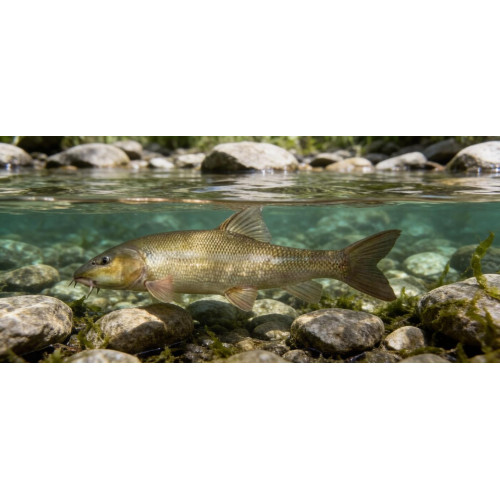
The Dnieper barbel has a torpedo-shaped (fusiform) body that is somewhat thicker compared to the common barbel, with a characteristic hump in the region of the dorsal fin. The caudal peduncle is wider and shorter than in related species. The mouth is inferior (positioned on the underside of the head) and horseshoe-shaped, with a thick lower lip featuring a median swollen pad. A distinctive feature is the presence of two pairs of barbels (whiskers) near the corners of the mouth, which are used to detect food on the riverbed. The eyes are relatively small. The lateral line contains 56 to 63 scales.
Features of Fish Fins
The dorsal fin has 3 or 4 unbranched rays (spines) and 7 to 9 soft rays, with a noticeable notch. The last unbranched ray is bony and serrated along its posterior edge. The dorsal fin is slightly concave on its posterior margin. The anal fin has 2 to 3 spines and 5 to 6 soft rays. The caudal fin is forked, with lobes approximately equal in length. The pelvic fin origin is located approximately below the dorsal fin origin. The fins are generally large and rounded.
Fish Colouring
The colouration of the Dnieper barbel is dominated by yellowish-golden tones. The back is darker, while the sides and abdomen are lighter. The fins are more intensely coloured: the paired fins (pectoral and pelvic), the anal fin, and the caudal fin display a prominent carrot-red or pinkish-red hue. The dorsal fin is pinkish-red. In larger individuals (over 10 cm), the body may feature fine dark spots or be free of spots.
Distribution
The Dnieper barbel is endemic to the basins of the Dnieper and Southern Bug rivers in Ukraine. It is also found within Russia in the Dnieper basin, including in the Smolensk and Bryansk regions, particularly in the Desna and Nerussa rivers. It may also occur in the Dniester basin, though this requires confirmation. The species is now considered rare throughout its range.
Habitat
This species is a freshwater, benthopelagic fish that lives exclusively in flowing waters with clean, well-oxygenated water. It is highly sensitive to low oxygen levels. It prefers deep areas with fast currents and a bottom composed of stones, gravel, coarse sand, or clay. It is typically found in the "barbel zone" of rivers, at depths of up to 5–6 meters, and often gathers around rapids and riffles.
Size
The Dnieper barbel can reach a maximum total length of 80–90 cm and a maximum weight of 10–12 kg. Some exceptional specimens have been reported to reach weights of up to 16 kg. The maximum reported age is 12–13 years.
Behavior
The Dnieper barbel is a schooling, sedentary species that does not undertake long migrations. It forms small schools or is found individually, though aggregations occur during spawning and wintering. It is predominantly active during dusk and dawn (crepuscular) and at night, hiding under overhanging trees or bridges during the day. It feeds and spawns on the bottom. During winter, it becomes inactive and overwinters in deep holes and in burrows under riverbanks.
Food and Feeding Habits
The Dnieper barbel is a carnivorous, benthic feeder that primarily consumes bottom-dwelling invertebrates. Its diet includes insect larvae (especially caddisflies and mayflies), mollusks, crustaceans, and worms. It also feeds on fish eggs, juvenile fish, and small fish, and occasionally on algae and aquatic vegetation. It may also feed on terrestrial insects that fall onto the water's surface.
Reproduction
The Dnieper barbel reaches sexual maturity at 2–4 years of age: males at 2–3 years (about 15–16 cm), females at 3–4 years (about 22 cm). The sex ratio in populations is approximately 1:1. The species is a partial spawner, spawning in several portions from late April to mid-July (with some sources extending this to the end of June-early July). Spawning occurs in fast-flowing riffles with gravel or coarse sand bottoms. The eggs are about 2.5 mm in diameter, slightly adhesive, and become lodged between stones. Fecundity ranges from 15,000 to 41,000 eggs per female.
Fishing
The Dnieper barbel was historically a valuable commercial species in the Dnieper and Southern Bug rivers, with significant catches reported in the early 20th century. However, due to a drastic decline in numbers, its commercial importance is now minimal. It is sometimes caught by recreational anglers. The fish is marketed fresh.
Relationship with a Person
The Dnieper barbel poses a significant health risk to humans. Its eggs (roe) are poisonous and can cause severe gastrointestinal illness if consumed, especially if undercooked. The toxin is not destroyed by ordinary cooking, and consumption should be strictly avoided. The flesh itself is considered safe for consumption when properly cleaned. The species is listed as Endangered and is included in the Red Books of Ukraine and Russia. The main threats include habitat destruction caused by river regulation and damming, water pollution, and overfishing.
| Classification | |
| Phylum | Chordata |
| Class | Actinopterygii |
| Squad | Cypriniformes |
| Family | Barbinae |
| Genus | Barbus |
| Species | B. borysthenicus |
| Features | |
| Conservation status | Endangered |
| Habitat | Benthopelagic |
| Life span, years | 13 |
| Maximum body weight, kg | 16 |
| Maximum length, cm | 90 |
| Sailing speed, m/s | No information |
| Threat to people | Edible |
| Way of eating | Carnivore |
Dnieper barbel
Tags: dnieper barbel