
Latin name
Trachurus trecae
Other name
Smallscale scad, chinchard bleu, jurel de cunene, chicharro, chinchard du cunène, chinchard, gascon, saurel, severau, kezin-kezin, mavrosavrido.
Identification
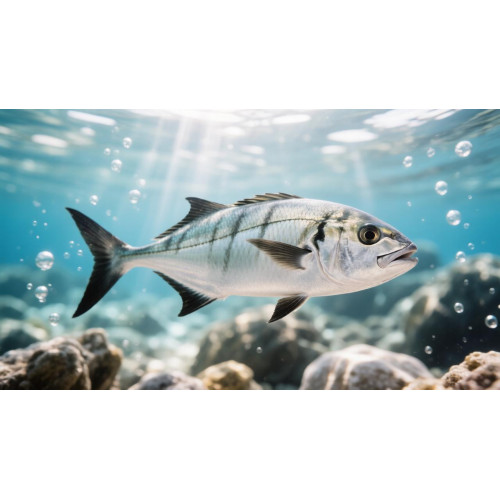
The Cunene horse mackerel has a typical carangid streamlined body, adapted for fast swimming in the water column. Its elongated, laterally compressed shape allows it to develop good speed and maneuver effectively in schools. A distinguishing feature is the presence of bony scutes (scales) along the lateral line, characteristic of the entire genus Trachurus (the genus name comes from the Greek words trachys — "rough" and oura — "tail," referring to the presence of these scutes).
Features of fish fins
First dorsal fin: consists of 8 spiny rays (spines). It is followed by a short gap, after which the second dorsal fin begins.
Second dorsal fin: begins with 1 spiny ray, followed by 28–33 soft rays. Together with the first fin, this provides a powerful propulsion system for fast swimming.
Anal fin: located on the belly, symmetrical to the second dorsal fin. It is preceded by 2 strong spiny rays, followed by 24–29 soft rays.
Pectoral fins: of moderate length, located on the sides. Contain 1 spiny and 5 soft rays (formula I, 5).
Pelvic fins: small, located on the belly below the base of the pectoral fins. Consist of 1 spiny and 5 soft rays.
Caudal fin: deeply forked, providing high speed.
As with all members of the jack family (Carangidae), the adipose fin is absent in this species.
Fish coloring
The coloration of the Cunene horse mackerel is a typical pelagic camouflage pattern. The back and upper head are colored in dark tones — from nearly black or gray to bluish-green. The sides and belly are lighter, usually whitish or silvery. There is a small black spot at the upper edge of the gill cover.
The French common name for this fish is "Chinchard bleu" (blue horse mackerel).
Distribution
This species is widely distributed in the eastern Atlantic Ocean. The main range extends from Morocco in the north to Angola in the south, with rare occurrences in the waters of northern Namibia.
Habitat
It inhabits coastal waters at depths of 20 to 100 meters (66–328 feet). The fish prefers water temperatures ranging from 15°C to 22°C (59–72°F). Adults are sometimes found near the surface but usually stay in bottom layers (benthopelagic species).
Size
This fish reaches a maximum length of about 35 cm (14 inches) (measured as fork length — from the tip of the snout to the end of the middle rays of the caudal fin), and its maximum recorded weight is 2 kg (4.4 lbs). Sexual maturity is reached at a length of about 24 cm (9.4 inches).
According to some data, the Cunene horse mackerel can live up to 11 years (individuals of this age have been found in samples). This is a fairly fast growth rate, characteristic of fish with short life cycles and high fecundity. The generation turnover time for this species is estimated at about 4.3 years.
Behavior
A typical schooling fish. It undertakes regular seasonal migrations along the West African coast, moving between the waters of different countries.
Spring-summer migration (northward): begins around May 9 and lasts about 69 days, until July 16. During this time, the fish moves from Senegalese waters toward Mauritania.
Autumn-winter migration (southward): begins between the first ten days of November and the first ten days of December, at water temperatures of 20.5–22.5°C (69–72.5°F), and ends between the third ten days of January and the third ten days of February, at temperatures of 18.0–20.5°C (64.4–69°F).
Food and feeding habits
Adults feed mainly on crustaceans (copepods, mysids), as well as small fish and squid. Jellyfish (siphonophores) are also found in their diet.
A group of Cunene horse mackerel, pursuing a school of silversides, typically cuts off a portion of it, surrounds it, and almost completely destroys it.
Reproduction
The species is characterized by early sexual maturation. Length at first maturity is 24.1 cm (9.5 inches). It first spawns upon reaching a length of about 16–18 cm (6.3–7.1 inches) at the age of 1–2 years. The spawning season lasts from October to April. The eggs are pelagic. It is a batch spawner — the female releases eggs in several batches throughout the season. The absolute fecundity of a single female ranges from 151,000 to 773,000 eggs.
Fishing
This is one of the most important commercial species in the eastern Central Atlantic. Fishing is conducted year-round, but the most productive period is considered to be May to July, which accounts for up to 60–70% of the annual catch, as well as December–January during the autumn-winter migration. The main fishing gear is pelagic trawls. In certain periods, the biomass of aggregations off the coast of Mauritania reached 73,000 tons.
Relationship with a person
This species is completely safe for humans. The meat of the Cunene horse mackerel has high culinary qualities. This fish is valued in the markets of many countries, especially in West Africa. Thanks to its high abundance and regular migrations, the species remains one of the main targets of fisheries in the region.
| Classification | |
| Phylum | Chordata |
| Class | Actinopterygii |
| Squad | Carangiformes |
| Family | Carangidae |
| Genus | Trachurus |
| Species | T. trecae |
| Features | |
| Conservation status | Least Concern |
| Habitat | Benthopelagic |
| Life span, years | 11 |
| Maximum body weight, kg | 2 |
| Maximum length, cm | 35 |
| Sailing speed, m/s | No information |
| Threat to people | Edible |
| Way of eating | Predator |
Cunene horse mackerel
Tags: cunene horse mackerel