
Latin name
Suezichthys aylingi
Other name
Butcher's dick, crimson cleaner wrasse, crimson wrasse, crimson rainbow wrasse, maori wrasse, butcher's dick.
Identification
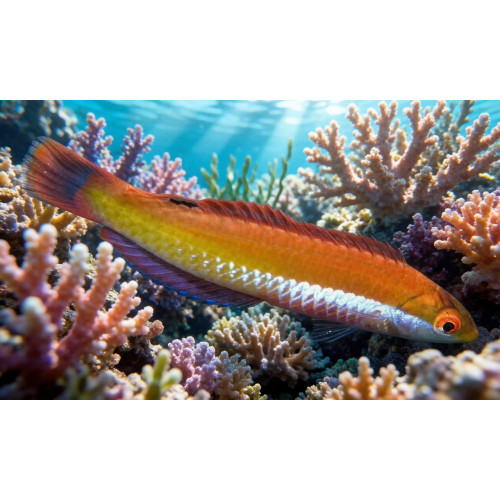
This is a small fish with an elongated, slightly laterally compressed oval body and a small head with a convex profile.
The body of the crimson cleaner fish is moderately elongated, compressed laterally, and oval in cross-section. The head is small, with its length comprising 26–29% of the standard body length. The mouth is terminal and small, with the upper jaw not reaching the level of the eyes. The eyes are moderately small. The teeth are conical, pointed, and arranged in a single row. Interestingly, the front pair of teeth on both jaws are enlarged and curved outward. There is a single lateral line. It makes a sharp downward bend under the soft portion of the dorsal fin. The scales that make up the lateral line have a simple tube of the seismosensory canal. The number of scales in the lateral line is usually 25–26. The scales are large, cycloid (smooth, without serrations), and firmly attached to the skin. The body is almost completely covered with scales, while the head, except for the cheeks and gill cover, is naked. The number of scales before the dorsal fin (predorsal scales) ranges from 3 to 5. On the cheek, scales are arranged in 1 row behind the eye and 2 rows below the eye. There is no scaly sheath at the base of the dorsal and anal fins. On the gill cover (opercle), there are 8–10 large scales.
Features of fish fins
Dorsal fin: single, continuous, extending along most of the back. Consists of 9 spiny and 11 soft rays. The adipose fin, as in many wrasses, is absent.
Anal fin: located symmetrically to the rear half of the dorsal fin. Contains 3 spiny and 10 soft rays.
Caudal fin: has a truncated shape. At its base, 12 main rays stand out, and there is also a characteristic white crescent-shaped spot at the base in juveniles and females.
Pectoral fins: short; their upper rays are the longest, but they do not reach the anal opening. Contain 13–14 soft rays, with the upper two rays being rudimentary. They have no spiny rays.
Pelvic fins: long, located below the base of the pectoral fins. Consist of 1 spiny and 5 soft rays.
Fish coloring
The coloration of the crimson cleaner fish is its main calling card, and it changes dramatically with age and sex.
Females and juveniles (initial phase): colored bright orange-red on top, fading toward the tail. Their main distinguishing feature is a black spot (eyespot) with a white border at the base of the last rays of the dorsal fin. Their fins are reddish with a white edge, and the caudal fin has a white crescent-shaped spot at its base.
Males (terminal phase): look even more striking. Their body is a deep crimson color, lightening toward the belly, with a pearly white stripe running along the sides from the mouth to the base of the tail. The male's head is adorned with six bright blue lines, making it incredibly conspicuous. The dorsal and anal fins of males have a complex coloration with orange, yellow, pink, and blue elements.
Distribution
This species has a rather limited range and is found only in the southwestern Pacific Ocean.
Southeastern Australia: it can be found off the coasts of New South Wales, Victoria, and around Tasmania.
New Zealand: it is found in the northeastern waters of this country.
Habitat
It is a marine demersal fish that lives exclusively in the salt water of the ocean and is not found in freshwater bodies. It inhabits coastal zones on sandy areas adjacent to reefs, at depths of 3 to 100 meters (10–328 feet).
Size
Adult males reach a length of about 11.7 cm (4.6 inches), and females about 8.6 cm (3.4 inches). Given such miniature dimensions and the slender body typical of wrasses, it can be confidently stated that the weight of an adult is most likely no more than a few grams.
Given that after two spawning seasons (corresponding to approximately two years of life), the process of sex change begins, and many fish die during this period, it can be assumed that their overall lifespan is several years (most likely 3–5 years), which is characteristic of many small reef fish.
Behavior
This fish is known as a cleaner. However, it belongs to the facultative symbionts. This means that cleaning is not its only way of obtaining food, but rather an additional "option." The crimson cleaner fish can remove parasites and damaged scales from other fish, or it can feed on small crustaceans that it gathers from the bottom or from algae. Some individuals may never engage in cleaning at all. However, those that do serve as cleaners may show preferences for a specific family or size of client fish.
The crimson cleaner fish has a bright, contrasting coloration that serves as a universal identification mark, understood even by predators, so even the most voracious ones rarely touch them. But although it relies on its coloration and "profession" for protection, this species is still sometimes vulnerable to predators, especially when it is not performing its "duties" to clients.
Food and feeding habits
It is a flexible predator in terms of feeding. It combines specialized cleaning of other fish with traditional hunting of small benthic invertebrates, making it an important link in the reef ecosystem.
Reproduction
These fish are protogynous hermaphrodites. All are born as females. After living through one or two spawning seasons, the strongest females change sex and become males. Each male guards a territory that contains a harem of several females.
Fishing
Despite the absence of targeted fishing, this fish can be encountered in catches accidentally.
The most likely way is through accidental capture in nets and traps intended for other species inhabiting the same biotopes. There is a possibility that rare specimens may be caught for sale to aquariums. In such cases, fishing is done by hand or with small nets to avoid damaging the fish, but this is more of an exception than a rule.
Relationship with a person
This species is completely harmless to humans. It is extremely rare and difficult to keep in aquariums and is of no interest to humans as a food product.
The International Union for Conservation of Nature (IUCN) has assigned this species a conservation status of Least Concern.
| Classification | |
| Phylum | Chordata |
| Class | Actinopterygii |
| Squad | Labriformes |
| Family | Labridae |
| Genus | Suezichthys |
| Species | S. aylingi |
| Features | |
| Conservation status | Least Concern |
| Habitat | Bottom |
| Life span, years | 5 |
| Maximum body weight, kg | No information |
| Maximum length, cm | 11,7 |
| Sailing speed, m/s | No information |
| Threat to people | Not edible |
| Way of eating | Predator |
Crimson cleaner fish
Tags: crimson cleaner fish