
Latin name
Torpedo torpedo
Other name
Ocellate torpedo or eyed electric ray.
Identification
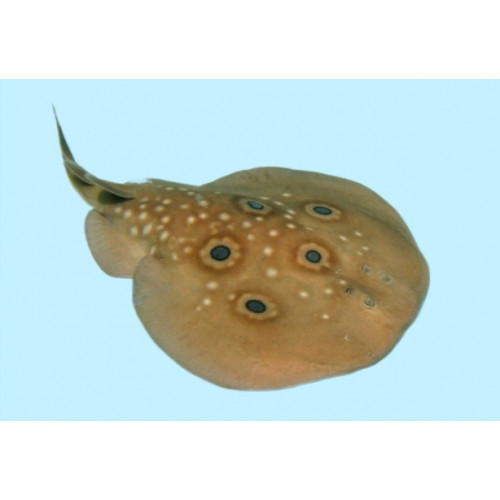
The common torpedo has a classic electric ray shape and a very recognizable coloration. Its body is flattened, forming an almost perfectly round disc (resembling a pancake). The tail is short, thick, and muscular. The mouth and gill slits are located on the underside of the body. Along the margins of the spiracles (respiratory openings behind the eyes) there are 8–10 small papillae.
The electric discharge is the main unique feature that has made this fish famous. On each side of the head, the ray has two kidney-shaped organs composed of many specialized muscle cells called electroplaques. These work like batteries connected in series. The fish can generate a discharge of up to 200 volts. This discharge is delivered in a series of pulses until the prey is immobilized. In this way, they stun the small fish and invertebrates they feed on and deter potential predators (including large sharks or careless divers).
Features of fish fins
These fish have a total of 5 unpaired fins. Two dorsal fins are located on the upper side of the tail (one behind the other, with the first being slightly larger than the second). Two pelvic fins are located on the sides of the body, separate from the pectoral disc. The caudal fin is large and triangular. They also have pectoral fins, but these are fused with the head and torso, forming the characteristic nearly round disc.
Fish coloring
The coloration of the common torpedo is its most striking and recognizable feature. The dorsal side is yellowish- or reddish-brown with characteristic ocelli (eyespots). There are usually five of them. Each spot has a bright blue or greenish central "apple." Around the blue center is a thin black ring. The black ring, in turn, is bordered by a light orange or yellow rim. In addition to the large spots, smaller light dots are scattered across the disc. The ventral side of the body is white or cream-colored.
Distribution
This species is quite widely distributed but prefers warm waters. It is found in the eastern Atlantic Ocean — from the southern Bay of Biscay along the coast of North Africa to Angola, as well as throughout the Mediterranean Sea (more commonly off the African coast).
Habitat
A typical benthic (bottom-dwelling) species. Prefers soft substrates — sandy flats, seagrass beds, and muddy areas. It stays mainly in shallow waters (up to 70 m / 230 ft), but can also be found at depths of up to 400 m (1,312 ft).
Size
Maximum size: up to 60 cm (24 inches) in length for males; females up to 41 cm (16 inches). Usual size: 30–40 cm (12–16 inches). The weight of such a ray, given its dense, flattened body, can range from 2 to 5 kg (4.4–11 lbs), though this is an expert estimate. Maximum lifespan in the wild: 10 years.
Behavior
A slow-moving, solitary hunter with a crepuscular and nocturnal lifestyle. During the day, it usually buries itself in the substrate or lies motionless on the bottom, camouflaged. Its name "torpedo" (from Latin torpere — "to be numb" or "to be sluggish") comes precisely from this apparent slowness.
Food and feeding habits
The common torpedo is a solitary, nocturnal predator. Its diet consists mainly of small benthic fish (gobies, mullet, sandeels), as well as shrimp, crabs, and worms.
Reproduction
This species is characterized by ovoviviparity (ovoviviparous). Fertilization is internal. The eggs develop inside the female's body, and fully formed, independent pups are born (3 to 21 individuals at a time). Gestation lasts about 6 months. Newborns measure about 9 cm (3.5 inches) in length.
Fishing
The common torpedo is not a commercial fish species. There is no targeted fishery for it; however, it regularly ends up in fishing nets as bycatch. The main reason for the absence of a fishery is that this fish has no economic value. Its meat is considered unpalatable, so even in the rare cases where fishermen are interested in a catch, the ray does not appeal to them. As a result, in modern conditions, it is almost always thrown overboard when caught.
Relationship with a person
This species poses a potential danger due to its ability to deliver electric shocks. However, the ray is not aggressive and never attacks first. A person can only be injured by stepping on the fish in shallow water or by trying to grab it with their hands. The shock is painful and can cause temporary muscle paralysis, but no fatalities have been recorded.
The global population of the species is assessed as Vulnerable due to declining numbers. In the Mediterranean Sea, the situation is currently better, where the species has a conservation status of Least Concern.
Ancient Greeks and Romans used the electric discharges of the torpedo ray to treat headaches and gout, applying a live fish to the affected area.
| Classification | |
| Phylum | Chordata |
| Class | Chondrichthyes |
| Squad | Torpediniformes |
| Family | Torpedinidae |
| Genus | Torpedo |
| Species | T. torpedo |
| Features | |
| Conservation status | Vulnerable |
| Habitat | Bottom |
| Life span, years | 10 |
| Maximum body weight, kg | 5 |
| Maximum length, cm | 60 |
| Sailing speed, m/s | No information |
| Threat to people | Not edible |
| Way of eating | Predator |
Common torpedo
Tags: common torpedo