
Latin name
Alosa kessleri
Other name
Blackback, or black-spined herring.
Identification
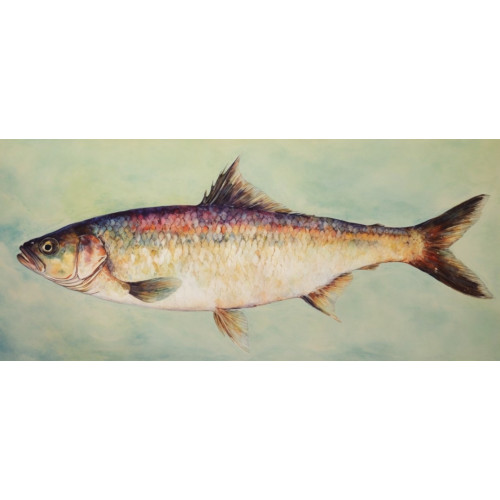
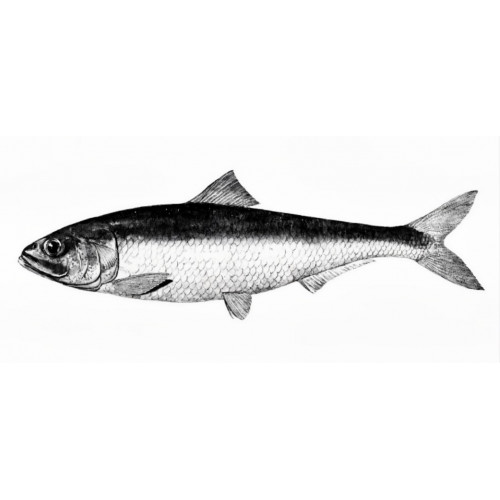
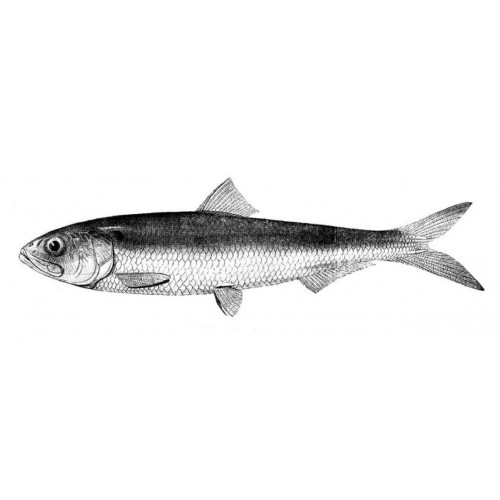
The body of the Caspian anadromous shad is stout, noticeably rounded, with a particularly elongated caudal region, often slightly downturned. The abdomen is laterally compressed. A prominent keel extends from the throat to the origin of the anal fin. The head is not laterally compressed. The head depth is 7/9 of its length. The eyes possess adipose eyelids. The mouth is large, with the maxilla extending beyond the vertical midline of the eye. Well-developed teeth are present on the jaws, palatine bones, and tongue. The lower jaw features a small tubercle and protrudes slightly when the mouth is open. The opercula are rounded, with faint, fan-shaped grooves on the opercular region. Well-developed teeth are present on the premaxillary, maxillary, and dentary bones. Gill rakers number over 90, typically 120–130; they are thick, uneven, long, and their distal ends form a wavy line. In large individuals, they are coarse and thick, with some possibly broken; in smaller fish, the rakers are thinner, shorter, or slightly longer than the gill filaments. Lateral scale count: 53–55; vertebrae: 47–50 (average 49).
Features of Fish Fins
The dorsal fin has 16–20 rays (average 18; the first 3–4 rays are unbranched); the anal fin has 19–23 rays (average 21; the first 3 rays are unbranched).
Fish Coloration
Body coloration is black, appearing dark purple in spring. The dorsal surface of the head and the pectoral fins are dark; the snout tip and base of the pectoral fins are nearly black. A dark spot is typically present dorsally behind each operculum, with a row of similar spots occasionally found along the sides. The back is black or blackish-purple. The head and pectoral fins are black.
Distribution
It inhabits the Caspian Sea, except for the Kara-Bogaz-Gol Bay. It enters the Volga River for spawning, and less commonly, the Ural River.
Habitat
The Caspian anadromous shad overwinters in the Southern Caspian, where surface water temperatures do not fall below 8°C. It appears in the Middle Caspian in early April when the water warms to 9–13°C. It arrives in the Northern Caspian in early April (water temperature 6–8°C). Migration to the pre-estuary areas of the Volga and Ural continues until late June. In the Volga Delta, fish appear in early April, with peak migration occurring from late April to early May at a water temperature of 9°C.
Size
This is the largest of the Volga herrings, with an average length of 36–44 cm, reaching up to 52 cm, and a weight of up to 2 kg.
Behavior
This is an anadromous fish that lives in the sea and enters the Volga and Ural rivers solely for spawning.
The spawning migration primarily occurs along the western shores of the Caspian Sea from mid- to late March. Fish migrate close to the coasts of Azerbaijan and Dagestan. Migration ends in late June.
Food and Feeding Habits
Feeding occurs mainly at sea. This predator's diet consists of small fish (sprats, silversides, gobies), crustaceans, and insect larvae. Stomach contents also include planktonic crustaceans, plant detritus, and fish fry. After spawning, fish actively feed on nektobenthic crustaceans (mysids and amphipods).
Caspian anadromous shad are preyed upon by predatory fish: beluga, pike-perch, catfish, and occasionally seals and birds (cormorants, great egrets, and gulls).
Reproduction
Spawning occurs from May to August, peaking in June when water temperatures range from 14 to 22°C. The Caspian anadromous shad releases pelagic eggs in the water column, both in the main river channel and in backwaters and secondary channels with slow currents. Spawning typically occurs in the first half of the day. After release, the eggs are dispersed by the current. Most eggs drift toward the mid-river area, slightly favoring the depositional bank. Approximately 56% of the eggs are found in the near-bottom water layer. The drift pattern of herring larvae resembles that of the eggs, with 53.2% found near the bottom.
This species may spawn up to four times during its lifetime. No mass post-spawning mortality occurs. Female fecundity ranges from 60,000 to 300,000 eggs, averaging 200,000.
The eggs are large (2.5–4.1 mm), semi-pelagic, with a large perivitelline space (22–33% of the egg diameter). The yolk lacks an oil globule. Females release eggs in three batches at intervals of 1 to 1.5 weeks. Depending on temperature, egg development lasts 42–56 hours. Hatching pre-larvae measure 3.8–4.5 mm in length; by the time the yolk is absorbed, they reach 6.4–8.0 mm.
Caspian anadromous shad reach sexual maturity at lengths of 22 to 46 cm (average 31–35 cm), weights of 170–1200 g (average 430–560 g), and at the age of 3, rarely 4 years. Lifespan is 7–8 years. Commercial catches are dominated by fish aged 3–5 years.
Fishing
A valuable commercial species. It is primarily harvested during its spawning migration in the Volga Delta using seines, and occasionally set gillnets.
Relationship with Humans
Highly valued for its food quality. Fat content in spring is approximately 19% (Azerbaijan) and 11–18% (Volga Delta). The fish is salted and sometimes smoked. The International Union for Conservation of Nature (IUCN) has assigned this species a conservation status of "Least Concern."
| Classification | |
| Phylum | Chordata |
| Class | Actinopterygii |
| Squad | Clupeiformes |
| Family | Alosidae |
| Genus | Alosa |
| Species | A. kessleri |
| Features | |
| Conservation status | Least Concern |
| Habitat | Pelagic |
| Life span, years | 8 |
| Maximum body weight, kg | 2 |
| Maximum length, cm | 52 |
| Sailing speed, m/s | No information |
| Threat to people | Edible |
| Way of eating | Predator |
Caspian anadromous shad
Tags: caspian anadromous shad