
Latin name
Diaphus theta
Other Names
The California headlightfish is also known as the theta lanternfish and white-spotted lantern-fish. Its scientific name, Diaphus theta, was given by Eigenmann & Eigenmann in 1890. The species name theta refers to the Greek letter and alludes to its body photophores, which are divided horizontally by a fine line of black pigment. In Spanish, it is called linternilla californiana. The genus name Diaphus comes from the Greek words "dia" (through) and "physa" (to beget).
Identification
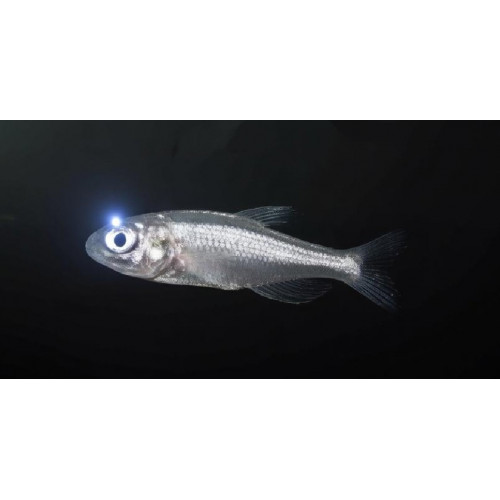
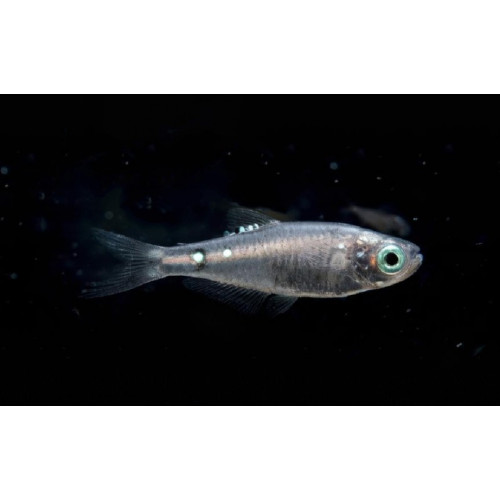
The California headlightfish has a fusiform (spindle-shaped) body typical of lanternfishes. The dorsal fin has no spines and 12–14 soft rays, while the anal fin has no spines and 12–14 soft rays. The vertebrae number 34–36. A key identifying feature is the small, narrow-based, slender adipose fin. The body is brown to black on the dorsal surface and lighter ventrally. The species has 9 branchiostegal rays.
Features of Fish Fins
The California headlightfish has no spines in its fins. The dorsal fin contains 12–14 soft rays, and the anal fin contains 12–14 soft rays. The adipose fin is small, narrow-based, and slender. All fins are pale in colouration.
Fish Colouring
The California headlightfish is brown to black on its dorsal surface and lighter ventrally. The fins are pale. A distinctive feature is the presence of photophores (light-producing organs) along the sides of the body, which are divided horizontally by a fine line of black pigment. These photophores produce bioluminescence used for camouflage and communication.
Distribution
The California headlightfish is found in the Eastern Pacific, common in the California Current region from 66°N to 20°S, including Hawaii. In the Northwest Pacific, it occurs throughout subarctic-transitional waters to northern Japan. It has been reported from 16 territories, including Canada, the United States, Mexico, Central America, Colombia, Ecuador, Peru, and the Galapagos Islands. Its presence in Japan is considered questionable.
Habitat
This species is marine and bathypelagic, inhabiting depths from 10 to 3,400 meters, though it is usually found between 10 and 400 meters. It occupies the epipelagic to mesopelagic zones. The species is a vertical migrant, moving between depth zones on a daily basis.
Size
The California headlightfish can reach a maximum total length of 11.4 cm (about 4.5 inches). Maturity is reached at a length of around 6 cm.
Behavior
The California headlightfish is a vertical migrant, moving between depth zones on a daily basis. It feeds at night or in the morning. Studies show one considerable peak in feeding occurring at nighttime. The species' feeding intensity is highest during the dark hours in the epipelagic zone. The species feeds mainly on euphausiids and amphipods at night and on copepods throughout the entire diel cycle. A study found the average ratio of stomach content weight to body weight was 2.2% during the day and 2.0% at night.
Food and Feeding Habits
The California headlightfish feeds mainly on euphausiids (especially Euphausia pacifica), copepods (especially Metridia pacifica and the Neocalanus plumchrus/flemingeri group), and amphipods (especially the Themisto japonica/pacifica group). One study found the diet composition to be 42.2% copepods, 26.3% euphausiids, 25.9% amphipods, and 5.6% ostracods. As the fish grow, the proportion of copepods in their diet decreases, while the proportion of euphausiids and amphipods increases. The daily ration is 1.5% of the fish's body weight in summer and 3.2% in autumn.
Reproduction
The California headlightfish is oviparous, meaning it reproduces by laying eggs. Eggs and larvae are planktonic, drifting in the open ocean. Specific details on breeding season, spawning behavior, and fecundity are not widely documented in available sources.
Fishing
The California headlightfish is not a commercial species and has no significant economic value. It is caught primarily as bycatch in scientific deep-sea trawling surveys. The species is never/rarely used in aquaculture or aquariums. It is of scientific interest due to its role in the pelagic food web and its vertical migration behavior.
Relationship with a Person
The California headlightfish is not considered a threat to humans and is classified as harmless. It is a small deep-sea fish that lives at depths of 10–3,400 meters and is never encountered by swimmers or recreational divers. The species is of scientific interest due to its bioluminescent capabilities and vertical migration ecology. The species is listed as Least Concern (LC) on the IUCN Red List, assessed on 26 June 2018.
| Classification | |
| Phylum | Chordata |
| Class | Actinopterygii |
| Squad | Myctophiformes |
| Family | Myctophidae |
| Genus | Diaphus |
| Species | Diaphus theta |
| Features | |
| Conservation status | Least Concern |
| Habitat | Bathypelagic |
| Life span, years | No information |
| Maximum body weight, kg | No information |
| Maximum length, cm | 11,4 |
| Sailing speed, m/s | No information |
| Threat to people | Edible |
| Way of eating | Planktonophage |
California headlightfish
Tags: california headlightfish