
Latin name
Bufoceratias wedli
Identification
The genus name Bufoceratias comes from the Latin bufo ("toad") and the Greek keras ("horn"), referring to a "horned toadfish." The species name wedli is given in honor of Anton Wedl — an Austrian industrialist, wholesale merchant, and philanthropist who supported the University of Vienna and its natural history museum after the end of World War I.
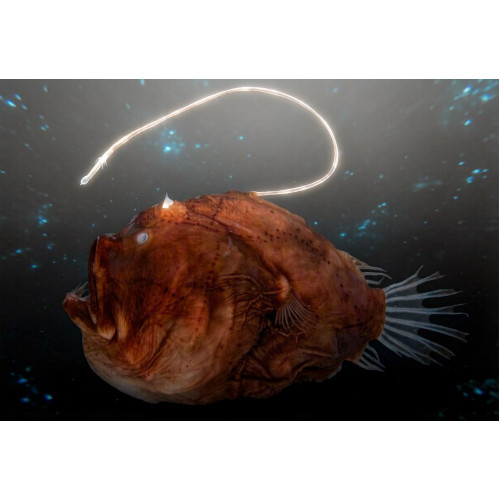
Bufoceratias wedli possesses the typical fearsome appearance of deep-sea anglerfish, but with a unique feature — the presence of two dorsal "fishing rods."
As with all anglerfish, this species exhibits extreme sexual dimorphism. Scientific descriptions exist only for females, which have a spherical, laterally compressed body, a large mouth, and powerful jaws.
The mouth of these fish is enormous, extending far past the eyes. It is armed with needle-sharp teeth, designed for capturing and holding slippery prey. On the symphysis of the lower jaw (the junction of the right and left halves), there is a well-developed spine.
The skin is covered with small bony spines (spinules). The second cephalic spine in individuals larger than 1.3 cm (0.5 inches) can retract under the skin, leaving only a small pore on the surface.
Features of fish fins
The fish has two modified dorsal fins.
First dorsal fin (illicium): a long, thin "fishing rod" located on the snout. Its length can range from 83% to 225% of the standard body length. At the tip of the illicium is a bioluminescent lure (esca), which serves to attract prey. The esca has characteristic anterior, posterior, and lateral projections, distinguishing it from other species of this genus.
Second dorsal fin (second cephalic pineal "fishing rod"): a unique tuberculate structure located behind the illicium. This second "fishing rod" also bears a luminous organ at its tip.
Fish coloring
Bufoceratias wedli has a very dark coloration, which serves as camouflage in the total darkness of the ocean depths.
Distribution
Bufoceratias wedli is an inhabitant of tropical and subtropical waters of the Atlantic Ocean.
Western Atlantic: Found from the coasts of Virginia and the Bermuda Islands, through the Caribbean Sea and the Gulf of Mexico, to the waters of southern Brazil and Suriname.
Eastern Atlantic: Distributed from the mainland coast of Portugal south to Namibia, including Macaronesia, the islands of the Gulf of Guinea, as well as the islands of St. Helena and Ascension.
A single record of this species being caught off the coast of Japan (Okinawa Trough) is currently considered a misidentification and belongs to another species, Bufoceratias thele.
Habitat
It inhabits the bathypelagic zone (in the water column) at depths ranging from 300 to 1,750 meters (984–5,741 ft), preferring the range of 300–1,500 meters (984–4,921 ft).
Size
Maximum length of females is up to 25 cm (10 inches). There is no data on their weight. The size of males is unknown.
Behavior
An ambush predator. It is presumed that larger individuals lead a benthic (bottom-dwelling) lifestyle, while smaller ones may inhabit the water column (bathypelagic zone). The main hunting method is to lie motionless in the water and attract prey with the glowing light of its "fishing rod."
Food and feeding habits
The diet of this species is diverse and has been studied based on stomach content analysis of caught specimens. Their primary prey includes fish, crustaceans, squid, and other cephalopods. They also eat small invertebrates: polychaetes (bristle worms), sea urchins, gastropods, and cnidarians (e.g., jellyfish).
The presence of benthic invertebrates (polychaetes, sea urchins) in their stomachs confirms that larger individuals spend a significant amount of time directly on the bottom, where they stalk their prey.
Reproduction
Extremely little is known about the reproduction of this species.
Sexual dimorphism: Males are unknown to science. Unlike many other deep-sea anglerfish (e.g., ceratioids), where dwarf males parasitize females, it is assumed that male Bufoceratias wedli live independently, without attaching to females.
Fishing
It has no commercial value due to its great depth of habitation and rarity. It may be caught as bycatch in deep-sea trawls.
Relationship with a person
It is completely harmless to humans. Theoretically, it is an edible fish. Its meat is simply muscle tissue that holds no gastronomic interest. No one has ever eaten it.
The International Union for Conservation of Nature (IUCN) has assigned this species a conservation status of Least Concern, meaning that currently, nothing threatens its global populations.
| Classification | |
| Phylum | Chordata |
| Class | Actinopterygii |
| Squad | Lophiiformes |
| Family | Diceratiidae |
| Genus | Bufoceratias |
| Species | B. wedli |
| Features | |
| Conservation status | Least Concern |
| Habitat | Pelagic |
| Life span, years | No information |
| Maximum body weight, kg | No information |
| Maximum length, cm | 25 |
| Sailing speed, m/s | No information |
| Threat to people | Edible |
| Way of eating | Predator |
Bufoceratias wedli
Tags: bufoceratias wedli