
Latin name
Epinephelus fuscoguttatus
Other Names
The brown marbled grouper is known by several alternative names, including tiger grouper, flower cod, and flowery cod. In Southeast Asia, it is commonly called lapu-lapu (Philippines), kugtong (Philippines), or kerapu (Malaysia/Indonesia). Its scientific name, Epinephelus fuscoguttatus, was given by Forsskål in 1775. The genus name Epinephelus comes from the Greek word "epinephelos," meaning cloudy.
Identification
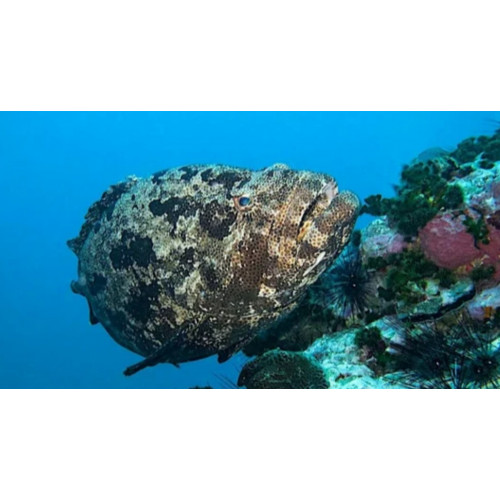
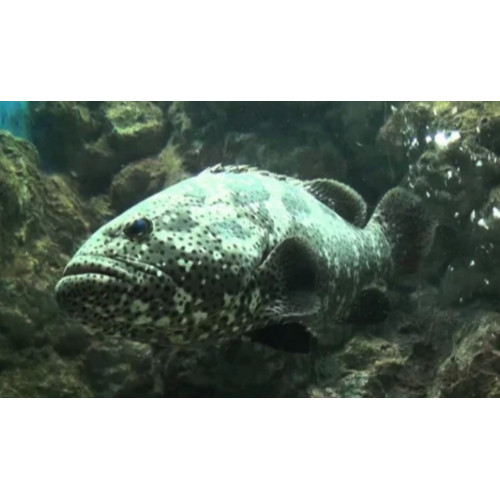
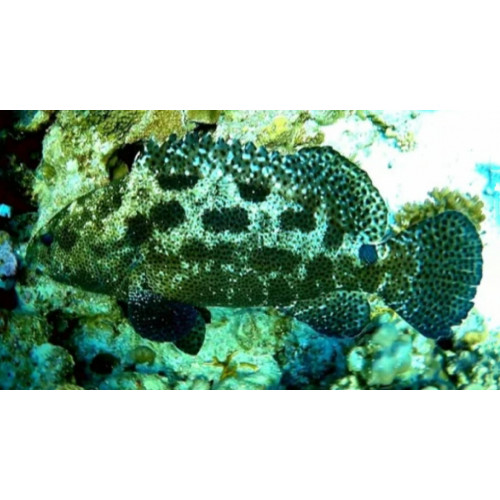
The brown marbled grouper has a large, oval-shaped body that is moderately deep and laterally compressed. The body depth is 2.6–2.9 times the standard length for specimens 11–55 cm SL. The head profile is distinctly convex from the eyes to the dorsal-fin origin in adults, with a flat or slightly concave interorbital area. The mouth is large and positioned superiorly, with many small teeth and canines in front. The upper jaw extends well behind the eye. The preopercle is rounded and finely serrated, while the upper edge of the operculum is distinctly convex. The posterior nostrils are triangular and 4–7 times larger than the anterior ones in adults. Gill rakers on the first gill arch number 10–12 + 17–21, and they are short and stout. The caudal fin is rounded, and the lateral line contains 52–58 scales. The body has auxiliary scales (small scales between the main scales). Juveniles less than 8 cm have small hexagonal spots on the head and body that become larger posteriorly.
Features of Fish Fins
The brown marbled grouper has one continuous dorsal fin with a distinct separation between spines and soft rays but no notch. The fin formula is as follows: dorsal fin — 11 spines and 14–15 soft rays, anal fin — 3 spines and 8 soft rays, pectoral fins — 0 spines and 18–20 rays, pelvic fins — 1 spine and 5 soft rays (thoracic position). The caudal fin is rounded. All fins are large and rounded. There is no adipose fin.
Fish Colouring
The colouration of the brown marbled grouper is distinctive and complex. The background colour ranges from pale yellowish-brown to brownish. The body features 5 vertical series of dark brown or grey blotches that are very irregular in size and outline. The head, body, and fins are densely covered with close-set small dark brown spots. The spots on the dark blotches are much darker than those in between the blotches. There is a small black saddle-like blotch on the top of the caudal peduncle. The side of the jaws has 2 or 3 faint dark bars. Juveniles less than 8 cm have small hexagonal spots on the head and body.
Distribution
The brown marbled grouper is widely distributed throughout the Indo-Pacific region. Its range extends from the Red Sea and East Africa in the west to Samoa and the Phoenix Islands in the east. It is found north to Japan and south to Australia. It is notably absent from the Persian Gulf, Hawaii, and French Polynesia. The species is often confused with Epinephelus polyphekadion.
Habitat
This species is a marine, reef-associated fish. It typically inhabits lagoon pinnacles, channels, and outer reef slopes in coral-rich areas with clear waters. Juveniles are commonly found in seagrass beds. The depth range is from 1 to 60 meters. The species is benthic (bottom-dwelling) and prefers tropical waters.
Size
The brown marbled grouper can reach a maximum total length of 120 cm (1.2 meters). The common length is around 50 cm. Its maximum published weight is 11 kg. The maximum reported age is 40 years. The length at first maturity is about 48 cm.
Behavior
The brown marbled grouper is a solitary, sedentary, and territorial species. It defends a well-defined territory and is known to be aggressive towards intruders. It is mainly active at dusk (crepuscular), though some sources describe it as nocturnal with peak activity at sunrise and sunset. The species is secretive and wary. It has a long lifespan, living up to 40 years.
Food and Feeding Habits
The brown marbled grouper is a carnivorous apex predator. It is an ambush predator that primarily feeds on fishes, crabs, and cephalopods (squid and octopus). Some sources also mention skates and spiny lobsters. It feeds on reef fishes and other benthic invertebrates.
Reproduction
This species is a protogynous hermaphrodite, meaning individuals first function as females and later, at least some mature females change sex to become males. Sex change can occur at a wide range of sizes and ages, though not all individuals change sex. The species can reproduce for over 30 years of its 40-year lifespan. It forms large spawning aggregations at specific times and places to reproduce. Maturity is reached within 2 to 6 years.
Fishing
The brown marbled grouper is an important commercial species and is caught using various methods, including hook-and-line, fish traps, drop-lines, and spearguns. It is a popular gamefish and is also kept in large marine aquaria. The species is of minor commercial importance globally but is highly valued in the live fish food trade, particularly in Hong Kong live fish markets. It is a candidate for aquaculture in Singapore and has been cultured under experimental conditions in the Philippines. Juveniles are in high demand for aquaculture farmers in Southeast Asia due to their good survival and rapid growth in culture. The species is listed as Vulnerable (VU) on the IUCN Red List.
Relationship with a Person
The brown marbled grouper poses a significant health risk to humans if eaten. It is known to be ciguatoxic in some areas, meaning the flesh may be contaminated with ciguatera toxin that can cause severe food poisoning. This toxin does not affect the fish but can make humans very sick if consumed. The species is territorial and aggressive towards intruders. It is considered potentially dangerous to the inexperienced diver, as it may defend its territory vigorously. However, it may also be hand-fed by divers in certain areas, though this is not recommended due to the risk of bites. The species is in great demand both as a food fish (despite the ciguatera risk) and for the aquarium trade. Due to overfishing, particularly of spawning aggregations and large individuals (which are primarily males), the species is under threat. The removal of large individuals can devastate the population's sex ratio and reproductive capacity.
Interesting facts
This is one of the most dangerous fish species, associated with numerous outbreaks of poisoning. Like other reef predators, the toxicity of this grouper is acquired. It does not produce the poison itself but accumulates ciguatoxin by eating smaller fish that feed on toxic microscopic algae (Gambierdiscus). The toxin concentrates in the muscles (meat) and is not destroyed by cooking, freezing, or drying. Being an apex predator of coral reefs in the Indo-Pacific region, this species is at the top of the food chain, leading to bioaccumulation of the toxin in its tissues. The degree of danger varies greatly depending on the size of the fish and the geographical region where it was caught. This is not a permanent property of all individuals of the species.
| Classification | |
| Phylum | Chordata |
| Class | Actinopterygii |
| Squad | Perciformes |
| Family | Epinephelidae |
| Genus | Epinephelus |
| Species | E. fuscoguttatus |
| Features | |
| Conservation status | Vulnerable |
| Habitat | Reef |
| Life span, years | 40 |
| Maximum body weight, kg | 11 |
| Maximum length, cm | 120 |
| Sailing speed, m/s | No information |
| Threat to people | Edible |
| Way of eating | Predator |
Brown Marbled Grouper
Tags: brown marbled grouper