
Latin name
Notorynchus cepedianus
Other Names
The broadnose sevengill shark is known by several alternative names, including broadnose seven-gill shark, cow shark, ground shark, sevengill shark, spottie, and Tasmanian tiger shark. Its scientific name, Notorynchus cepedianus, was given by Péron in 1807. The genus name Notorynchus refers to the single dorsal fin set far back on the body, while the species name honours Bernard Germain de Lacépède, a French naturalist.
Identification
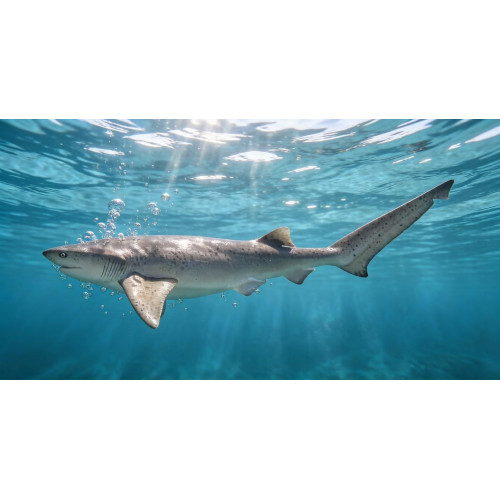
The broadnose sevengill shark has a large, fusiform (spindle-shaped) body with a wide, rounded head and a short, blunt snout. A key identifying feature is the presence of seven long gill slits on each side of the head, unlike most sharks which have five. The eyes are small, and the mouth is wide and arched. The teeth are distinctive: the upper jaw teeth are small with a single oblique point, while the lower jaw teeth are large, wide, and comb-like with multiple small points.
Features of Fish Fins
This shark has no spines in its fins. It possesses a single, small dorsal fin located far back on the body, near the tail. The anal fin is smaller than the dorsal fin, and the caudal fin has a small lower lobe. The species has 123–157 vertebrae.
Fish Colouring
The colouration is variable. The shark is generally grey, reddish-brown, or olive-brown above, with a cream to white underside. A distinctive feature is the presence of numerous small black and/or white spots scattered over the body and fins. The dorsal fin and upper caudal lobe lack black tips.
Distribution
This species has a circumglobal distribution in tropical and temperate waters, but is notably absent from the North Atlantic and Mediterranean Sea. In the eastern Pacific, it ranges from British Columbia, Canada, to Chile. In the western Pacific, it is found from southern Japan to New Zealand. It also occurs off southern Brazil, northern Argentina, Namibia, and South Africa.
Habitat
The broadnose sevengill shark is a demersal (bottom-dwelling) species that inhabits the continental shelf. It is often found in shallow coastal waters, including bays, estuaries, and the surf zone, at depths of less than 1 metre. Larger individuals may range into deeper waters, down to 570 metres. It can also occur in brackish water.
Size
This species can reach a maximum total length of approximately 296 cm (9.7 ft); some unconfirmed records suggest up to 400 cm. The maximum published weight is 107 kg. Males mature at 150–180 cm, while females mature at a larger size of 192–208 cm. The maximum reported age is 49 years. Newborns measure 45–53 cm.
Behavior
The broadnose sevengill shark is an active and strong swimmer, often found cruising slowly near the bottom, but capable of sudden bursts of speed when attacking prey. It is a coastal species that coordinates its movements in bays with the tidal cycle, moving in with the rising tide and out with the falling tide. The species is ovoviviparous, meaning embryos develop inside the mother's body and are born live. Litters are large, containing 82 to 95 pups, born in shallow bays during late spring and early summer. In captivity, newborns grow rapidly, adding about 38 cm and 16 kg during their first year.
Food and Feeding Habits
This species is a powerful and indiscriminate predator that feeds on a wide variety of prey. Its diet includes other sharks, rays, chimaeras, bony fish, hagfish, dolphins, seals, sea lions, shark egg cases, snails, crabs, octopus, and mammalian carrion, including rats and human flesh. Juvenile sevengill sharks feed primarily on small sharks, rays, and fish.
Reproduction
The broadnose sevengill shark is ovoviviparous (aplacental viviparous). Females give birth to large litters of 82–95 pups in shallow coastal bays, which serve as nursery areas. Newborns are about 45–53 cm in length. Males reach maturity at 4–5 years (150–180 cm), while females mature later at around 11 years (192–208 cm). The gestation period is about 12 months, and females may breed in alternate years. Mating and pupping occur in late spring and early summer.
Fishing
The broadnose sevengill shark is caught by commercial and recreational fishers. It is often taken by anglers from the shore. The species is utilised for human consumption, its skin for leather, and its liver as a source of oil.
Relationship with a Person
The broadnose sevengill shark is classified as traumatogenic and is considered potentially dangerous to people. It is aggressive when provoked and has attacked divers in captivity. It may have been involved in a few shark attacks off California and South Africa, though verified attacks in open waters have not been recorded. When captured by fishermen, it vigorously snaps and thrashes. The species is listed as Vulnerable (VU) on the IUCN Red List.
| Classification | |
| Phylum | Chordata |
| Class | Elasmobranchii |
| Squad | Hexanchiformes |
| Family | Hexanchidae |
| Genus | Notorynchus |
| Species | Notorynchus cepedianus |
| Features | |
| Conservation status | Vulnerable |
| Habitat | Demersal |
| Life span, years | 49 |
| Maximum body weight, kg | 107 |
| Maximum length, cm | 296 |
| Sailing speed, m/s | No information |
| Threat to people | Edible |
| Way of eating | Predator |