
Latin name
Idiacanthus atlanticus
Other Names
The black dragonfish is also known as the Atlantic dragonfish and common black dragonfish. Its scientific name, Idiacanthus atlanticus, was given by Brauer in 1906. The genus name Idiacanthus comes from the Greek words "idia" (own privative) and "akantha" (thorn). The species is also known by the synonym Idiacanthus niger.
Identification
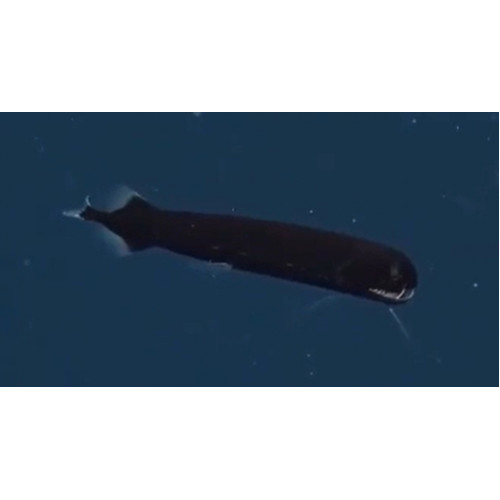
The black dragonfish is a long, slender fish that exhibits extreme sexual dimorphism — males and females look so different they could be mistaken for separate species.
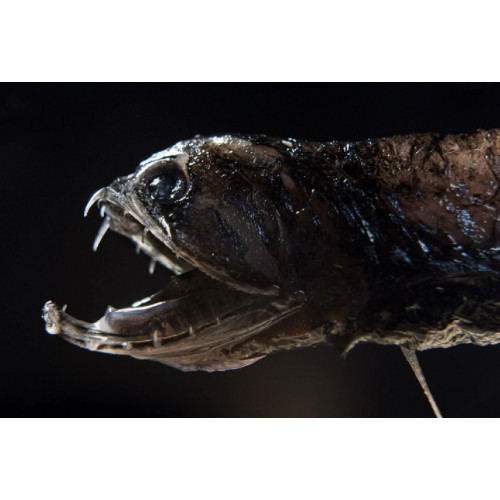
Females: The body is extremely elongate and black, with a small head that is 5–10% of standard length. The mouth is large, about equal to the head in length, and contains barbed, fang-like teeth. The eyes are small (1–3% SL). A long chin barbel (about twice the head length) ends in a laterally compressed, unpigmented bioluminescent tip. The skin is smooth, black, and scaleless, with numerous small photophores scattered over the body and two rows of larger photophores along each lower side. Pelvic fins are present, positioned at about midbody. The dorsal-fin origin is anterior to the midpoint of the body, well in advance of the anal-fin origin.
Males: Much smaller, dark-brown in colour, and larval in appearance. They lack teeth on the maxilla, lack a chin barbel, lack pelvic fins, and have a non-functional gut. The postorbital photophore is much larger than the eye diameter.
Larvae: Transparent with eyes positioned at the ends of long stalks that can be up to half the length of the body. This structure increases the field of view and the sensitivity of the larva's eye to light. The fish looks like a tree branch.
Features of Fish Fins
The black dragonfish has no spines in its fins. The dorsal fin has 55–63 soft rays. The anal fin has 37–42 soft rays. The pectoral and pelvic fins are absent in males. Females have pelvic fins with 6 rays. Pectoral fins are absent in both sexes.
Fish Colouring
Females are black and may have six stripes along the body. Males are dark-brown. The larvae are transparent. The skin is smooth, black, and scaleless in females. The species has numerous small photophores scattered over the body, with two rows of larger photophores along the sides. The chin barbel of the female has a luminous tip.
Distribution
The black dragonfish is found in subtropical to temperate waters of the southern hemisphere, probably limited by the subtropical convergence. It is incidentally found in sub-Antarctic waters of the Southern Ocean. In Australia, it occurs off southern Queensland southwards to off Tasmania, and off Cape Leeuwin, southwestern Western Australia. The species is distributed between latitudes approximately 25°S and 60°S.
Habitat
This species is marine and bathypelagic, inhabiting depths down to 2,000 metres. The depth range is typically 1,239 to 2,000 metres. Females inhabit depths below 500 metres during the day and migrate vertically at night to shallower waters. Males remain in deep water, at approximately 1,000–2,000 metres, at all times.
Size
The black dragonfish exhibits extreme size dimorphism. Females can reach a maximum length of 53 cm SL (about 21 inches). Males reach a maximum length of only about 5 cm (2 inches). Weight ranges from 13 to 15 grams.
Behavior
The black dragonfish is a mesopelagic species that performs diel vertical migration. Females migrate upward at night to feed in shallower waters and return to depths below 500 metres during the day. Males do not migrate and remain in deep water (1,000–2,000 m) at all times. The species is bioluminescent and can see its own light, unlike most predators that use light only to attract prey. This allows the fish to use its light for hunting. The light is nearly in the infrared and barely visible to the human eye. Larvae have stalked eyes on long projections from the head, which retract as the fish matures.
Food and Feeding Habits
The black dragonfish is a carnivorous predator that feeds mostly on other fishes. It also consumes krill, copepods, and small cephalopods. Females use the luminous tip of their chin barbel to attract prey. The species uses its large mouth and fang-like teeth to capture prey.
Reproduction
The black dragonfish reproduces through sexual reproduction with external fertilization. The species shows extreme sexual dimorphism: males are much smaller, lack teeth and a functional gut, and survive only until mating. Males die shortly after breeding. Females are batch spawners, releasing multiple batches of eggs. The larvae have stalked eyes and transparent bodies.
Fishing
The black dragonfish has no commercial value and is not targeted by fisheries. It is occasionally caught as bycatch in deep-sea trawling surveys. The species is of scientific interest due to its remarkable sexual dimorphism, bioluminescence, and larval morphology.
Relationship with a Person
The black dragonfish is not considered a threat to humans and is classified as harmless. It lives at depths of 1,239–2,000 metres and is never encountered by swimmers or recreational divers. The species is of scientific interest due to its remarkable sexual dimorphism, bioluminescent capabilities, and unique larval morphology. The species is listed as Least Concern (LC) on the IUCN Red List, assessed on 26 May 2013.
| Classification | |
| Phylum | Chordata |
| Class | Actinopterygii |
| Squad | Stomiiformes |
| Family | Stomiidae |
| Genus | Idiacanthus |
| Species | Idiacanthus atlanticus |
| Features | |
| Conservation status | Least Concern |
| Habitat | Bathypelagic |
| Life span, years | No information |
| Maximum body weight, kg | No information |
| Maximum length, cm | 53 |
| Sailing speed, m/s | No information |
| Threat to people | Not edible |
| Way of eating | Predator |
Black dragonfish
Tags: black dragonfish