
Latin name
Centroscyllium fabricii
Other name
Spinax fabricii
Identification
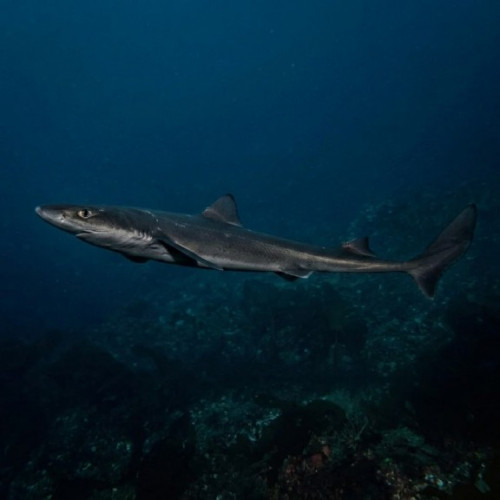
The black dogfish has a rather stocky, laterally compressed body, a moderately long, thick, and flattened snout that forms a very wide arch at the front. The large, horizontally oval eyes lack nictitating membranes; behind them, at a short distance, are much smaller spiracles. The nostrils are located on the front part of the snout, with short skin folds in front of them. The mouth is wide, with an even curve, thin lips, and short but deep grooves at the corners. There are about 34 tooth rows on each side of both jaws; each tooth has three (sometimes up to five) slender cusps, with the central one being the longest. The skin is densely covered with tiny dermal denticles; each is curved and resembles a spine growing from an irregular star-shaped base.
Features of fish fins
Both dorsal fins are preceded by thick, grooved spines, with the second spine being much longer than the first. The small first dorsal fin has a rounded apex and an almost straight posterior margin, and its base is located behind the pectoral fins. The second dorsal fin is quite angular, its area approximately twice that of the first fin, and its base is positioned opposite the middle of the pelvic fins. The pectoral fins are small and rounded. The pelvic fins are roughly the same size as the second dorsal fin, with rounded tips and almost straight posterior margins. The caudal peduncle is short and leads to a broad caudal fin that makes up less than a quarter of the total body length; the upper lobe has a convex upper margin ending in a squared tip, while the lower lobe is indistinct.
Fish coloring
This species has a uniform dark brown coloration above and nearly black below, with white dorsal fin spines. Juvenile sharks have white edges on the dorsal, pectoral, and pelvic fins. Small luminous spots are scattered irregularly across the skin. The eyes have a greenish tint when alive.
Distribution
This species is widely distributed in the Northwest Atlantic: from southern Baffin Island and Greenland to Virginia, USA, and possibly to the Gulf of Mexico. Eastern Atlantic: Iceland along the Atlantic slope to Senegal; Guinea to Sierra Leone; Namibia to Quoin Point, South Africa. Southwest Atlantic: from Uruguay to Argentina.
Habitat
A marine bathydemersal species. It inhabits the outer continental shelf and continental slope at depths of 180–2250 meters (590–7380 feet). Females typically inhabit greater depths than males, and depending on the region, smaller sharks may be found at different depths than larger ones. At high latitudes, it may rise to the surface, especially in winter. Temperatures range from 3.5 to 4.5°C, but occasionally drop to 1°C.
Size
Adult sharks typically reach 60–75 cm (24–30 inches) in length, but can grow up to 1.1 m (3.6 feet), making them the largest members of their family. Females grow larger than males. According to various authors, adult size ranges from 46 to 63 cm (18 to 25 inches) in males and from 51 to 70 cm (20 to 28 inches) in females, reflecting differences between geographic regions.
Behavior
Black dogfish form schools or shoals, which tend to become larger in winter and spring. Although they are fairly active, their swimming muscles exhibit lower glycolytic enzyme activity and higher creatine phosphokinase activity compared to the shallow-water spiny dogfish (Squalus acanthias), indicating a reduced capacity for burst swimming. The lipid-rich liver makes up about one-fifth of the shark's total weight and is responsible for maintaining neutral buoyancy.
Food and feeding habits
Omnivorous in feeding habits. They typically hunt in open water but can also scavenge from the bottom. Their diet consists primarily of various bony fishes, including spiny fish, hakes, flatfish, lanternfish, and barracudas, as well as pelagic crustaceans such as krill and shrimp, and cephalopods. As the sharks mature, fish becomes an increasingly important food source, while crustaceans become less important. They sometimes eat polychaete worms and jellyfish.
Food and feeding habits
Omnivorous in feeding habits. They typically hunt in open water but can also scavenge from the bottom. Their diet consists primarily of various bony fishes, including spiny fish, hakes, flatfish, lanternfish, and barracudas, as well as pelagic crustaceans such as krill and shrimp, and cephalopods. As the sharks mature, fish becomes an increasingly important food source, while crustaceans become less important. They sometimes eat polychaete worms and jellyfish.
Reproduction
Reproduction in the black dogfish occurs throughout the year without pronounced seasonal patterns. This species is ovoviviparous, with developing embryos remaining in the uterus and feeding exclusively on yolk. Mature females have two functional ovaries and two functional uteri. Fertilized eggs are released into the uterus at a diameter of 3.0–4.5 cm (1.2–1.8 inches), although some may remain in the ovary. The eggs are not enclosed in a capsule. The external yolk sac is completely absorbed when the embryo approaches term, and the remaining yolk moves into an internal yolk sac attached to the intestine. The internal yolk sac serves as a source of nutrition for the newborn until it learns to feed on its own. Litter size varies from four to 40 individuals. Newborns measure 13–19 cm (5.1–7.5 inches) in length.
Fishing
Black dogfish are of little commercial value. Significant numbers are caught incidentally in commercial deepwater trawl, gillnet, and longline fisheries throughout the North Atlantic, including the Icelandic Greenland halibut fishery, the French mixed-species trawl fishery, and Canadian fisheries for Greenland halibut, crab, roughhead grenadier, monkfish, and thorny skate. Captured sharks are usually discarded, although in recent years they are increasingly being retained and processed into fishmeal. Due to the reproductive characteristics of these sharks, such as the large size of females at sexual maturity, they may be susceptible to overfishing, although they are more fecund than other deep-sea sharks.
Relationship with a person
This shark species is harmless to humans.
| Classification | |
| Phylum | Chordata |
| Class | Actinopterygii |
| Squad | Squaliformes |
| Family | Etmopteridae |
| Genus | Centroscyllium |
| Species | C. fabricii |
| Features | |
| Conservation status | Least Concern |
| Habitat | Pelagic |
| Life span, years | No information |
| Maximum body weight, kg | No information |
| Maximum length, cm | 110 |
| Sailing speed, m/s | No information |
| Threat to people | Not edible |
| Way of eating | Predator |
Black dogfish
Tags: black dogfish