
Latin name
Hippocampus abdominalis
Other name
Pot-bellied seahorse
Identification
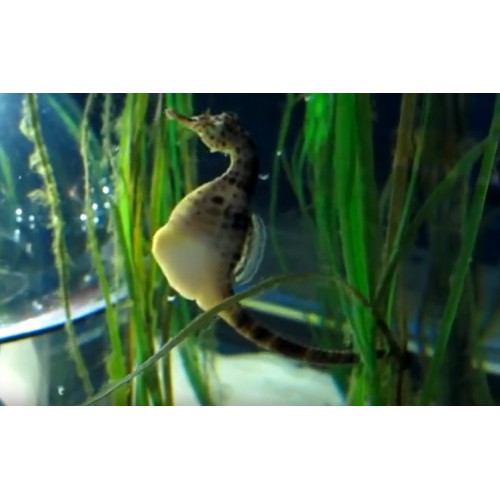
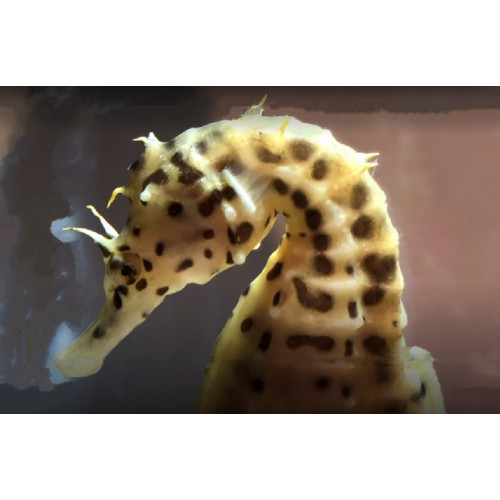
The big-belly seahorse has a forward-inclined head with a long snout, a swollen but narrow belly, and a long, coiled tail. The skin is naked (scaleless) and stretched over a series of bony plates that form rings around the trunk and tail. There are 12–13 trunk rings and 45–48 tail rings. The hard bony structure on the head (the so-called "coronet") is low and triangular in shape. Each eye moves independently, making it easier for them to watch for food and predators.
Distinguishing males from females is easy: males have a smooth, soft, pouch-like area at the base of the belly where the abdomen joins the tail in front. Males also have a fin there, but it is less prominent. Females have a more pointed belly with a very noticeable fin at its base.
Notably, this is the largest seahorse species in southeastern Australia; they have more dorsal fin rays and tail rings than any other seahorse.
Features of fish fins
The dorsal fin has a short base and 25–33 soft rays and is supported by 4 trunk rings and 1 tail ring. The anal fin has 4 soft rays. The pectoral fins have 15–17 soft rays. The caudal and pelvic fins are absent.
Fish coloring
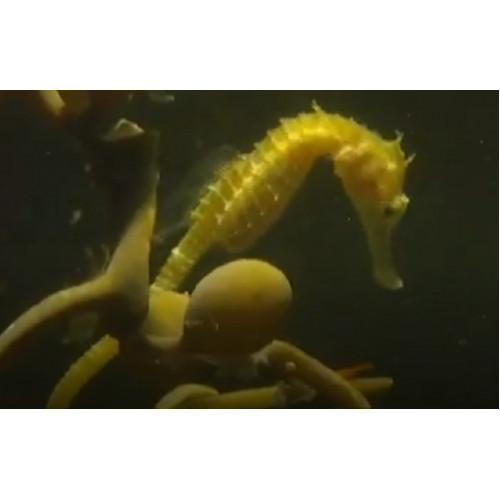
They can be yellow, brown, or sometimes white. Juvenile coloration varies from brown with yellowish-brown flecks to darker shades. The tail is often edged with yellow stripes. In deeper waters, where the tail is attached to other colorful life forms such as sponges and hydroids, they often take on those colors.
Distribution
They are distributed in the coastal waters of southeastern Australia and New Zealand.
Habitat
They typically inhabit shallow waters, such as large tidal pools with rocks during low tide. These habitat types are preferred because they are most productive for the seahorse's ambush predation strategy. They are able to remain motionless among seaweed, which may be beneficial for avoiding predation. Juveniles lead a pelagic lifestyle or attach themselves to drifting algae. Adults typically inhabit waters less than 50 meters (160 feet) deep; they have also been observed at depths of up to 104 meters (340 feet).
Size
The largest representative of the seahorse genus, with a maximum body length of 35 cm (14 inches), but typically up to 18 cm (7 inches).
Behavior
They are nocturnal. They can often be observed in groups at night and may attach themselves to sponges, colonial hydroids, or artificial structures such as pier pilings in deeper water. These fish swim using their dorsal fin in an upright position; when not swimming, they wrap their prehensile tails around any suitable vegetation, such as seaweed, waiting for planktonic animals to drift by, which are sucked into the small mouth located at the tip of the snout, much like a vacuum. Within the species, unpaired individuals do not exhibit greater mobility compared to those that are paired.
Females, males, and juveniles of seahorses produce "clicking" sounds during feeding, often accompanied by a head movement called "clicking." Females click more frequently than males, indicating a possible link to sexual selection.
Food and feeding habits
Seahorses are voracious predators, feeding primarily on crustaceans such as shrimp and other small animals living among seaweed, such as copepods and amphipods.
When given a choice, juvenile and adult seahorses prefer vegetation (even artificial seagrass) over open water. They consistently choose vegetation, even when mysid prey is nearby in clear water. This preference is linked to their ambush predation behavior.
Adult seahorses eat 30 to 50 times per day if food is available; due to slow consumption, they must feed constantly to survive. They have no stomach or teeth, so they feed by sucking small invertebrates through their bony tubular snouts with a slight head movement. Their snouts can expand if the prey is larger than the snout, allowing them to consume a variety of organisms.
Reproduction
They are ovoviviparous, with the male carrying the eggs in a brood pouch located under his tail. In the wild, reproduction may begin when seahorses are about one year old, while in captivity this time may be reduced to approximately eight months. Reproduction in big-belly seahorses occurs year-round, with peaks during the warmer months.
Courtship initiation involves a series of color and posture changes. Slightly expanding the opening of the brood pouch, the male fills it with water until it reaches the size of a balloon, swimming forward or pushing his body forward as if rocking it, then closes the pouch opening. At the same time, the male colors his pouch white or light yellow. The male also changes his overall body coloration, typically intensifying the yellow hue. The male constantly approaches his chosen female with his head lowered, while his dorsal and pectoral fins flutter rapidly.
If the female responds by also raising her snout upward, the final stage of courtship begins. The male and female then swim straight upward toward the water surface, with their heads pointing up and their tails down. When they reach the water surface, one or both seahorses can often be seen and heard clicking their heads. To transfer eggs to the male, the female turns to face the male, positioning herself slightly above him. Male seahorses produce 300–700 young at a time and may have up to four broods during the summer.
Fishing
This species is not a commercial fishery fish.
Relationship with a person
A popular aquarium species. It is not an edible fish. Dried specimens are sold in Asia as a traditional medicine.
| Classification | |
| Phylum | Chordata |
| Class | Actinopterygii |
| Squad | Syngnathiformes |
| Family | Syngnathidae |
| Genus | Hippocampus |
| Species | H. abdominalis |
| Features | |
| Conservation status | Vulnerable |
| Habitat | Demersal |
| Life span, years | No information |
| Maximum body weight, kg | No information |
| Maximum length, cm | 35 |
| Sailing speed, m/s | No information |
| Threat to people | Not edible |
| Way of eating | Planktonophage |
Big-belly seahorse
Tags: big belly seahorse