
Latin name
Opisthonema oglinum
Other Names
The Atlantic thread herring is known by several alternative names, including thread herring, hairyback, shad herring, and bristle herring. In Portuguese, it is called sardinha-bandeira (flag sardine). Its scientific name, Opisthonema oglinum, was given by Lesueur in 1818. The genus name Opisthonema comes from the Greek words "opisthe" (behind) and "nema" (filament), referring to the elongated last ray of the dorsal fin. It is sometimes confused with the scaled sardine, Harengula jaguana, by anglers.
Identification
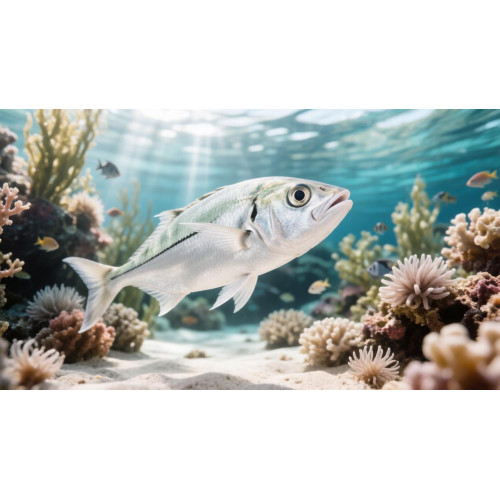
The Atlantic thread herring has a fusiform (spindle-shaped), moderately compressed body. The abdomen has 32 to 36 scutes forming a distinct keel, and the lower profile is deeply curved. The mouth is terminal (positioned at the front of the head), with a short, deep lower jaw hidden by a wide rounded upper jaw. The head is pointed. No frontal notch is present in the upper jaw, and no enlarged scales are found on the back in front of the dorsal fin. The shoulder under the operculum has 2 small fleshy lobes. A key identifying feature is the filamentous last ray of the dorsal fin, which is greatly elongated and distinguishes this species from all other western Atlantic herring-like fish except the gizzard shad, which has an inferior mouth. The species superficially resembles Sardinella (but has 8 pelvic fin rays versus 7 in Opisthonema) and Harengula (but has a small toothed hypomaxilla in the upper jaw). Gill rakers are fine and numerous, increasing with the size of the fish up to 12 cm SL, then becoming stable at 28 to 46 on the lower arch after 8 cm.
Features of Fish Fins
The Atlantic thread herring has no spines in any of its fins. The dorsal fin has 17–21 soft rays, with the last ray being filamentous. The anal fin has 21–25 soft rays. The pectoral fins have 15–17 rays, and the pelvic fins have 8 rays (7 branched). The dorsal fin is located slightly anterior to the centre point of the body, and the pelvic fin origin is at about the vertical through the middle of the dorsal fin base. The anal fin is short and placed well posterior to the vertical through the posterior base of the dorsal fin. All fins are primarily translucent.
Fish Colouring
The colouration of the Atlantic thread herring is distinctive. The dorsum (back) and upper sides are blue-green, sometimes with dark horizontal lines. The lower sides and abdomen are silvery. A dark spot is present on the side posterior to the gill cover, about equal in size to the diameter of the pupil, with a larger dark spot behind the opercle. This spot is sometimes followed by one or more irregular lines of smaller spots. The margin of the dorsal fin and its filament are dusky, and the caudal fin has black tips.
Distribution
The Atlantic thread herring is widely distributed in the Western Atlantic Ocean, from the Gulf of Maine (USA) and Bermuda in the north, throughout the Gulf of Mexico, the Caribbean Sea, and the West Indies, southward to Santa Catarina, Brazil. It has also been found in Uruguay and Argentina. The species has also been recorded off the coasts of Ecuador and Peru. Within the Gulf of Mexico, it is most abundant in coastal waters within 20 fathoms (about 36 meters).
Habitat
This species is a marine, reef-associated fish. It typically inhabits harbors and shallow coastal areas. It prefers temperatures above 17°C and below 29°C, with a preference for summer temperatures of 26°–29°C. It also prefers salinities of 32–34 ppt and probably does not enter water of low salinity. The depth range is from 1 to 50 meters, but it is usually found at depths of 5 to 30 meters, frequently in the upper 3 meters. It has been recorded in freshwater in the St. Johns River, Florida.
Size
The Atlantic thread herring can reach a maximum total length of 38 cm (15 inches). The common length is around 20 cm (8 inches) SL. Its maximum published weight is 375 g. Females mature at a fork length of 135 to 169 mm (about 13.5–16.9 cm).
Behavior
The Atlantic thread herring is a pelagic, coastal, and migratory species. It forms compact surface schools, but solitary individuals have also been reported. Schools from the southeastern United States migrate south during autumn and winter when temperatures fall below 20°C, presumably to overwinter. It moves northward and disperses offshore with warming temperatures in spring. The species is known to school with other species, including Spanish sardine, scaled sardine, and round scad.
Food and Feeding Habits
The Atlantic thread herring is a filter feeder that primarily feeds on plankton, especially copepods. However, adults also take small fishes, crabs, and shrimps. Juveniles feed on planktonic organisms. The species is near the base of the food chain and serves as an important forage fish for pelagic carnivores such as king and Spanish mackerel, bluefish, seatrouts, red drum, tunas, and dolphins (mahi-mahi).
Reproduction
The Atlantic thread herring reaches maturity at about 11.5 cm TL, though females mature at a fork length of 135–169 mm. Spawning occurs from May to June off North Carolina, from February to September (with a peak from April to August) in the eastern Gulf of Mexico, and possibly from March to July off Venezuela. Fecundity is estimated at 13,638 to 67,888 eggs per female, with a relative fecundity of 471 to 746 eggs per gram. The eggs are pelagic and measure 1.08 to 1.31 mm in diameter. Newly fertilized eggs are collected only at night, and recruitment occurs throughout the year, with a maximum in summer. Sex ratios can vary by season; off St. Petersburg, Florida, the summer ratio is 1 male to 5 females, while the winter ratio is 1:1.
Fishing
The Atlantic thread herring is a commercially important species. It is caught using various methods, including beach seines, purse seines, cast nets, and sometimes gill nets and as bycatch in the shrimp trawl fishery. In 1995, the total reported catch was 7,737 tonnes, with the USA accounting for 5,056 tonnes. The species is marketed fresh, frozen, and salted; it is also used in the fishmeal and fish oil industry. It is occasionally canned as 'sardine' for human consumption and processed into pet food. In some regions, it is the target of artisanal fisheries, such as in Caponga, Brazil, and Kingston Harbour, Jamaica. However, prospects for a large-scale commercial fishery have been limited by legislation and availability outside state waters.
Relationship with a Person
The Atlantic thread herring is primarily important to humans as a fishery resource. It has a slightly milder taste than most species of herring and can be served raw, pickled, or cooked. It is also taken by anglers for use as bait or for personal consumption. However, the species poses a health risk to humans if eaten. It is known to be ciguatoxic in some areas, meaning the flesh may be contaminated with ciguatera toxin that can cause severe food poisoning. This toxin does not affect the fish but can make humans very sick if consumed. The species is listed as Least Concern (LC) on the IUCN Red List, with its status last assessed on 23 August 2012.
| Classification | |
| Phylum | Chordata |
| Class | Actinopterygii |
| Squad | Clupeiformes |
| Family | Dorosomatidae |
| Genus | Opisthonema |
| Species | O. oglinum |
| Features | |
| Conservation status | Least Concern |
| Habitat | Pelagic |
| Life span, years | No information |
| Maximum body weight, kg | 0,375 |
| Maximum length, cm | 38 |
| Sailing speed, m/s | No information |
| Threat to people | Edible |
| Way of eating | Planktonophage |
Atlantic thread herring
Tags: atlantic thread herring