
Latin name
Istiophorus albicans
Identification
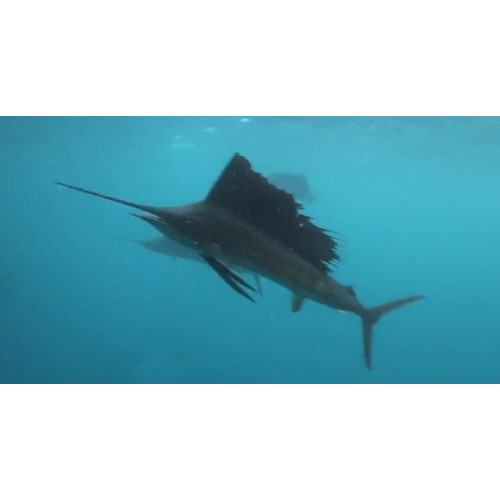
The Atlantic sailfish is a fish that cannot be mistaken for any other due to its "sail" and spear-like rostrum.
Its body is elongated, torpedo-shaped, strongly compressed laterally, and perfectly streamlined. The head is pointed, with the upper jaw forming a long, sharp rostrum ("spear" or "sword"), which is round in cross-section and about three times longer than the lower jaw. The upper jaw is non-protrusible, as in all istiophorids.
The main ornament is the "sail"! The first dorsal fin is incredibly high (the greatest height is at the 20th ray), sail-shaped, dark blue or black with small dark spots. When folded, it fits into a special groove on the back, allowing the fish to develop tremendous speed. The fish raises its "sail" when excited, frightened, or when herding a school of prey. It is believed that raising the "sail" helps the fish warm up when rising from cold depths to the surface, and also serves as a means of communication between individuals during hunting.
The sailfish's rostrum is quite flexible and not as rigid as that of the swordfish, so it is used for striking and stunning rather than impaling.
The Atlantic sailfish was long considered the fastest animal in the ocean.
In the 1920s, the sailfish's speed was estimated at a fantastic 111 km/h (69 mph). These data were based on approximate calculations and turned out to be greatly overestimated. More accurate measurements using modern methods show that the sailfish's actual maximum speed is between 36 and 55 km/h (22–34 mph). Recent studies lean toward the lower end of this range — about 36 km/h (22 mph). Despite the "title of fastest" having passed to other fish, the sailfish remains a lightning-fast predator capable of incredibly sharp bursts of speed.
Features of fish fins
First dorsal fin: very high, sail-shaped.
Second dorsal and anal fins: short, concave.
Pelvic fins: very long, thread-like, extending to the anal fin.
Caudal fin: deeply forked, with a narrow base and broad sickle-shaped lobes — a classic feature of a fast swimmer.
Pectoral fins: long, sickle-shaped, dark blue.
Fish coloring
The back is dark blue or blackish-blue, the sides are silvery with a coppery tint, and the belly is white. Along the sides run about twenty pale blue horizontal stripes consisting of dots and small spots. The coloration can change depending on the fish's excitement — during hunting or fighting, the sailfish becomes brighter.
Distribution
It inhabits tropical and subtropical waters of the Atlantic Ocean. In the western Atlantic, it is found from the coast of the United States (about 40°N) to southern Brazil (about 40°S). In the eastern Atlantic — from the coast of Portugal and Spain (about 50°N) to South Africa. It also enters the Caribbean Sea and the Mediterranean Sea (mostly juveniles).
Habitat
This is a pelagic species, inhabiting the open ocean but often approaching the shore, especially in areas with a continental shelf. It usually stays in the upper water layers (up to 200 m / 656 ft), but can descend deeper. It undertakes seasonal migrations, following the movements of prey fish.
Size
Maximum length of this fish species is 3.15 m (10.3 ft), with some reports up to 3.4 m (11.2 ft). Usual length is up to 2.4 m (7.9 ft). Maximum weight is 58.1 kg (128 lbs), officially published; unconfirmed data — up to 100 kg (220 lbs). The weight of an adult is about 55 kg (121 lbs). Females grow larger than males.
Lifespan is relatively short. The maximum recorded age in the wild is 13 years. According to some data, most individuals live no more than 4–5 years.
Behavior
They can be found singly, in pairs, or in small groups of 3 to 30 individuals. They often form loose aggregations over large areas, coordinating their actions when hunting schools of fish.
Food and feeding habits
A specialized predator whose diet consists almost entirely of fish.
Primary prey: sardines, anchovies, mackerel, horse mackerel — any medium-sized schooling pelagic fish. They also feed on squid, octopus, and large crustaceans.
It uses its long rostrum ("spear") not for impaling prey, but as a slashing weapon. It charges into a school, delivering rapid side-to-side strikes with its rostrum, stunning or injuring the fish. The sailfish then picks up and swallows the stunned prey whole. Often they hunt in coordinated groups, surrounding a school and attacking it in turn.
During hunting, the sailfish often raises its dorsal fin ("sail") above the water. It is believed that this helps the group of fish contain the prey school (herding it into a "net" of fins) and also serves as a visual signal to other members of the group.
Reproduction
Spawning occurs during the warm season in tropical waters. Spawning is fractional — the female releases eggs in several batches throughout the season. Fertilization is external, with no parental care. A single female can spawn up to 4.8 million eggs in one spawning season. They grow at a phenomenal rate, especially in the first year of life. By 6 months (November), they reach a length of about 56 inches (142 cm) and a weight of about 3.2 kg (7 lbs). By 1 year, they reach a length of about 72 inches (183 cm) and a weight of about 9.5 kg (21 lbs). By 2 years of age, the length is about 85 inches (216 cm) and weight about 19.5 kg (43 lbs). By 3 years, the length reaches about 92 inches (234 cm) and weight about 28.6 kg (63 lbs).
Fishing
The Atlantic sailfish is one of the most sought-after trophies for sport fishing worldwide. It is prized for its incredible speed, spectacular leaps out of the water, and fierce resistance when being reeled in. Catch-and-release practices are used to conserve the population.
It has virtually no commercial value. It may be caught as bycatch in longline and trawl fisheries.
Relationship with a person
The species has not been formally assessed by the IUCN (status NE), but the population is considered vulnerable due to high pressure from sport fishing (in the past) and bycatch. In many countries (e.g., the United States), strict regulations on sailfish catch are in effect.
The meat of these fish is not highly prized. It is eaten fresh, canned, and frozen (most often at the place of catch).
Interesting facts
Atlantic sailfish conduct highly organized group raids on sardines, which can be called a model of teamwork among ocean predators. This well-coordinated military operation consists of the following stages:
Stage 1 – Schooling and coordination. Sailfish gather in groups and act together, alternately attacking the sardine school. This process is described as "very orderly" — the fish do not interfere with each other to avoid accidentally injuring a fellow hunter with their swords. A visual signal for attack or a way to intimidate prey is a change in coloration: the sailfish's bodies darken and begin to "flash" with stripes and spots.
Stage 2 – Formation of the "bait ball." Using their huge dorsal fins (sails) as barriers, sailfish begin to circle around the sardine school, herding them into a dense living ball at the water's surface. In this bait ball, the sardines have no room to maneuver and become easy prey.
Stage 3 – Attack with the "sword." This is the most spectacular part of the hunt. Sailfish approach the herded school and use their long sword in two ways:
Stealth approach tactic: Despite being capable of reaching speeds of up to 110 km/h (68 mph), the sailfish approaches slowly — from behind — so as not to provoke the sardines into sudden flight.
Slashing strike method: Carefully inserting its sword into the center of the school, the fish sharply and with enormous force swings its head from side to side. The acceleration of the sword tip in the water is comparable to the acceleration of a baseball bat during a swing. Such strikes do not so much impale as stun and cripple the fish. The water around becomes filled with scales and fragments of sardine bodies.
Precise jab method: In about half of the cases, the sailfish uses its sword like tweezers. It can precisely poke a single sardine to knock it out of the school, then calmly pick it up with its mouth. The sword has small teeth (denticles) that help hold the prey.
Stage 4 – Marathon without rest. Such a hunt can last for hours. Exhausted sailfish move back, giving way to rested members who continue to "process" the school. This continues until almost nothing remains of the sardine school.
| Classification | |
| Phylum | Chordata |
| Class | Actinopterygii |
| Squad | Carangiformes |
| Family | Istiophoridae |
| Genus | Istiophorus |
| Species | I. albicans |
| Features | |
| Conservation status | Not Evaluated |
| Habitat | Pelagic |
| Life span, years | 13 |
| Maximum body weight, kg | 100 |
| Maximum length, cm | 340 |
| Sailing speed, m/s | 10 |
| Threat to people | Edible |
| Way of eating | Predator |
Atlantic sailfish
Tags: atlantic sailfish