
Latin name
Scomber colias
Other name
Tinker mackerel
Identification
This species was long considered a subspecies of the Pacific chub mackerel (Scomber japonicus) under the name Scomber japonicus colias. In the Indo-Pacific region, it is replaced by S. japonicus itself.
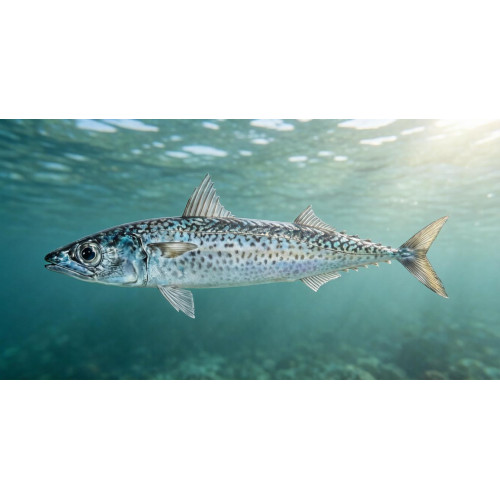
The Atlantic chub mackerel has a typical scombrid streamlined body, perfectly adapted for fast swimming in the water column.
Body shape: elongated, spindle-shaped, compressed laterally. The head is pointed. The caudal peduncle is narrow, with small keels on the sides. The scales are very small, and the skin feels velvety to the touch.
In the Mediterranean Sea, this fish exhibits seasonal fluctuations in condition: in autumn, it is fatty and full of roe; in winter and spring, it is almost lean, which is even reflected in different Greek names for it.
Features of fish fins
This species has two dorsal fins, separated by a gap that is equal to or exceeds the length of the first fin's base.
First dorsal fin: consists of 9–10 spiny rays.
Second dorsal fin: consists of soft rays, followed by 5 small finlets directed toward the caudal fin.
Anal fin: begins directly below or slightly behind the start of the second dorsal fin.
Pectoral fins: located quite high, at the edge of the gill cover.
Caudal fin: deeply forked and powerful.
The presence of 5 small finlets behind the second dorsal and anal fins is a characteristic feature of all mackerels, helping them reduce turbulence at high speeds.
Fish coloring
The back of the Atlantic chub mackerel is bluish or blue-green. The upper half of the body is covered with dark wavy or zigzag lines. The sides and belly are silvery, with dark spots scattered on the lower half of the body — this is the key difference from the common Atlantic mackerel (Scomber scombrus), which lacks spots.
Distribution
This species is widely distributed in the Atlantic Ocean and adjacent seas.
In the western Atlantic, it is found from Nova Scotia to Florida and in the Gulf of Mexico. In the eastern Atlantic — from Scandinavia to South Africa, including the entire Mediterranean Sea and the southern part of the Black Sea.
Habitat
This is a pelagic neritic species, inhabiting coastal waters over the continental shelf.
Size
This is a fish whose size varies considerably depending on the region of habitation.
On average, fishermen most often catch individuals about 30 cm (12 inches) in length, weighing 0.45 to 0.68 kg (1–1.5 lbs). For example, in one study in the northern Aegean Sea, the average size was 22 cm (8.7 inches) and weight about 100 g (3.5 oz). The largest recorded specimen was caught off the coast of Spain and reached 65 cm (26 inches). Its maximum weight can reach 2.9 kg (6.4 lbs).
Behavior
It forms large schools that can number thousands of individuals. Sometimes it enters brackish waters. When it spots a bonito, in order to escape danger, Atlantic chub mackerel cluster together and move rapidly in a circle.
Food and feeding habits
Like all mackerels, it is a predator whose diet changes with age.
Juveniles and adults feed mainly on zooplankton. As they grow, the proportion of larger prey increases: squid, crustaceans, and small pelagic fish.
Reproduction
Typically, the Atlantic chub mackerel becomes sexually mature when it reaches a length of about 21 cm (8.3 inches), corresponding to approximately 2–3 years of age. The breeding period depends on the region. In the Mediterranean, Aegean, and Marmara seas, spawning usually occurs in summer — from May to August. Off the coast of Madeira, the spawning peak occurs in February–March. This is a very fecund fish. A single female can spawn from 18,000 to nearly 500,000 eggs in one spawning season. The average number of eggs per batch is about 54,000–60,000. The larger and fatter the female, the more eggs she produces. This species exhibits so-called "indeterminate fecundity." This means that oocytes (future egg cells) mature in the female's ovaries continuously throughout the spawning season, rather than all at once.
A generation turnover occurs approximately every 4.5 years.
Fishing
This is one of the most important commercial species in the world's oceans, although its status and catch volume vary greatly by region. The Atlantic chub mackerel is caught using purse seines and pelagic trawls.
Relationship with a person
The Atlantic chub mackerel is safe for humans. Its meat is highly valued in cooking, especially in Mediterranean countries. It is listed on the IUCN Red List as a species of Least Concern.
| Classification | |
| Phylum | Chordata |
| Class | Actinopterygii |
| Squad | Scombriformes |
| Family | Scombridae |
| Genus | Scomber |
| Species | S. colias |
| Features | |
| Conservation status | Least Concern |
| Habitat | Pelagic |
| Life span, years | 4,5 |
| Maximum body weight, kg | 2,9 |
| Maximum length, cm | 65 |
| Sailing speed, m/s | No information |
| Threat to people | Edible |
| Way of eating | Predator |
Atlantic chub mackerel
Tags: atlantic chub mackerel