
Latin name
Danio rerio
Other name
Zebra danio
Identification
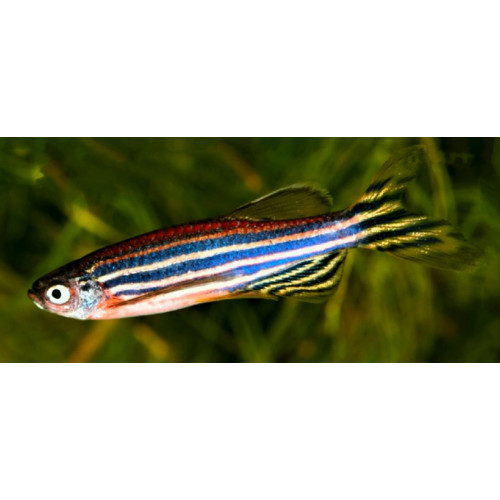
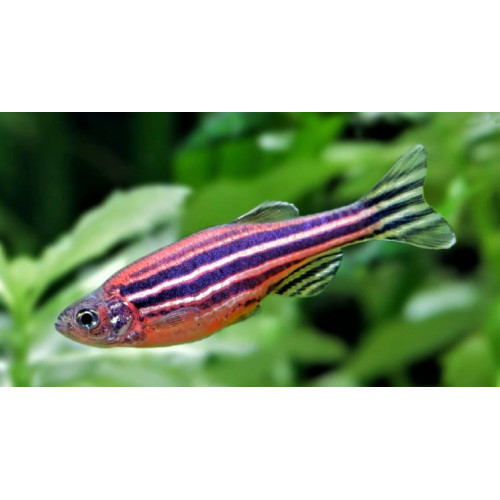
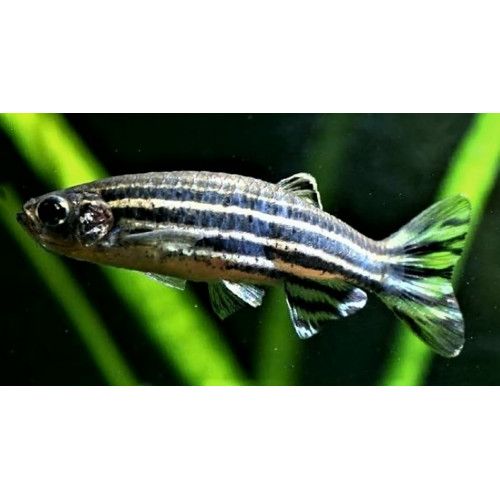
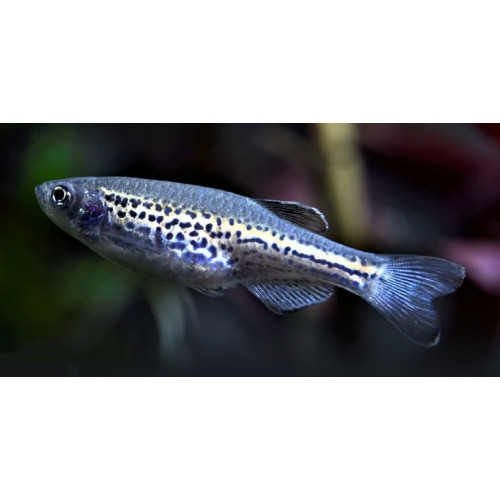
The body shape of the zebrafish is fusiform, with compressed lateral sides and a superiorly oriented mouth. Males exhibit a torpedo-shaped body form. Adult females possess a small genital papilla located anterior to the anal fin origin.
Features of Fish Fins
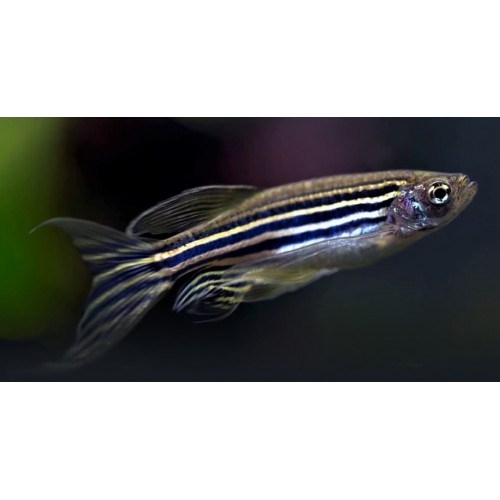
There are 7–9 rays in the dorsal fin. In juvenile fish, the fins are short; over time, they elongate and form a veil (long-finned strains also exist).
Fish Coloration
These fish derive their name from five uniform, pigmented, horizontal blue stripes along the sides of the body, reminiscent of a zebra's pattern, which extend to the end of the caudal fin. Males display golden stripes between the blue ones; females have a larger, whitish abdomen and silver stripes in place of the gold.
Among plants growing along the water's surface, transverse striped patterns are highly conspicuous. Under these conditions, fish with stripes oriented longitudinally along the body appear less noticeable. This is precisely the coloration pattern of the zebrafish.
Distribution
It inhabits freshwater bodies in South Asia, where it can be found in India, Pakistan, Bangladesh, Nepal, and Bhutan. The northern boundary of its range is in the Southern Himalayas, stretching from the Sutlej River basin at the Pakistan-India border to Arunachal Pradesh in northeastern India. Its distribution is concentrated in the basins of the Ganges and Brahmaputra rivers, and this species was first described from the Kosi River (lower Ganges basin) in India. Its range further south is more localized, with scattered findings from the Western and Eastern Ghats regions.
It has been introduced to various locations outside its natural range, including California, Connecticut, Florida, and New Mexico in the United States, presumably through intentional releases by aquarium enthusiasts or as a result of escapes from fish farms.
Habitat
Zebrafish typically inhabit moderately flowing or still clean waters at relatively shallow depths in streams, channels, ditches, oxbows, ponds, and rice fields. They are often found in areas with vegetation, either submerged or overhanging the banks, and the bottom tends to be sandy or muddy, often mixed with gravel or pebbles. Research on the habitats of Danio rerio in much of their range in Bangladesh and India indicated that the water had nearly neutral or slightly alkaline pH levels, mostly ranging from 16.5 to 34 °C (61.7–93.2 °F). In one unusually cold location, the temperature was only 12.3 °C (54.1 °F), while in another unusually warm site, it reached 38.6 °C (101.5 °F), yet the fish still appeared healthy. The unusually low temperature was recorded at one of the highest known habitats of this species at an elevation of 1576 m (5171 feet) above sea level, although this species has been documented at elevations of up to 1795 m (5889 feet).
Size
This species of fish can reach 4–5 cm in length, although in the wild its length is usually 1.8–3.7 cm with some variations depending on the habitat. The lifespan in captivity is about two to three years, although under ideal conditions it can be increased to more than five years. In the wild, this is usually an annual species.
Behavior
Schooling fish prefer to live and move in groups, demonstrating a 'hierarchy' within them. They use body language and movement as a means of communication, especially during the formation of schools, mating, and territory establishment.
Food and feeding habits
An omnivorous species, their diet depends on the habitat. In the wild, they mainly feed on small insects, larvae, and plankton. They also consume algae and other plant materials. They exhibit opportunistic behavior, eating food as it becomes available.
Feeding methods in breeding this species in aquariums vary significantly at different stages of development, reflecting changing nutritional needs. For newly hatched larvae, which begin feeding about 5 days after fertilization, small live prey such as paramecia or rotifers is usually used. As the larvae develop, they are usually transitioned to a diet that includes Artemia nauplii and dry foods.
Reproduction
The approximate generation time for Zebrafish is three months. A male is required for ovulation and spawning. The fish spawn asynchronously and, under optimal conditions (such as food availability and favorable water parameters), can successfully spawn frequently, even daily. Females are able to spawn at intervals of two to three days, laying hundreds of eggs in each clutch. After release, embryonic development begins; in the absence of sperm, growth stops after the first few cell divisions. Fertilized eggs almost immediately become transparent, making these fish a convenient model species for research.
The fish embryo develops quickly, and the precursors of all the main organs appear within 36 hours after fertilization. The embryo starts with the yolk, on top of which there is one huge cell that divides into two and continues to divide until thousands of tiny cells are formed. Then the cells migrate down the sides of the yolk and begin to form the head and tail. Then the tail grows and separates from the body. The yolk gradually decreases in size as the fish uses it as food during the first few days of development. Within a few months, the adult fish reaches reproductive maturity.
Fishing
Zebrafish are caught using a float and fly fishing. The bait can be a caddisfly or bark beetle larvae.
Relationship with a person
A popular aquarium fish, very hardy, well-suited for beginner aquarists. Their enduring popularity is explained by their playful nature, as well as rapid breeding, attractive appearance, low cost, and wide availability. They also do well in schools or groups of six or more and interact well with other fish species in the aquarium. If given the opportunity, adult specimens will eat fry.
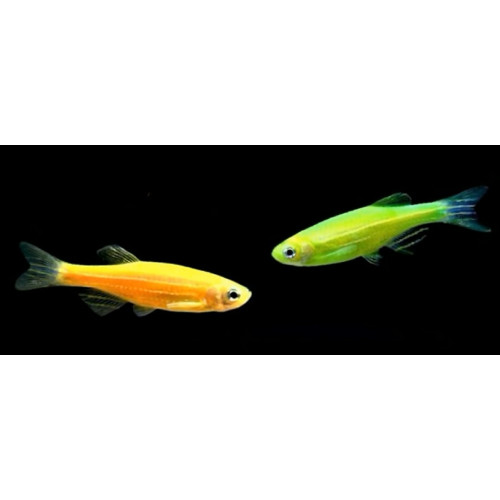
Zebrafish have also been used to create genetically modified fish and were the first species sold as GloFish (fish with fluorescent coloring).
This species is an important and widely used vertebrate model organism in scientific research, especially in developmental biology, as well as in the study of gene functions, oncology, teratology, and drug development, particularly at the preclinical stages, due to the ability to scale to a large number of offspring and the ease of delivering drugs through water via the gills. It is also notable for its regenerative abilities and has been modified by researchers to create numerous transgenic strains.
| Classification | |
| Phylum | Phylum |
| Class | Actinopterygii |
| Squad | Cypriniformes |
| Family | Danionidae |
| Genus | Danio |
| Species | D. rerio |
| Features | |
| Conservation status | Least Concern |
| Habitat | Pelagic |
| Life span, years | 5 |
| Maximum body weight, kg | No information |
| Maximum length, cm | 5 |
| Sailing speed, m/s | No information |
| Threat to people | Not edible |
| Way of eating | Planktonophage |
Zebrafish
Tags: zebrafish