
Latin name
Dermogenys pusilla
Other Names
The wrestling halfbeak is also known as the Malayan halfbeak, freshwater halfbeak, and silver halfbeak. Its scientific name, Dermogenys pusilla, was given by Kuhl and van Hasselt in 1823. The genus name Dermogenys comes from the Greek words "derma" (skin) and "geny" (jaw). In its native range, it is sometimes referred to as Ek Thota in Bangladesh.
Identification
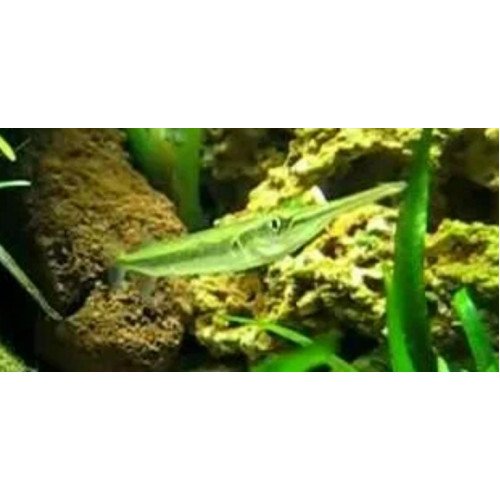
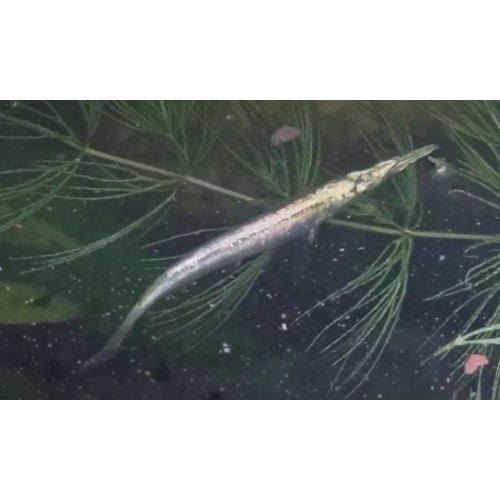
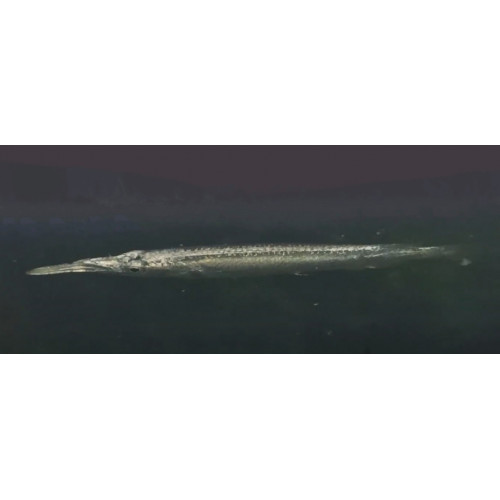
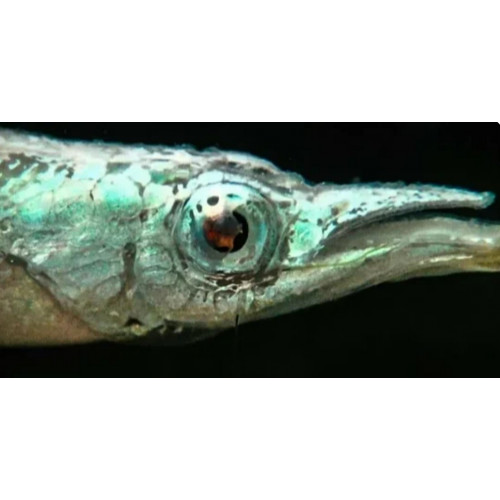
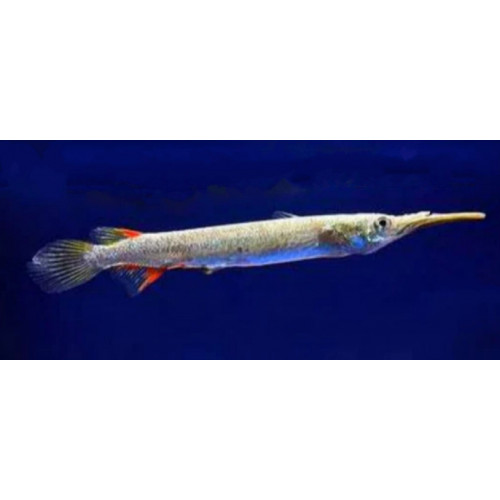
The wrestling halfbeak has a slender, elongated body with a distinctive extended lower jaw that forms a bony beak, which is 2.0–2.5 times longer than the upper jaw. The upper jaw is short and triangular, lacking a mesial keel. Both jaws contain villiform (small, brush-like) teeth in multiple rows. The species exhibits sexual dimorphism: females are larger and less colourful than males, while males are smaller with brighter colouration and a modified anal fin that forms an andropodium (a reproductive organ used for internal fertilisation).
Features of Fish Fins
The wrestling halfbeak has a dorsal fin with 3–4 spines and 6–9 soft rays, and an anal fin with 3–4 spines and 11–14 soft rays. The pectoral fin is approximately as long as the head, and the pelvic fin originates at the midpoint between the eye and the caudal fin. The caudal fin is rounded. In males, the anterior lower part of the anal fin is modified into an intromittent organ (andropodium) used for mating.
Fish Colouring
The colouration of the wrestling halfbeak varies depending on locality. The body is typically olive-brown or brownish-grey, with reddish hues on the flanks and a paler to white belly. Males are more brightly coloured and may have red or yellow patches on the dorsal fin and beak, which are absent in females.
Distribution
The wrestling halfbeak is widely distributed in South and Southeast Asia. Its range includes India, Myanmar, Thailand, Laos, Cambodia, Vietnam, Malaysia, Indonesia, the Philippines, Singapore, Borneo, and Sumatra. It has also been recorded in Bangladesh. FishBase lists the species from Java, Indonesia, but notes its distribution is broader.
Habitat
This species inhabits a variety of freshwater and occasionally brackish water biotopes, including rivers, rivulets, canals, drains, flooded fields, ponds, and lakes. It prefers slow-flowing or stagnant waters and is most commonly found in areas with floating plants or rooted aquatic vegetation that reaches the surface. Larvae and early juveniles may be found in mangroves during the wet season. It is a surface-dwelling species, spending almost all its time just beneath the water surface.
Size
The wrestling halfbeak exhibits strong sexual dimorphism in size. Females are larger and can reach up to 7 cm (2.8 inches) in standard length, while males typically reach only about 5.5 cm (2.2 inches). However, maximum total length of 16.1 cm for unsexed individuals.
Behavior
The wrestling halfbeak is a surface-dwelling species that is nervous and easily startled, especially when first introduced to new surroundings. It is an excellent jumper and requires a tightly fitting cover. The species can be kept in groups, with males engaging in jaw-locking fights, hence the common name "wrestling" halfbeak. In the wild or large aquaria, the weaker male quickly disengages, so serious injury is rare. However, in their native range, males are sometimes used in fish fighting contests for betting purposes. The species is also a live-bearer (viviparous), with internal fertilisation.
Food and Feeding Habits
The wrestling halfbeak is a surface-feeding carnivore that feeds primarily on small invertebrates. Its diet includes crustaceans, insect larvae (especially mosquito larvae), worms, and flying insects that have fallen onto the water's surface. It plays a beneficial role in controlling mosquito populations, as it feeds on both larvae and adult female mosquitoes that approach the water to lay eggs.
Reproduction
The wrestling halfbeak is a viviparous (live-bearing) species with internal fertilisation. Females give birth to 10–30 fry after a gestation period of about one month, though this is temperature-dependent and can vary from 3–6 weeks. Gestation is highly sensitive to temperature. Brood size is typically 10–20. Newborn fry are about 1–1.5 cm in length and can be fed powdered dry foods and brine shrimp nauplii from birth. The adults may predate on the fry, so they should be separated after birth.
Fishing
The wrestling halfbeak is rarely taken in commercial catches and is not commonly seen in markets. It is occasionally found in subsistence catches but is not considered a popular food fish. In some regions, it may be used in controlling mosquito larvae and is traded as an aquarium fish.
Relationship with a Person
The wrestling halfbeak is not considered a threat to humans and is classified as harmless. It is of minor commercial importance but is widely traded as an aquarium fish under various names such as "silver halfbeak" or "golden halfbeak". In its native range, the species is sometimes used for fish fighting contests, with wagers placed on the outcomes of male bouts. The species is listed as Data Deficient (DD) on the IUCN Red List, assessed on 2 September 2020. In Bangladesh, it is considered Endangered due to habitat loss.
An interesting story
A German aquarium fish dealer, during a trip to Singapore, noticed unusual fish in a roadside ditch that resembled small pikes — they were representatives of the species known as the wrestling halfbeak. He realized that such exotic fish could fetch a large sum in Europe and decided to catch as many as possible.
However, his first attempt ended in failure: all the caught fish died the very next day after he placed them in an aquarium. The dealer then made a second attempt, trying to create ideal conditions for them. He tried different aquarium sizes, changed the temperature, added plants, and aerated the water — but all his efforts were in vain; the fish continued to die one after another.
Just before his departure, he asked a local resident to catch the fish once more. The man brought 50 specimens, and along with them, two marine fish were also caught. This incident gave the dealer an idea: 'What if the ditch where these "pikes" live is connected to the sea and the water is salty?' To test his hypothesis, he divided the caught fish into two groups: one was placed in fresh water, and the other had a small amount of sea salt added. The result was clear — all the fish in fresh water died, while those in the brackish environment thrived.
Thus, the dealer discovered that these fish originate from brackish waters and was able to safely transport them to Berlin. In captivity, they turned out to be livebearers and began to reproduce rapidly. Remarkably, their offspring no longer needed saltwater — they successfully adapted to fresh water, making these fish accessible to a wide range of aquarists.
| Classification | |
| Phylum | Chordata |
| Class | Actinopterygii |
| Squad | Beloniformes |
| Family | Zenarchopteridae |
| Genus | Dermogenys |
| Species | Dermogenys pusilla |
| Features | |
| Conservation status | Data Deficient |
| Habitat | Pelagic-neritic |
| Life span, years | No information |
| Maximum body weight, kg | No information |
| Maximum length, cm | 7 |
| Sailing speed, m/s | No information |
| Threat to people | Not edible |
| Way of eating | Predator |
Wrestling halfbeak
Tags: wrestling halfbeak