
Latin name
Ballerus sapa
Other name
White-eye, southern white eye, Aral white eye, danube bream, zobel, beloglazka.
Identification
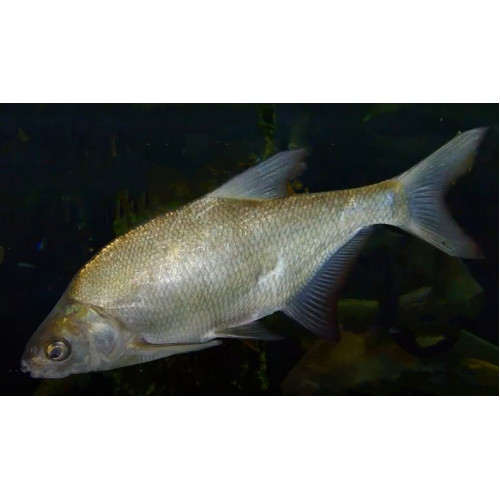
The body of the white-eye bream is compressed laterally and more elongated than that of its relative, the common bream (Abramis brama). The back is curved but not humped anteriorly; overall, the dorsal and ventral profiles have the same curvature. The scales are cycloid, medium-sized, and firmly embedded in the skin. The head is relatively small and rounded in front. The snout (the anterior part of the head up to the eye) is short, thickened, blunt, convex, and projects slightly above the mouth, which is directed somewhat downward. The mouth is small, semi-inferior, and protrusible. The eyes are very large and strongly protruding, with a diameter approximately equal to the length of the snout (about 1/3 of the head length). There are 48–53 scales along the lateral line. There are 18–23 gill rakers.
Features of fish fins
The dorsal fin is short, moderately high, with three rigid (unbranched) rays and 8–9 soft (branched) rays, located approximately at the midpoint of the back. The fin rays are very clearly visible. The anal fin is extremely long (at least 1/3 of the body length), consisting of 3 unbranched (simple) rays and 35–44 branched rays, most commonly 37–39, with an almost straight or slightly concave margin; the anterior part is more developed than the posterior part. The pectoral fins reach the origin of the pelvic fins. The caudal fin is asymmetrical, deeply forked, with pointed lobes; the lower lobe is slightly longer than the upper lobe.
Fish coloring
The overall body color is uniform, silvery, with the back somewhat darker (sometimes with a greenish or bluish tint). The sides of the body are lighter, often silvery-white, sometimes with a pearlescent sheen. The belly is whitish. The semi-transparent fins are grayish (light gray); the unpaired fins often have darker edges. The fins are often reddish at the base. The iris is colored silver or silvery-white. Once removed from the water, the fish quickly loses its silvery hue. Before spawning and during the spawning period, males develop breeding tubercles in the form of a white pearly rash on the head, body, and inner surfaces of the pectoral and pelvic fins.
Distribution
Europe and Asia: large rivers draining into the Black, Azov, Caspian, and Aral Seas. It has been introduced or occurs naturally in the Northern Dvina basin (White Sea basin), where it is currently spreading from the warmer upper reaches (Vychegda system) northward. It has been introduced into the Volkhov River (a tributary of Lake Ladoga), into the Rhine, and has invaded the Vistula drainage system, having arrived from the Black Sea basin via the Pripet–Bug Canal (connecting the Dnieper and Vistula drainage systems).
Habitat
A freshwater and brackish species, preferring a temperate climate. It is found in flowing waters: streams, rivers, and marine shallows influenced by currents. It inhabits large lowland rivers and river mouths. Its lifestyle is demersal (bottom-dwelling). It prefers biotopes with clean water, fast or moderate currents, areas with significant depths, and rocky, sandy-rocky, or pebbly bottoms. Its body shape—not as deep as that of the common bream (Abramis brama)—helps it maneuver confidently in strong currents. In mountain rivers, this fish inhabits their lower reaches but ascends further upstream than the common bream (Abramis brama). It is less commonly found in backwaters, lakes, and reservoirs; it avoids quiet pools, floodplain and heavily vegetated waters, slow-flowing ponds, and areas with muddy bottoms.
Size
The maximum length of these fish is 46 cm (18 inches) and weight up to 1.5 kg (3.3 lbs). The usual length is 15 cm (6 inches). The maximum age is 7–8 years.
Behavior
The white-eye bream leads a schooling and sedentary lifestyle in small groups. Its behavior and feeding depend on the time of year. In summer, the white-eye bream is active throughout the day. During the day, individuals stay at depth, with peak activity occurring at night and during twilight hours, or on cloudy days. Their schools increase significantly before wintering and during spawning. With the arrival of autumn, the fish gather in large schools. As temperatures drop, they move further downstream to areas with greater depth. The fish are also found in shallow waters, but not as frequently. Anadromous populations return to freshwater. In late autumn, the fish find shelters for wintering. They choose depressions in the bottom and deep holes. They feed around the clock until the ice cover forms. In winter, they lead a sedentary lifestyle. They do not stop feeding, but the amount of food needed decreases sharply. With the beginning of ice melt, they become active. They remain in their wintering areas until the ice has completely disappeared. They try to stay below riffles, where the current carries a huge number of benthic organisms, which form part of their diet. In spring, mature fish begin to prepare for spawning. This happens after the water warms up to certain temperatures. The fish gather in schools and begin moving upstream to spawning grounds. After spawning, they return to their usual habitats and stop feeding for 1–2 weeks. The numerous schools split into small groups. Regardless of the season, adults prefer deeper areas in the main current, while juveniles inhabit shallow waters.
Food and feeding habits
By feeding type, it is classified as a benthophage. The feeding habits of adult fish depend on the type of water body, but are primarily oriented toward animal food. Typically, the diet includes larvae of aquatic insects, mainly chironomids (bloodworms), caddisflies (trichopterans), mayflies (ephemeropterans), various worms, crustaceans (benthic amphipods, pond slater, ostracods), small mollusks (clams and snails), eggs and fry of other fish, organic remains, detritus, and various algae. A small portion of the diet consists of aerial insects and higher vegetation. Larvae and juveniles intensively consume small zooplankton freely floating in the water column (rotifers, small crustaceans). Their usual habitats may change in search of food. Preferring rivers with strong currents and a hard bottom, the fish eats encrustations on rocks or bottom-dwelling organisms beneath them. It also visits tributaries and old riverbeds of slow-flowing rivers, where it searches for food in loose benthic substrate. While foraging in bottom layers, it often swallows a lot of sand along with its food, sometimes with an admixture of silt and detritus. It has been observed that the diet also depends on the season: more plant food is consumed in summer, while animal food is consumed in spring and autumn. Throughout all periods of life, its feeding intensity remains generally low.
Reproduction
It spawns in river channels in May. The water temperature must be above 8°C (46°F). Sexual maturity is reached at 3–4 years of age. For reproduction, it uses sections of the main, faster current with rocky, sediment-free channels, as well as other areas of the water body with pronounced flow and a bottom composed of pebbles, gravel, and sand. The female lays eggs on submerged or last year's vegetation or on suitable benthic substrate. The eggs are yellowish, sticky, 1.4–1.9 mm in diameter, and adhere to hydrophytes or other surfaces until the larva hatches. After the eggs are fertilized by the males, embryonic development occurs relatively quickly; the larvae hatch within a few days, depending on water temperature. The hatched larvae remain lying on the bottom for some time (until the yolk sac is absorbed); unlike many of their relatives, they do not develop attachment organs. After spawning, adults move to feeding grounds, while semi-anadromous forms head to desalinated parts of the seas. The early life of the fry takes place in shallow waters, close to the spawning site. They graze in grassy shallows along shores and near islands. Juveniles feed on small zooplankton freely floating in the water column, while those that have drifted down from rivers stay near river mouths and feed primarily on chironomid larvae. This fish grows more slowly than other similar species. The minimum population doubling time averages 1.4–4.4 years.
Fishing
This fish species has no significant commercial value, and industrial fishing for it is not widespread. However, where it does occur in certain regions, it takes place in April–May or September–October. It is caught using gill nets and seines. For recreational anglers, finding this fish in a body of water can be difficult, even when it is abundant in the river, as it is unevenly distributed.
Relationship with a person
The meat of the white-eye bream is not only nutritious but also tasty, although it contains many bones. The autumn fatty fish, after active summer feeding, is especially delicious.
| Classification | |
| Phylum | Chordata |
| Class | Actinopterygii |
| Squad | Cypriniformes |
| Family | Leuciscidae |
| Genus | Ballerus |
| Species | B. sapa |
| Features | |
| Conservation status | Least Concern |
| Habitat | Bottom |
| Life span, years | 8 |
| Maximum body weight, kg | 1,5 |
| Maximum length, cm | 46 |
| Sailing speed, m/s | No information |
| Threat to people | Edible |
| Way of eating | Bentophage |
White-eye bream
Tags: white eye bream