
Latin name
Protopterus annectens
Other name
Tana lungfish or simply African lungfish.
Identification
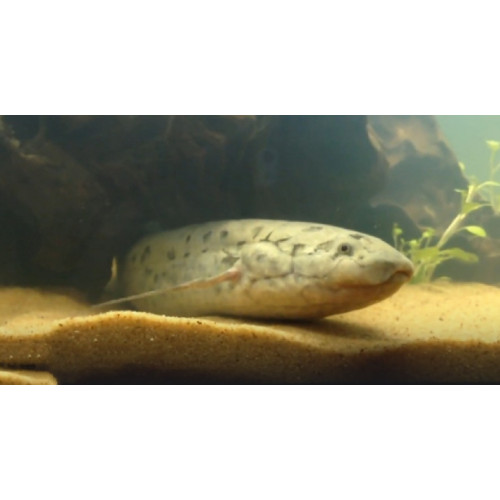
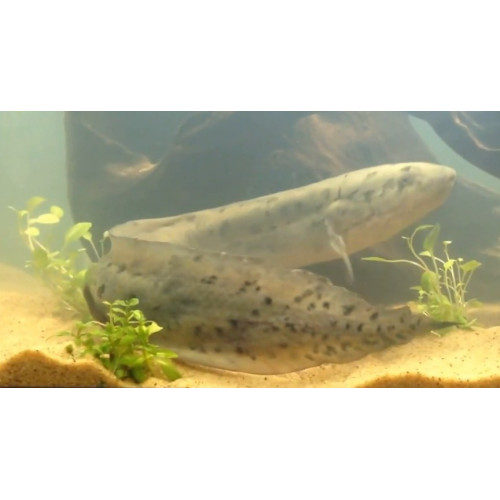
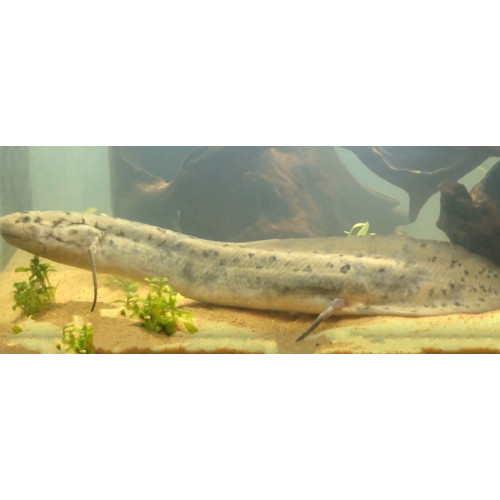
The body of the West African lungfish is elongated, 9 to 15 times longer than the head; it is round in cross-section anteriorly and laterally compressed behind the pectoral fins. It is covered with small, deeply embedded cycloid scales: 40–50 scales run between the gill cover and the anus, and 36–40 run to the origin of the dorsal fin. It has 34–37 pairs of ribs. In the subspecies P. a. brieni, the caudal part of the body is slightly longer than in the nominate subspecies. Three external gills are located behind the gill openings and above the pectoral fins. The snout is protruding, with small eyes on the upper part, their diameter being 6.6–11% of the head length. The wide mouth is bordered by prominent lips. The jaws are equipped with four horny plates used by the lungfish to grind food. The swim bladder is modified into two lungs, allowing the fish to breathe air. Sexual dimorphism is weakly expressed.
Features of Fish Fins
The pectoral and pelvic fins are reduced to fleshy filaments. The pelvic fins are twice the length of the head. The pectoral fins are long, sometimes three times longer than the head; their base is surrounded by a fringe.
Fish Coloration
The body color of the West African lungfish is olive-brown with numerous dark spots (the flanks are lighter than the back), and the belly is dirty white.
Distribution
Its range covers the basins of the Sahel rivers, as well as the basins of the West African rivers Comoé, Bandama, Sierra Leone, and the territory of Guinea; the upper Congo basin, the middle and lower Zambezi, and all rivers on the eastern coast north of the Limpopo. The subspecies P. a. brieni inhabits Lake Rukwa. The species is widely distributed in West African countries—Mali, Burkina Faso, Senegal, Gambia, Guinea, Sierra Leone, Ivory Coast, Ghana, Togo, Benin, Niger, Nigeria, Cameroon—in Central African countries (Central African Republic, Chad, Sudan), and in Kenya, Tanzania, among others.
Habitat
It is found in swamps and backwaters of rivers and lakes. The species is closely associated with aquatic plants in terms of its reproductive ecology and feeding.
Size
It reaches a maximum length of 1 meter and a weight of 4 kilograms. It lives up to 18 years.
Behavior
Nests are built in weedy areas. Typically, West African lungfish live in river floodplains. When these dry up during the dry season, the fish secretes a thin mucus around itself, which dries to form a fragile cocoon. They can remain in this state for over a year, although they usually aestivate only from the end of one rainy season until the start of the next. Under unfavorable conditions, they can endure starvation for more than three years. During aestivation, the fish literally burrows into the substrate, expelling mud from its gill openings. It can bury itself 3–25 cm below the bottom, depending on the fish's length. The lungfish wriggles to carve out a bulb-shaped chamber and positions itself with its nose upward. It breathes air at the entrance of the chamber's tube before descending back into the expanded part of the chamber. When the water disappears, air reaches the fish through the tube at the surface.
Food and Feeding Habits
It is an omnivorous and unfussy feeder. Its diet includes small fish, amphibians, mollusks, and plants. It adapts to various foods such as shrimp, insects, mussels, algae wafers, and a variety of plant-based feeds.
Reproduction
During the rainy season, they spawn in swamps where they build nests and deposit white eggs about 4 mm in diameter. The nest is typically placed among the roots of aquatic vegetation, where the male attends to several females during the breeding season. Males of the subspecies P. a. brieni dig a U-shaped burrow about 60 cm deep for spawning. The larvae hatch after eight days and leave the nest after twenty days. Males aerate the eggs with body and fin movements and protect the young for some time after hatching.
Fishing
The West African lungfish has commercial importance in some regions of Africa, where it is actively caught and sold as food (for example, in markets in Uganda and Kenya).
Relationship with a person
Used in aquariums. It is recommended to keep them singly. They can show aggression towards other fish, which they may bite and injure; they are intolerant of their own kind.
| Classification | |
| Phylum | Chordata |
| Class | Dipnoi |
| Squad | Ceratodontiformes |
| Family | Protopteridae |
| Genus | Protopterus |
| Species | P. annectens |
| Features | |
| Conservation status | Least Concern |
| Habitat | Bottom |
| Life span, years | 17 |
| Maximum body weight, kg | 4 |
| Maximum length, cm | 100 |
| Sailing speed, m/s | No information |
| Threat to people | Edible |
| Way of eating | Predator |
West African lungfish
Tags: west african lungfish