
Latin name
Electrophorus voltai
Identification
The species is named in honor of Alessandro Volta — the Italian physicist and inventor of the electric battery. Interestingly, it was the study of electric eels that inspired Volta to create the first galvanic cell in 1800.
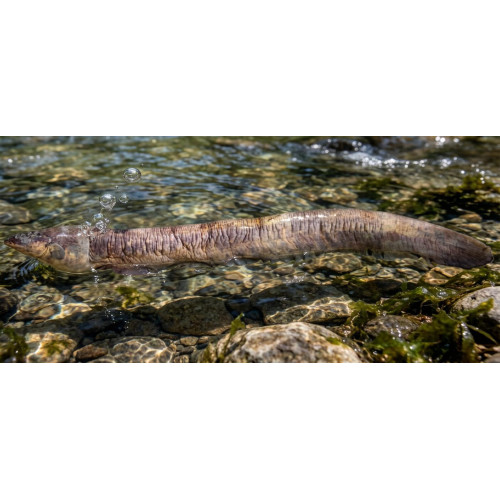
The body of Volta's electric eel is long, cylindrical, tapering toward the tail. The head is flattened and broad, distinguishing it from other electric eel species. Scales are completely absent — the skin is smooth.
Unlike E. electricus, E. voltai has an oval-shaped head (rather than U-shaped) and significantly more lateral line pores (112–146 vs. 88–101). It differs from E. varii by its flattened skull and broader head.
The ability of this species to generate electricity is its main superpower, which gave the genus its name (Electrophorus — from Greek elektron and pherein, "bearing amber"). Inside the eel's body are three specialized electric organs, consisting of thousands of modified muscle cells — electrocytes — that work like batteries connected in series.
Main organ: located along the back, generates the most powerful discharges.
Hunter's organ: located below the main organ, participates in high-voltage discharges.
Sachs' organ: located in the tail region, produces low-voltage pulses (about 10 V) for navigation and communication in murky water.
This species can generate a discharge of up to 860 volts — the strongest electrical discharge of any animal on Earth. For comparison, the voltage in a standard European wall outlet is 220–240 volts. The high-voltage discharge is used to stun prey (fish, crustaceans) and for defense against predators (caimans). Low-voltage pulses serve for electrolocation — orientation in murky water and searching for prey.
Features of fish fins
The most noticeable feature is the long anal fin, which runs along almost the entire underside of the body, from the head to the tip of the tail. It is the undulating movements of this fin that allow the fish to move forward and backward with equal ease. The dorsal and pelvic fins are absent; the caudal fin is reduced, which is characteristic of all gymnotiforms.
Fish coloring
The coloration of these fish is usually grayish-brown, sometimes with a reddish tint on the belly.
Distribution
This species is distributed in rivers draining from the Brazilian Shield and the Guiana Shield, mainly in northern Brazil.
Habitat
A freshwater benthopelagic species. Unlike other electric eel species, E. voltai inhabits specific conditions. The water in the highland regions of their habitat has very low electrical conductivity. It is believed that this environmental feature was the evolutionary driver that "forced" the eels to develop such high voltage for effective hunting.
It lives exclusively in fresh water, preferring slow-flowing or stagnant waters. It must rise to the surface to gulp atmospheric air approximately every 5–10 minutes. Its mouth is highly vascularized and functions like a lung, while its gills are rudimentary and serve only to expel carbon dioxide.
Size
This is the largest representative of the order Gymnotiformes (knifefishes).
This species can reach a length of 2.5 meters (8.2 feet) and a weight of 22 kilograms (48.5 lbs). Males grow larger than females by about 35 centimeters (14 inches).
Behavior
Despite living in water, electric eels must rise to the surface to breathe atmospheric air, obtaining up to 80% of their required oxygen. They do this approximately every 20 minutes.
To deal with large prey, the electric eel may wrap its body around it, increasing the effectiveness of the electric discharge.
When encountering a large predator or a human, the eel is capable of leaping out of the water to touch the enemy and deliver a stronger electric shock.
A school of Volta's electric eels often discharges their "electric batteries" together, killing all living things in the hunting area.
Food and feeding habits
An active and ingenious predator that not only hunts alone but is also capable of social hunting — a rare phenomenon among fish.
The eel lies motionless on the bottom, emitting low-voltage pulses to detect prey. Upon detecting a fish, it delivers a powerful electric discharge, paralyzing its victim. If the prey is large and attempts to escape, the eel may curve its body into an arc, encircling the prey and doubling the strength of the electric field. It then sucks the stunned prey directly into its stomach through its mouth, doing so so quickly that it often gives the prey no chance to resist.
A unique behavior has been documented: groups of several E. voltai off the banks of the Iriri River (a tributary of the Amazon) coordinated their actions to hunt schools of fish. They surrounded their prey, delivered synchronized electric shocks, herding and stunning the victims, then took turns swallowing them. This is the first known case of pack hunting among electric eels.
Reproduction
Data on the reproduction of Volta's electric eel is extremely scarce, but it is known to be similar in this regard to other electric eel species. Sexual dimorphism is expressed in size — males are larger than females. Spawning occurs during the dry season. The male builds a nest from his own saliva in the coastal zone, where the female lays her eggs. The male guards the clutch until the fry hatch. Exact data is unavailable, but it is assumed that, like other electric eels, this species may live from 10 to 15 years.
Fishing
It is not a target of commercial fishing, but is eaten by local populations.
Relationship with a person
"Harmless" if the fish is not provoked.
A shock of up to 860 volts can be very painful and cause temporary paralysis, but is generally not fatal to a healthy adult human, as the current does not exceed 1 ampere. Additionally, a strike from its tail delivered in a leap can be particularly painful.
The species is not under threat and is listed on the IUCN Red List as Least Concern.
| Classification | |
| Phylum | Chordata |
| Class | Actinopterygii |
| Squad | Gymnotiformes |
| Family | Gymnotidae |
| Genus | Electrophorus |
| Species | E. voltai |
| Features | |
| Conservation status | Least Concern |
| Habitat | Benthopelagic |
| Life span, years | 15 |
| Maximum body weight, kg | 22 |
| Maximum length, cm | 250 |
| Sailing speed, m/s | No information |
| Threat to people | Edible |
| Way of eating | Predator |
Volta's electric eel
Tags: volta's electric eel