
Latin name
Nannostomus trifasciatus
Other name
Three-stripe pencilfish
Identification
The genus name Nannostomus comes from the Greek nannos ("dwarf") and the Latin stomus ("mouth"), referring to the small size of the fish. The species name trifasciatus translates from Latin as "three-banded."
N. trifasciatus was one of the first four species of the genus Nannostomus described by science (in 1876). Due to its wide distribution, the species has many color variations, and some of these were initially mistakenly described as separate species.
It is a classic representative of the "pencilfish," which received its name for its elongated body shape and characteristic pattern.
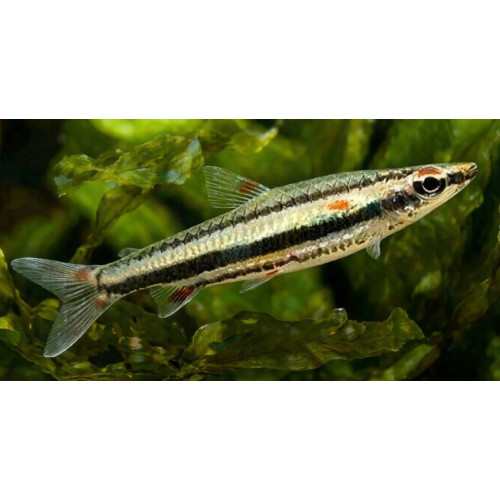
The three-lined pencilfish has an elongated, slender, spindle-shaped body with a small terminal mouth. The dorsal profile is almost straight, the belly slightly convex. The caudal peduncle is thin. An adipose fin may be present or absent depending on the population.
Difference from similar species: N. trifasciatus is often confused with Nannostomus marginatus. However, the latter differs by its smaller size and more stocky, "square" body profile.
Features of fish fins
Dorsal fin: small, located almost in the middle of the back. It consists of 2 spiny (rigid) rays and 8 soft rays.
Adipose fin: This species has an adipose fin — a small fleshy fold on the back between the dorsal and caudal fins without rigid rays. However, the three-lined pencilfish exhibits intraspecific variability: in some individuals, the adipose fin is well developed, in others it is reduced (rudimentary), and in still others it is completely absent. This is one of the key features by which Nannostomus trifasciatus is distinguished from its close relative Nannostomus marginatus, which always lacks an adipose fin.
Anal fin: short, pressed against the belly, not reaching the base of the caudal fin. Unlike many other Nannostomus species, the anal fin in N. trifasciatus is not modified in males — it is identical in shape and coloration in both sexes. Structure: 3 spiny and 9 soft rays.
Caudal fin: bilobed, with rounded edges. The upper lobe has 10 main rays, the lower lobe has 9 rays.
Pectoral fins: located on the sides of the body. Consist of 1 spiny and 9–13 soft rays.
Pelvic fins (paired): consist of 2 spiny and 7 soft rays.
Fish coloring
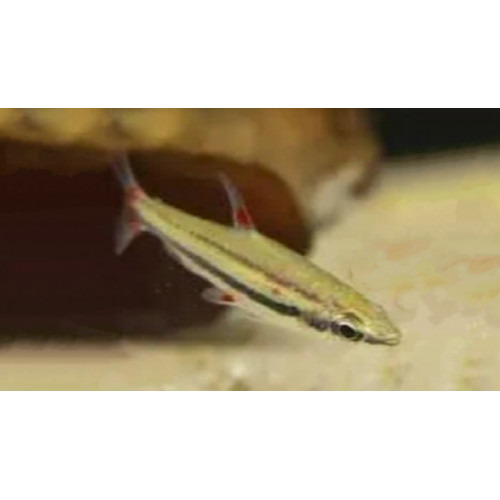
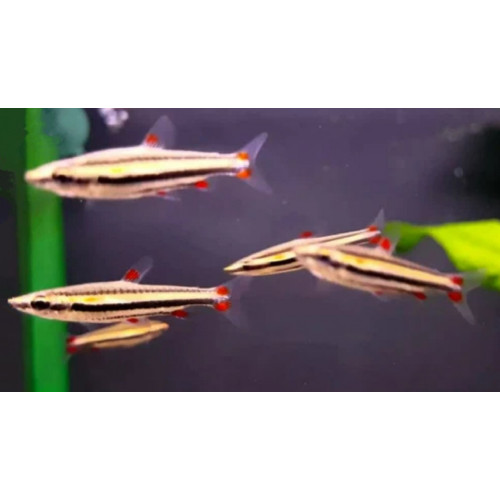
Daytime coloration: The main body color is greenish-golden on the back and sides, with a silvery belly. The main distinguishing feature is three longitudinal black stripes running from head to tail. The upper stripe runs along the back. The middle stripe runs along the middle of the body and is the widest. The lower stripe runs along the lower part of the sides.
Nighttime coloration: With the onset of darkness, the fish transforms. The three longitudinal stripes disappear, and in their place, three large dark spots appear, located vertically along the body. Studies show that this change is caused by the action of the hormone melatonin on pigment cells. Such camouflage helps the fish remain invisible to nocturnal predators.
The gill covers, dorsal, pelvic, anal, and caudal fins have bright red spots and stripes, which vary in intensity depending on the population. Because of this feature, in Chinese classification, the species is called the "three-lined red pencilfish." Additionally, the fin tips may have a bluish edge.
Distribution
This species is widely distributed in South America and prefers specific biotopes. It inhabits the basins of the Amazon and Rio Negro rivers in Peru, Bolivia, Brazil, and Guyana.
Habitat
It inhabits slow-flowing, slightly acidic waters. During the rainy season, the fish swim into flooded forests, and during the dry season, they often find themselves in isolated small lakes. In the Rio Negro, they prefer large swampy areas at the confluence of tributaries.
Size
One of the most miniature aquarium fish. Its maximum length is 3.6 cm (1.4 inches) (this is the so-called standard length, excluding the caudal fin), and on average, adults grow to 3–3.5 cm (1.2–1.4 inches). The weight of this tiny fish is also extremely small — the maximum recorded body weight is only 0.41 grams.
Lifespan under good care in a home aquarium is up to 5 years.
Behavior
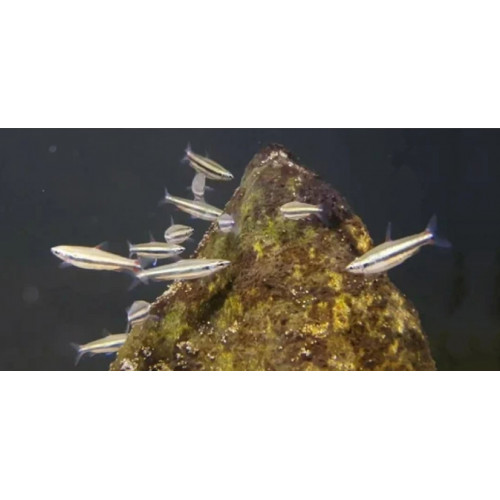
The three-lined pencilfish stays in the middle and upper water layers during the day. At night, it rises to the very surface, resting near it. It is a schooling fish, recommended to be kept in groups of 6–10 individuals.
The amazing ability to dramatically change coloration within minutes is not just an interesting fact but a vital defense mechanism. In the Amazon jungle, total darkness falls suddenly, and such camouflage helps the fish survive.
Food and feeding habits
In the wild, it is an omnivorous species but with a noticeable preference for animal food. It feeds on small invertebrates — worms, crustaceans, and insects. It spends a lot of time at the water's surface, collecting fallen insects. Additionally, it feeds by actively scraping biofilm (microorganisms and algae) from plant leaves and other surfaces.
In an aquarium, it readily accepts small dry, frozen, and live foods: brine shrimp, daphnia, cyclops, and microplankton.
Reproduction
Spawning in the wild occurs during daylight hours among beds of aquatic plants. The eggs are adhesive and are laid on leaves. The female spawns 30 to 100 eggs. Fertilization is external. Depending on the water temperature, larvae hatch within 24–72 hours.
Breeding the three-lined pencilfish in captivity is a challenging but achievable task.
Fishing
It is a target of commercial fishing for the aquarium trade.
Relationship with a person
This fish species is completely safe for humans. It is not consumed by humans and is not edible in a practical sense. The International Union for Conservation of Nature (IUCN) has assigned this species a conservation status of Least Concern. Despite being caught for aquariums, the species' populations remain stable.
The three-lined pencilfish rarely breeds in home aquariums and is never bred on an industrial scale. All individuals available for sale are wild-caught. The main reasons for the difficulty are sensitivity to water quality and the tendency of breeders to eat their own eggs.
| Classification | |
| Phylum | Chordata |
| Class | Actinopterygii |
| Squad | Characiformes |
| Family | Lebiasinidae |
| Genus | Nannostomus |
| Species | N. trifasciatus |
| Features | |
| Conservation status | Least Concern |
| Habitat | Pelagic |
| Life span, years | 5 |
| Maximum body weight, kg | 0,00041 |
| Maximum length, cm | 3,6 |
| Sailing speed, m/s | No information |
| Threat to people | Not edible |
| Way of eating | Bentophage |
Three-lined pencilfish
Tags: three lined pencilfish