
Latin name
Anostomus anostomus
Other name
Striped anostomus, and striped anastomus.
Identification
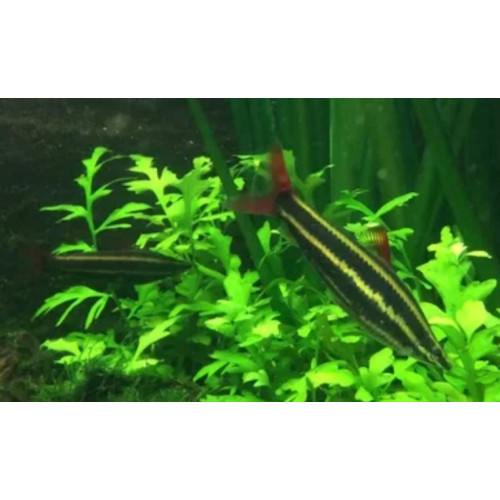
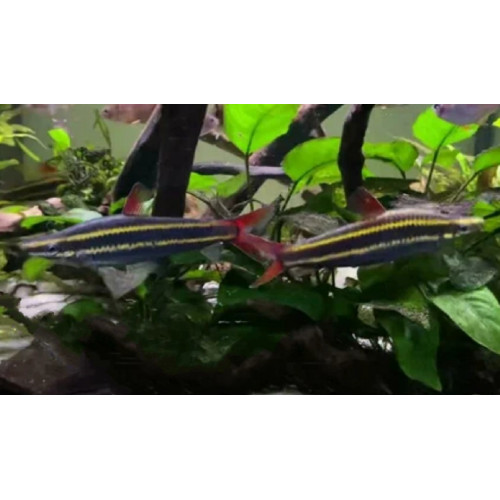
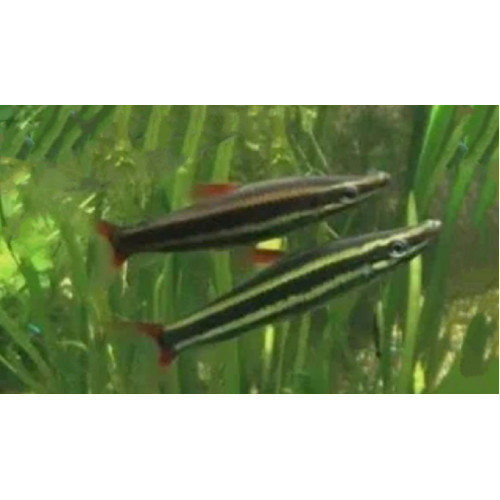
The body of the striped headstander is elongated, slightly compressed laterally, resembling a torpedo. The head is pointed, with a characteristic superior mouth — the lower jaw projects forward and curves upward, allowing the fish to scrape algae from the underside of rocks and submerged wood. The lips of anostomus are thick and wrinkled. The central stripe running along the middle of the body ends at the base of the dorsal fin in a curved arc — this is a key distinguishing feature of the species, allowing it to be differentiated from the very similar Anostomus ternetzi. Sexual dimorphism is weakly expressed. Females are generally larger and have a fuller belly, while males appear more slender.
Features of fish fins
This fish species has a full set of fins typical of most fish, but with one important feature — the presence of an adipose fin, linking it to salmonids or characins. It has unpaired fins: dorsal, anal, caudal, and adipose, as well as paired: pectoral and pelvic. The dorsal fin consists of 9 soft branched rays. The anal fin is positioned closer to the caudal fin and is short in shape. The number of rays ranges from 26 to 30. The caudal fin is located at the end of the caudal peduncle, is well developed, and helps the fish make rapid bursts of speed. The adipose fin is a small fleshy fold without rigid rays, located on the back between the dorsal and caudal fins. Its presence is an important systematic characteristic. The pectoral fins are paired, located on the sides behind the head. The pelvic fins are paired, located on the belly closer to the middle of the body.
Fish coloring
The main body color ranges from golden-yellow to honey or pale peach. Running along this background are three distinct longitudinal stripes of dark brown or black. The fins are one of the most striking features of the appearance. The dorsal and caudal fins have a pronounced blood-red color, especially in adults. At the base of the caudal fin, there are often two bright red spots. The pelvic and anal fins are usually transparent or yellowish. In the pre-spawning period, the coloration of males becomes more intense, with enhanced red tones. The scales may have a slight reddish pearlescent sheen in reflected light.
Distribution
In the wild, the striped headstander inhabits fast-flowing South American rivers with rocky bottoms and clean, oxygen-rich water. Their greatest presence is in the basins of the Amazon and Orinoco rivers (Brazil, Venezuela, Colombia, Peru, Guyana).
Habitat
A benthopelagic species. They prefer the shallows of fast-flowing rivers with rocky banks where there is plenty of algae. They are practically never found in lowland, slow-moving stretches. They live in tropical climates and prefer warm water. According to ichthyological databases, the temperature range in their natural habitat is 22°C to 28°C (72–82°F).
Size
According to scientific sources, the striped headstander is a medium-sized fish. In the wild, its maximum length is 16 cm (6.3 inches), and weight data indicates a maximum recorded mass of 39.31 grams (1.39 ounces). Interestingly, in aquarium conditions, the size of the fish may differ slightly. Specialized sources indicate that in captivity this species can grow to 15–18 cm (6–7 inches) or even exceed 12 cm (4.7 inches), which is generally comparable to wild measurements. With good care, they can live 8–12 years in an aquarium.
Behavior
In the wild, these are schooling fish that prefer to stay in groups. They received their English name "headstander" because of their unique way of swimming at a 45-degree angle (or even vertically) with their heads down. This posture allows them to effectively scrape algae from the undersides of rocks and submerged wood. The fin structure of these fish is ideally adapted to their lifestyle: a powerful, forked tail allows rapid movement, pectoral fins provide maneuverability near the bottom, and the small dorsal and anal fins help stabilize their position in the water without creating unnecessary drag.
Food and feeding habits
An omnivorous fish with a strong inclination toward plant-based food. Algae and encrustations are the main course on their menu. Aquatic plants: they may also eat the soft parts of higher aquatic plants. Despite their love for plants, they do not refuse animal food, which makes up a smaller part of their diet. This mainly consists of worms, insects, and crustaceans (e.g., small amphipods).
The feeding behavior of the striped headstander is very different from that of predatory fish. Their mouth is adapted for scraping encrustations off surfaces, so they primarily search for food on the bottom and on objects. In search of food, they may even burrow their "superior" snout into the substrate.
Reproduction
In the wild, spawning is seasonal and paired. The fish migrate to spawn and lay eggs in fast-flowing currents. In aquariums, there are virtually no cases of successful breeding in hobbyist conditions. All fish available for sale are either caught in the wild or raised on specialized fish farms using hormonal stimulation.
Fishing
Although the fish is edible, it has no commercial fishing value whatsoever and is practically never sold as a food product. The main reason is its small size (maximum length in the wild is 16 cm / 6.3 inches). This fish is valued much more in the aquarium trade.
Relationship with a person
An aquarium fish. This is its primary purpose in the eyes of humans. It is not poisonous, is not aggressive toward humans, and is valued exclusively for its decorative qualities and interesting behavior.
| Classification | |
| Phylum | Chordata |
| Class | Actinopterygii |
| Squad | Characiformes |
| Family | Anostomidae |
| Genus | Anostomus |
| Species | A. anostomus |
| Features | |
| Conservation status | Least Concern |
| Habitat | Pelagic |
| Life span, years | 12 |
| Maximum body weight, kg | 0,039 |
| Maximum length, cm | 18 |
| Sailing speed, m/s | No information |
| Threat to people | Edible |
| Way of eating | Omnivore |
Striped headstander
Tags: striped headstander