
Latin name
Cobitis taenia
Other name
Spotted weather loach
Identification
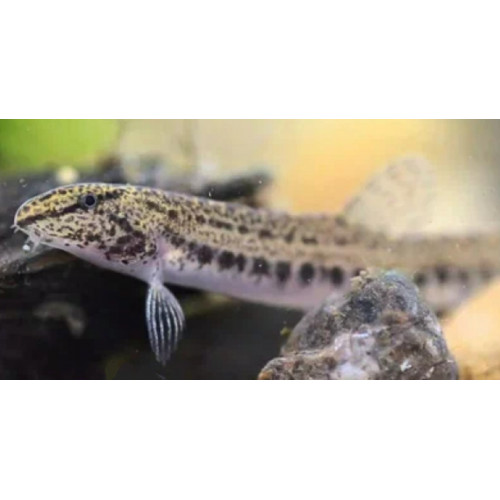
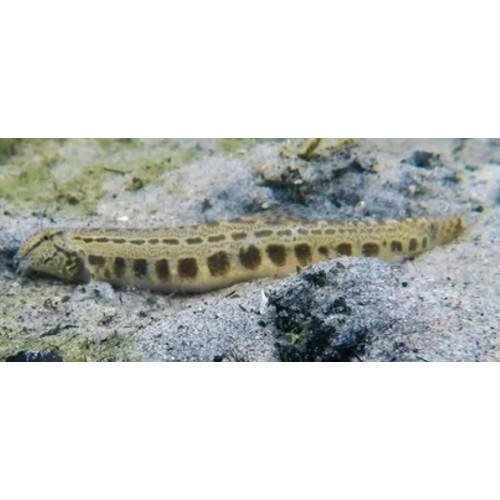
The spined loach has a long, slender body, slightly compressed laterally, which helps it move easily through sand and among plants. It has 6 small barbels around its mouth, which help it find food by touch.
Its "calling card" is a two-pronged spine under each eye, which the fish can flare out in case of danger. It is because of this spine that it received its name.
Features of fish fins
Dorsal fin: single, small. Consists of 3 spiny (rigid) rays and 6–8 soft rays. Adipose fin is absent.
Anal fin: short, located closer to the tail. Has 3 spiny and 5 soft rays.
Caudal fin: not forked, but slightly truncated or rounded. It has 15–16 rays.
Pectoral fins: paired, located on the sides of the body. Contain 1 spiny and 7–8 soft rays. In males, these fins are noticeably longer than in females, and on their inner side, there is a special bony plate — the Canestrini's organ.
Pelvic fins: paired, located on the belly. Have 1 spiny and 5–6 soft rays.
All fins are rather short.
Fish coloring
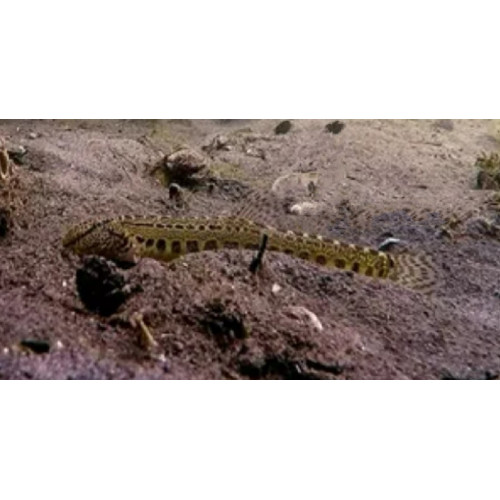
Coloration varies from yellowish-brown to gray, with small dark spots scattered across the entire body.
Distribution
Widely distributed in Europe and Asia — from the Loire River basin in France to the Ural River. However, in Great Britain, its range is limited to just five river systems in eastern England: the Trent, Welland, Witham, Nene, and Great Ouse.
Habitat
This is a demersal or benthopelagic species found in river estuaries flowing into seas, capable of tolerating only very slight increases in salinity. It prefers slow-flowing water bodies with clean, oxygen-rich water and a sandy bottom where it can comfortably bury itself.
Size
This is one of the smallest fish in the loach family. Typically, adults grow to 5–12 cm (2–4.7 inches) in length, rarely reaching 13.5 cm (5.3 inches). Females are usually larger than males.
The weight of this fish is also very small: according to some data, it is about 10 grams (0.35 oz), while according to others, it can reach up to 25 grams (0.88 oz).
Lifespan: according to some data, it can live up to 5 years, according to others — up to 10 years. This difference is likely due to different habitat conditions, as well as the fact that females live longer than males.
Behavior
The entire life of the spined loach is closely tied to a single, well-established area of the bottom, beyond which it almost never ventures.
The main reason for such sedentariness is its lifestyle and feeding method. It is a bottom-dwelling fish, and its main "home" is the sandy or muddy bottom, into which it burrows at the slightest danger. It does not chase prey in the water column but patiently filters the sand in search of small food items — insect larvae, worms, and small mollusks. Therefore, it does not leave its established spots with suitable substrate.
Interestingly, it uses its "home" not only as a shelter and dining room. The spined loach is known as a "living barometer" — when atmospheric pressure changes, it changes its behavior, rising to the surface. This is another reason why it is tied to a particular water body and its microclimate.
Thus, the sedentariness of this species is not just a habit, but a well-thought-out evolutionary strategy that allows it to survive and thrive in its small but native ecosystem.
Food and feeding habits
It is a nocturnal fish — during the day it buries itself in the sand or hides under stones, leaving only its head and tail visible. At nightfall, it emerges to hunt: it swallows sand together with small animals and organic particles, while expelling the "empty" sand through its gills.
The spined loach's menu consists of tiny bottom-dwelling and aquatic plant inhabitants. These include: small crustaceans (daphnia, cyclops, cladocerans such as chydorids), insect larvae, worms and small mollusks, and detritus.
Reproduction
Spawning occurs in spring, from April to June. The female lays 300 to 1,500 eggs, attaching them to stones, roots, or aquatic plants. This species has an interesting feature: females can be very active during spawning, and the male wraps around her body, stimulating egg release.
Fishing
It is not a commercial fish. Although it is sometimes found in large numbers in water bodies, its commercial value is practically nonexistent.
Relationship with a person
According to the International Union for Conservation of Nature (IUCN), the spined loach is classified as a species of Least Concern. Nevertheless, in some European countries, it is considered a vulnerable species due to habitat loss. Special protected areas (SACs) have been designated in the UK for its conservation.
| Classification | |
| Phylum | Chordata |
| Class | Actinopterygii |
| Squad | Cypriniformes |
| Family | Cobitidae |
| Genus | Cobitis |
| Species | C. taenia |
| Features | |
| Conservation status | Least Concern |
| Habitat | Demersal |
| Life span, years | 10 |
| Maximum body weight, kg | 0,025 |
| Maximum length, cm | 13,5 |
| Sailing speed, m/s | No information |
| Threat to people | Not edible |
| Way of eating | Bentophage |
Spined loach
Tags: spined loach