
Latin name
Hypophthalmichthys molitrix
Other name
Silverfin
Identification
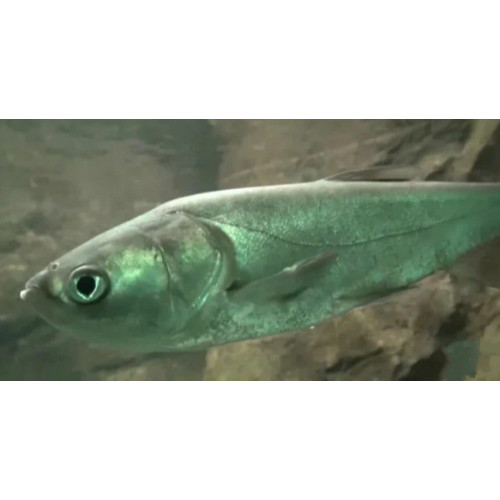
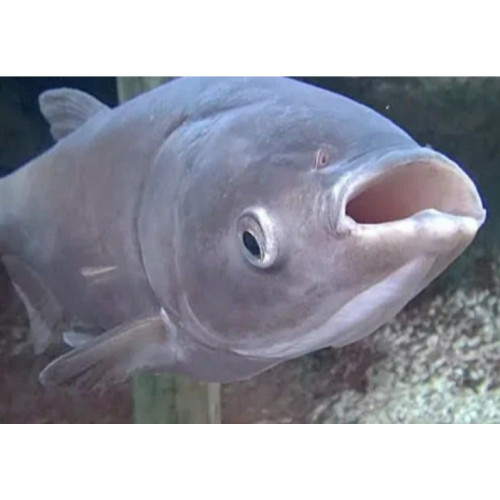
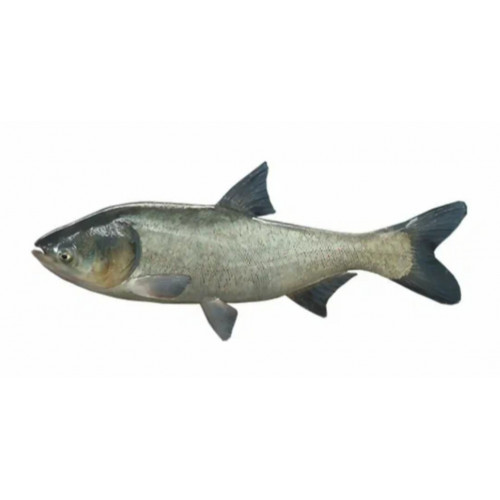
The body of the silver carp is quite deep, moderately elongated, and covered with small, easily shed scales. The head is wide, with a convex, sloping forehead. The eyes are very small and positioned far down — below the body axis, which is clearly visible in profile. A distinctive feature is a sharp, unscaled keel that runs along the belly from the throat to the anal fin. In the similar bighead carp, the keel begins only behind the pelvic fins. The mouth is superior, meaning it is directed upward.
This species has adaptations for filtering plankton from the upper water layers. They are like a living "vacuum cleaner" for water. Their main evolutionary adaptation is a specialized filtering apparatus in the gills. The gill rakers are very long, thin, and tightly packed together, forming a continuous spongy or mesh-like band that resembles a sieve or membrane. As water passes through, the fish traps the smallest particles — phytoplankton, bacteria, detritus — with this "net." Essentially, it filters out of the water anything edible that is larger than a certain size.
The species name molitrix comes from Latin, meaning "miller" or "grinder," referring to its powerful pharyngeal apparatus for grinding food.
Features of fish fins
Dorsal spines (total): 0; dorsal soft rays (total): 7–10; anal spines: 0; anal soft rays: 11–17.
The dorsal fin is short and located behind the base of the pelvic fins. The anal fin is long. The caudal fin is forked. There are no spiny rays in any of the fins.
Fish coloring
The coloration of the silver carp's back is greenish-gray or olive; the sides and belly are silvery-white, without any spots or stripes. The fins are light, with a yellowish tint on the pelvic and anal fins.
Distribution
Natural range: basins of large rivers in East Asia — the Amur, Yangtze, and Xi Jiang rivers.
Artificial introduction: Due to its ability to clear algal blooms from eutrophic waters, the silver carp has been introduced into many countries around the world, including nearly all of Europe, North and South America, as well as the territory of the former USSR (the Volga, Dnieper, Don, Kuban, and Aral Sea basins).
Habitat
This is a pelagic fish that stays in the upper layers of water in areas with slow currents — backwaters, oxbow lakes, and bays. For feeding, it prefers shallow, well-warmed areas.
Size
Maximum size: up to 120 cm (47 inches) – some reports up to 150 cm (59 inches). Maximum weight: up to 50 kg (110 lbs), averaging 16–25 kg (35–55 lbs). Maximum recorded age: up to 20 years.
Behavior
A warm-loving and very active species. It is a schooling fish. It is known for its skittishness and ability to leap high out of the water (up to several meters) in response to sudden noise, such as from a motorboat. This behavior has made them "flying carp," posing a danger to people on jet skis and boats in some US rivers.
In US rivers (especially the Illinois and Mississippi), their ability to leap at the sound of motors has created a serious problem. Hundreds of kilogram-sized fish launch out of the water when boats pass by, injuring people and damaging equipment. This phenomenon has become an internet meme and a hallmark of these rivers.
Food and feeding habits
The diet of the silver carp changes with age, but remains planktivorous. Juveniles (larvae and fry) feed exclusively on zooplankton — small crustaceans, rotifers. Adults transition to feeding on phytoplankton (microscopic algae). They become typical phytoplankton feeders. Thanks to their filtration apparatus, they can consume huge volumes of "blooming" water, which is why they are valued as water body reclaimers.
Reproduction
For reproduction, these fish require specific conditions that mimic river floods. Spawning season: spring–summer (April to July), when water temperatures exceed 18–20°C (64–68°F). Spawning occurs in the main river channel with fast currents. The eggs are pelagic — they are released into the water column, swell, become buoyant, and drift downstream, developing as they travel. The female spawns between 500,000 and 1 million eggs. Sexual maturity is reached relatively late — at 5–7 years (sometimes up to 8 years).
Fishing
One of the most important targets of global aquaculture.
Relationship with a person
Valued for its tasty, relatively low-fat meat, although with many small bones. Important: the fish's gall is poisonous!
| Classification | |
| Phylum | Chordata |
| Class | Actinopterygii |
| Squad | Cypriniformes |
| Family | Xenocyprididae |
| Genus | Hypophthalmichthys |
| Species | H. molitrix |
| Features | |
| Conservation status | Near Threatened |
| Habitat | Pelagic |
| Life span, years | 20 |
| Maximum body weight, kg | 50 |
| Maximum length, cm | 150 |
| Sailing speed, m/s | No information |
| Threat to people | Edible |
| Way of eating | Planktonophage |
Silver carp
Tags: silver carp