
Latin name
Diptychus maculatus
Identification
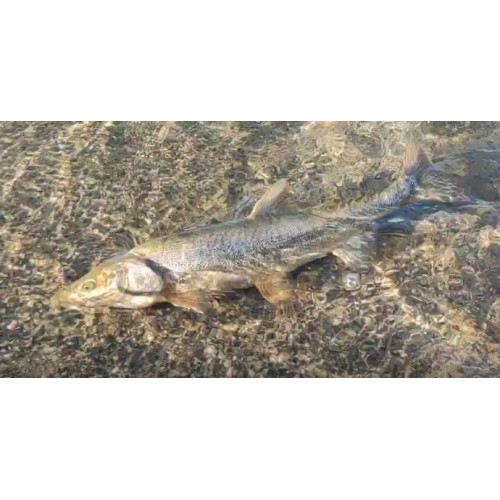
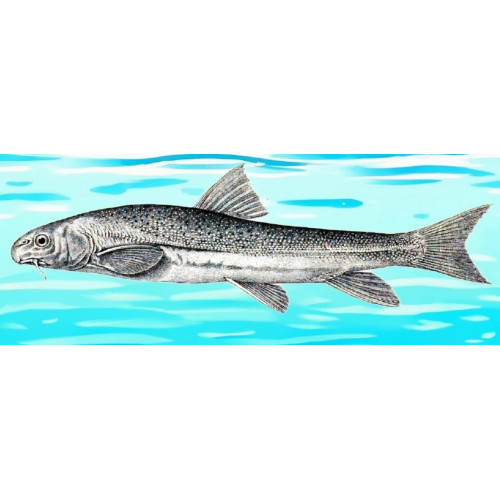
The body of the Scaly osman is fusiform (spindle-shaped), elongate, and shallow. The mouth is inferior and wide. The lower jaw is covered with a sharpened horny sheath. The lower lip is developed only at the corners of the mouth; however, in adults and large specimens, it forms a continuous, villous fold extending posteriorly from the horny sheath. A single pair of barbels is present. Pharyngeal teeth are in two rows. Above the lateral line, the body is densely covered with scales; below it, scales are very few.
In large individuals, the scales become more robust, the unbranched rays of the anal fin thicken and become keratinized, and the outer surface of the anal papilla also keratinizes. Consequently, this body region is well-protected against abrasion against rocks during spawning.
Sexual dimorphism is well pronounced in this species. Males possess hooks on the ends of the bifurcated last ray of the anal fin, which possibly serve to clasp the female's fins during fertilization. By the time of sexual maturity, the dorsal fin of males enlarges, becoming fan-shaped, and remains this way for the rest of their lives. Nuptial tubercles appear on the bodies of both males and females, but they are more numerous in males and are distributed over almost the entire body.
Features of Fish Fins
The dorsal fin contains 7–9 soft rays; the anal fin contains 5. The dorsal fin is rounded. The pelvic fins originate below the posterior third of the dorsal fin. The caudal fin is more forked with pointed lobes in small specimens; in large specimens, the lobes become rounded. However, the degree of rounding varies greatly, even among individuals of the same length. In sexually mature males, the posterior part of the dorsal fin is enlarged.
Fish Coloration
In adults, the back is dark, the flanks are olive-greenish or slate-gray, and the head is colored in the same tones but of a lighter shade. The overall ground color lightens towards the belly; at the level of the pectoral and pelvic fins, orange borders stand out sharply, framing the light-yellow belly. Well-defined dark brown spots are sparsely scattered on the head, back, and flanks. Spots are also present on all fins. In juveniles, spotting is barely visible. Throughout its extensive range, fish from different water bodies can vary greatly from one another.
Distribution
Distributed in the Himalayas and the Tibetan Plateau of China, India, Nepal, and Pakistan, extending westward to the Tien Shan mountains and Central Asia.
Habitat
A tropical freshwater benthopelagic species. It inhabits the highest mountain reaches, into which other species rarely penetrate. It is found mainly in rocky mountain streams and lakes, as well as in rivers with fast currents.
Size
Fish of this species can reach up to 70 cm (2 ft 4 in) in length. They weigh approximately 1 kg.
Behavior
They are potamodromous, migrating from one zone of a water body to another.
Food and Feeding Habits
They feed on vegetation and various invertebrates; fattening occurs mainly in summer, as the water bodies they inhabit usually freeze over in winter. The intestinal tract is long, 1.5–2 times the length of the body. Juveniles feed on plankton and small invertebrates.
Reproduction
Spawning in the Scaly osman is group spawning and occurs in fast currents. In the Tien Shan osman, a group consists of one female and 3–7 males, while in Severtsov's osman, it consists of one female and 10–12 males. Fecundity in the Tien Shan osman is low—1340–7180 eggs—and in Severtsov's osman, being a smaller fish, it is even lower—950–1500 eggs. Spawning is protracted from April to August. The eggs are released in batches. The Tien Shan osman matures at 3–4 years of age, at a length of 16–24 cm, while Severtsov's osman matures at 2–3 years of age, at a length of 10 cm.
Fishing
The Scaly osman could be a subject of sport fishing, but this is practically impossible due to the inaccessibility of its habitats.
Relationship with Humans
Harmless. The musculature of these fish is edible, but the roe and viscera are poisonous.
| Classification | |
| Phylum | Chordata |
| Class | Actinopterygii |
| Squad | Cypriniformes |
| Family | Cyprinidae |
| Genus | Diptychus |
| Species | D. maculatus |
| Features | |
| Conservation status | Least Concern |
| Habitat | Bottom |
| Life span, years | No information |
| Maximum body weight, kg | 1 |
| Maximum length, cm | 70 |
| Sailing speed, m/s | No information |
| Threat to people | Edible |
| Way of eating | Bentophage |
Scaly osman
Tags: scaly osman