
Latin name
Acheilognathus asmussii
Other name
Spiny bitterling
Identification
The Russian bitterling has a very characteristic appearance that distinguishes it from other members of the family.
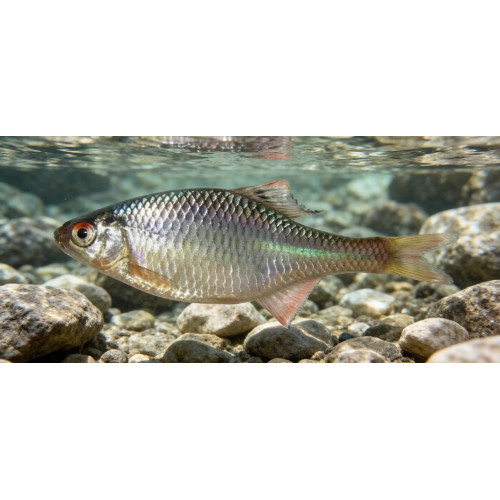
Its body is deep, compressed laterally, with a small, blunt head. The body depth fits about twice into its length in large specimens. The snout is short, its length not exceeding the diameter of the eye. The forehead is convex. At the corners of the mouth, there are small barbels, which are clearly visible in large individuals. In juveniles, they may be absent. The scales are large, with 34–39 scales along the lateral line (according to other sources — 36–39). Sexual dimorphism is present. During spawning, females develop a long ovipositor that can reach 12–16 cm (4.7–6.3 inches) in length. With it, the female lays eggs inside the mollusk.
Features of fish fins
The main distinguishing feature is spines! Unlike Rhodeus sericeus, Acheilognathus asmussii has strong spiny rays in the dorsal and anal fins (hence the name). The third ray of the dorsal fin is powerful, hard, and flexible only at the very tip.
Fish coloring
The body is golden or bright golden, like that of goldfish. The back is gray-green, the sides are bluish-green. Above the pectoral fins, behind the gill cover, there is a bright golden spot. A narrow green or neon stripe may run along the body. A thin black stripe is often present on the caudal peduncle. The dorsal and anal fins have alternating white and dark bands.
Typically, juveniles stay in a school and have a black spot on their dorsal fin; at an older age, they live alone — and the spot disappears. The black spot on the dorsal fin serves as a kind of identification mark — a visual marker that helps them easily keep track of their schoolmates in the water.
Distribution
It is found in the Amur River basin — from Blagoveshchensk to the middle reaches of the Ussuri River, in Lake Khanka, as well as in China, the Korean Peninsula, and Mongolia (the Onon and Khalkhin-Gol rivers).
Habitat
It prefers lakes and rivers with slow currents, avoiding backwaters and areas with stagnant water. It is a freshwater, benthopelagic species. From mid-April to late October, it may live in one place, but for wintering, it moves to the main channel of the Amur River.
Size
This is a small fish. It reaches a maximum total length of 16 cm (6.3 inches). On average, its length is about 5 cm (2 inches) (this is standard length, without the caudal fin). For comparison, most other bitterlings grow to only 8–10 cm (3–4 inches), so the spiny bitterling is a true "giant" among them. This species reaches sexual maturity later than its relatives — at about three years of age, when its length reaches approximately 7 cm (2.8 inches). As for weight and lifespan, this data is unavailable. However, given that this is a medium-sized fish, it can be assumed that its life lasts several years. It is known that by the end of October, bitterlings migrate to the main channel of the Amur for wintering, which indicates their annual life cycle but does not reveal the overall lifespan.
Behavior
It leads a diurnal, schooling lifestyle.
Juvenile bitterlings spend the first three weeks of life inside the mollusk shell, where they are completely protected from predators. This is one of the most amazing examples of symbiosis in the animal world.
Food and feeding habits
The basis of its diet consists of plant food, but as a supplement, it readily eats animal food.
Main food: plant-based (algae, soft parts of aquatic plants).
Supplementary food: live food — insect larvae, small crustaceans.
Reproduction
This is the most amazing feature of the Russian bitterling, as with all members of the bitterling family.
The female lays her eggs inside the mantle cavity of bivalve mollusks (e.g., Cristaria plicata) through a specialized long ovipositor. The male releases milt into the water, which is drawn into the mollusk with the water current and fertilizes the eggs. The hatched larvae do not leave the mollusk's shell for about three more weeks, where they remain in complete safety. Then they swim out and begin their independent life. Spawning occurs in May–July. Fecundity ranges from 363 to 1,157 eggs, which is higher than in Rhodeus sericeus.
Fishing
The species has commercial value. However, no large-scale industrial fishing is conducted — rather, it concerns local recreational fishing.
Relationship with a person
This fish is completely safe for humans. Formally, it is edible, but there are several good reasons not to eat it: its small size, bitter taste, and very modest culinary value. The International Union for Conservation of Nature (IUCN) has assigned the species a conservation status of Least Concern. The species is widely distributed within its range, and its populations are not threatened. Bitterlings are kept in public aquariums. They are less common in private aquariums but are of interest due to their unusual method of reproduction.
| Classification | |
| Phylum | Chordata |
| Class | Actinopterygii |
| Squad | Cypriniformes |
| Family | Acheilognathidae |
| Genus | Acheilognathus |
| Species | A. asmussii |
| Features | |
| Conservation status | Least Concern |
| Habitat | Benthopelagic |
| Life span, years | No information |
| Maximum body weight, kg | No information |
| Maximum length, cm | 16 |
| Sailing speed, m/s | No information |
| Threat to people | Not edible |
| Way of eating | Herbivorous |
Russian bitterling
Tags: russian bitterling