
Latin name
Chanodichthys erythropterus
Other name
Redfin culter or skygazer.
Identification
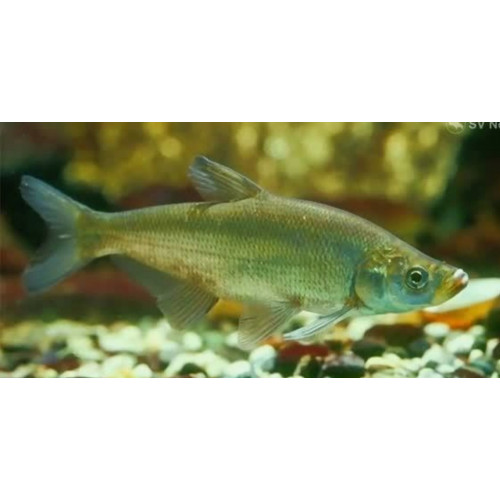
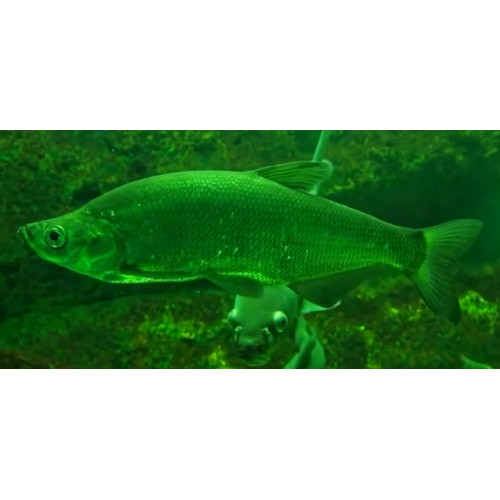
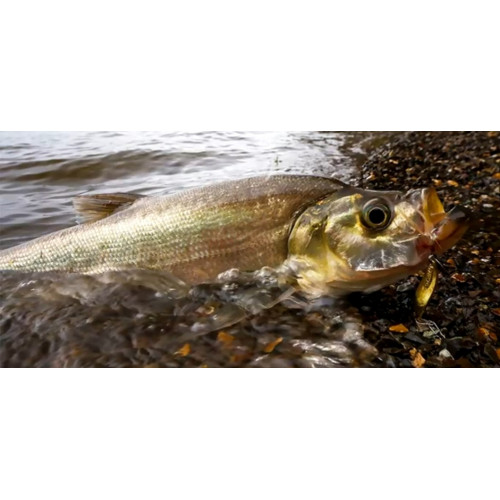
The predatory carp has a body structure typical of an active pelagic predator — streamlined, elongated, adapted for fast bursts of speed and prolonged pursuit. It is elongated, cylindrical or slightly compressed laterally, with an almost straight dorsal line and a slightly convex belly. The back is noticeably darker than the sides, which is typical camouflage for a fish hunting in the water column. The mouth is superior — the lower jaw projects forward and curves upward, with the mouth opening directed obliquely upward. Such a structure is ideally adapted for capturing prey swimming above or at the same level as the predator. The jaws are powerful, with small, sharp teeth arranged in several rows. The scales are small, cycloid, and easily detached. There are 64–67 scales along the lateral line.
Features of fish fins
Dorsal fin: short, located in the rear part of the back, with 3 rigid and 7 soft rays.
Anal fin: long, extending from the anal opening almost to the caudal fin, with 3 rigid and 25–28 soft rays.
Caudal fin: deeply forked, with elongated lobes — a classic feature of a fast swimmer.
Pectoral and pelvic fins: of moderate length, positioned low on the body.
Fish coloring
The coloration of the back is dark gray or bluish-gray; the sides and belly are silvery-white. A characteristic feature is the reddish or orange fins: the dorsal, caudal, and especially the anal fin have a bright red or orange coloration. In adults, the pectoral and pelvic fins may also have a pinkish tint.
Distribution
The predatory carp is widely distributed in the fresh waters of East Asia. It is found in the basins of large rivers — the Amur, Yangtze, and Red River — as well as in lakes Khanka and Buir-Nur. It inhabits the territories of Russia (in the lower reaches of the Amur), China, North and South Korea, Mongolia, Taiwan, and northern Vietnam.
Habitat
It lives in subtropical and temperate climate zones, tolerating significant seasonal fluctuations in water temperature. It prefers large lowland rivers and lakes with slow currents or standing water. It stays in the upper and middle layers of the water (pelagic zone), at depths ranging from 3 to 20 meters (10–65 feet). Juveniles are often found in beds of aquatic vegetation, where they find shelter and food.
Size
This is a fairly large fish. The maximum recorded length is 102 cm (40 inches), with a typical average length of about 47 cm (18.5 inches). Weight can reach 9 kg (20 lbs), although hobbyist sources mention larger specimens weighing up to 14 kg (31 lbs), but these are not officially confirmed.
Regarding lifespan, exact data on maximum age is unavailable. However, it is known that it grows rather slowly: it reaches a length of 80 cm (31.5 inches) at approximately 8–10 years of age.
Behavior
It leads an active, schooling lifestyle. It forms large schools, especially during feeding periods and migrations. This allows it to effectively hunt schooling prey (e.g., small cyprinids) and defend itself against larger predators. It is active during daylight hours, especially in the morning and evening when its prey is most active. At night, it rests in bottom layers or among vegetation. It undertakes spawning migrations in spring and summer, moving upriver or to shallow bays rich in aquatic vegetation. When hunting insects, it can jump out of the water to a height of 1–1.5 meters (3–5 feet), reminiscent of the behavior of tropical archerfish or Asian jumping carp.
Food and feeding habits
It is an active ambush predator. It patrols the upper water layers for long periods in search of prey, and upon spotting a victim, makes a lightning-fast lunge. Thanks to its superior mouth, it can capture prey swimming above it without changing its horizontal position. Its powerful jaws and sharp teeth allow it to effectively grasp and hold slippery prey.
The predatory carp fully lives up to its name — it is an obligate predator (predator by definition), and its diet changes with age.
Juveniles (up to 1 year): feed on zooplankton (small crustaceans, daphnia, cyclops), insect larvae (chironomids, dragonflies), and small aquatic invertebrates.
Adults: switch to feeding on small and medium-sized fish — this forms the basis of their diet. Their main prey include juvenile cyprinids (roach, crucian carp, bream), topmouth gudgeon, gudgeon, and other species that inhabit the water column. Large individuals are capable of hunting fish up to 15–20 cm (6–8 inches) in length.
Supplementary diet: they may also eat aquatic insects (beetles, water striders), crustaceans (freshwater shrimp), and, during mass mayfly hatches, feed on them from the water surface.
They hunt by pursuit, developing high speed over short distances. Thanks to their streamlined body shape and powerful caudal fin, they are capable of sharp bursts of speed and quick turns. In murky water, they navigate primarily using their lateral line (a sensory organ that detects water vibrations).
Reproduction
Reproduction is confined to the warm season and is associated with specific environmental conditions. It occurs at the age of 5–6 years, at a body length of about 40 cm (16 inches). Spawning takes place in May–July, when the water temperature rises to 18–25°C (64–77°F). Spawning is fractional (eggs are laid in 2–3 batches at intervals of 10–14 days), which increases offspring survival. For spawning, it selects shallow areas rich in aquatic vegetation (bays, floodplain lakes, overgrown channels). The eggs are adhesive and attach to aquatic plants (water lilies, pondweed, elodea) or submerged driftwood. The female lays between 50,000 and 200,000 eggs, depending on her size and age. The eggs are small (0.7–1.3 mm in diameter) and translucent. The incubation period is 3–7 days (depending on temperature). The larvae hatch at a length of about 5 mm (0.2 inches) and initially feed on their yolk sac, then switch to zooplankton. Growth is rapid — they reach a length of 10–15 cm (4–6 inches) in the first year, and 30–40 cm (12–16 inches) by 3–4 years of age. Their growth rate depends on the food supply and climatic conditions.
Fishing
A valuable commercial fish and a popular object of recreational fishing in East Asia. The species has commercial significance (both industrial and aquacultural). In China, Korea, and Vietnam, it is raised in pond farms alongside carp and silver carp. Fishing is carried out using nets, seines, and fyke nets. It is a popular target for sport fishing with spinning rods and float rods. It is caught using live bait (small fish), worms, maggots, as well as artificial lures (vobblers, spoons, twisters). Thanks to its strength and swift bursts, the predatory carp is prized as a trophy species.
Relationship with a person
The meat of the predatory carp is white, tender, moderately fatty, with a moderate number of small bones. It is suitable for all types of culinary preparation.
The International Union for Conservation of Nature (IUCN) has assigned the species Chanodichthys erythropterus a conservation status of "Least Concern."
| Classification | |
| Phylum | Chordata |
| Class | Actinopterygii |
| Squad | Cypriniformes |
| Family | Xenocyprididae |
| Genus | Chanodichthys |
| Species | C. erythropterus |
| Features | |
| Conservation status | Least Concern |
| Habitat | Pelagic |
| Life span, years | 10 |
| Maximum body weight, kg | 14 |
| Maximum length, cm | 102 |
| Sailing speed, m/s | No information |
| Threat to people | Edible |
| Way of eating | Predator |
Predatory carp
Tags: predatory carp