
Latin name
Cynolebias porosus
Other Names
The Porous seasonal killifish is also known as the peixe de nuvem (cloud fish) in Brazil, a name that reflects its remarkable life cycle. Its scientific name, Cynolebias porosus, was given by Steindachner in 1876. The genus name Cynolebias comes from the Greek words "kyon" (dog) and "odous" (teeth), and the Greek "lebias" meaning a kind of small fish. The species is endemic to the São Francisco river floodplain in Brazil.
Identification
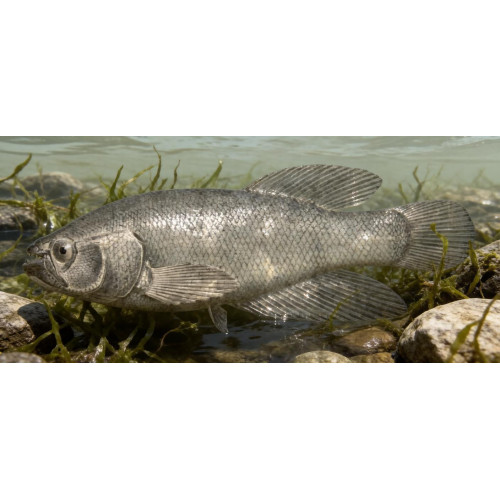
The Porous seasonal killifish has a fusiform (spindle-shaped) body that is laterally compressed. The snout is gently pointed with a non-elongated lower jaw. A key identifying feature is the ventrally displaced upper jaw, which distinguishes this species from all others in the genus Cynolebias. The base of the anal fin is scaled, and both the caudal and pectoral fins are rounded. The species exhibits sexual dimorphism, with males being more colourful than females.
Features of Fish Fins
The Porous seasonal killifish has no spines in its fins. The dorsal fin contains 14–18 soft rays, and the anal fin contains 18–22 soft rays. The pectoral fins have 14–15 rays, and the pelvic fins have 6 rays. The caudal fin is rounded and the pectoral fins are also rounded. The body is covered with cycloid scales, and the lateral series contains 40 scales.
Fish Colouring
The Porous seasonal killifish is a colourful species, especially the males. Specific colouration details are not extensively documented in the available sources, but like other members of the genus Cynolebias, males display striking colouration during the breeding season. Females are generally less colourful.
Distribution
The Porous seasonal killifish is endemic to South America and is found exclusively in the São Francisco river floodplain in Brazil. It has been recorded between the city of Petrolina and the village of Ibaré. It is a non-migratory species with a very restricted range.
Habitat
This species is a freshwater, benthopelagic fish that inhabits the river floodplain. It is found in temporary pools that form during the rainy season and dry up completely for part of the year. The species is adapted to seasonal environments with a tropical climate, with water temperatures ranging from 22°C to 30°C.
Size
The Porous seasonal killifish can reach a maximum total length of 15 cm (about 6 inches). This is one of the larger species within its genus and is considered one of the "giant" killifish.
Behavior
The Porous seasonal killifish is a bottom spawner that lays its eggs in the substrate of temporary pools. The eggs have an incubation period of 5–7 months, during which they remain buried in the dry sediment, resistant to desiccation. When the rains return and the pools refill, the eggs hatch, and the fish "reappear". This species is non-migratory. Males can be aggressive towards females that are not ready to spawn, and larger individuals may eat smaller ones from the same brood.
Food and Feeding Habits
There is no specific information on the diet of Cynolebias porosus. Based on the biology of other seasonal killifish species, it likely feeds on small invertebrates, insect larvae, and zooplankton. In an aquarium, they require a lot of food to maintain good condition. Based on the biology of other seasonal killifish, it likely feeds on small invertebrates, insect larvae, and zooplankton. In the aquarium, they require a lot of food to maintain good condition.
Reproduction
The Porous seasonal killifish has a unique reproductive strategy adapted to seasonal environments. It is a bottom spawner, laying its eggs in the substrate of temporary pools. The eggs are resistant to desiccation and can survive for 5–7 months in the dry sediment. When the pools refill with water after the dry season, the eggs hatch, and the life cycle begins again. Adults do not survive the dry period. The species is sexually reproductive and exhibits sexual dimorphism.
Fishing
The Porous seasonal killifish is not a commercial fishery species. It is considered very difficult to maintain in an aquarium, which limits its availability to specialist hobbyists.
Relationship with a Person
The Porous seasonal killifish is not considered a threat to humans and is classified as harmless. It is of scientific interest due to its remarkable adaptation to seasonal environments and its unique life cycle. The species is listed as Least Concern (LC) on the IUCN Red List, assessed on 18 May 2022. However, it faces threats from habitat loss, with its natural populations declining due to anthropogenic stressors. Some sources consider it critically endangered due to the sharp reduction of its habitats.
Interesting facts
The porous seasonal killifish (Cynolebias porosus) inhabits tropical countries, living in ditches, puddles, and even in tree hollows where rainwater collects. During the hot season, the puddles dry up — and their inhabitants die. But before dying, they manage to care for their offspring. The eggs they lay are not afraid of drought and can remain in dry mud for several months. Moreover, if a puddle does not dry out for some reason, the eggs will still not begin to develop immediately but will wait for the rainy season; otherwise, the larvae and fry would dry out before they could grow into adult fish and leave offspring.
| Classification | |
| Phylum | Chordata |
| Class | Actinopterygii |
| Squad | Cyprinodontiformes |
| Family | Rivulidae |
| Genus | Cynolebias |
| Species | Cynolebias porosus |
| Features | |
| Conservation status | Least Concern |
| Habitat | Benthopelagic |
| Life span, years | No information |
| Maximum body weight, kg | No information |
| Maximum length, cm | 15 |
| Sailing speed, m/s | No information |
| Threat to people | Not edible |
| Way of eating | Predator |