
Latin name
Pygocentrus piraya
Other Names
The piraya is known by several alternative names, including San Francisco piranha, Rio São Francisco piranha, black-tailed piranha, and king emperor piranha. It is sometimes sold under the sensational name "man-eating piranha". Its scientific name, Pygocentrus piraya, was given by Cuvier in 1819. The genus name Pygocentrus comes from the Greek words "pyge" (rump) and "kentron" (sting), referring to the serrated keel on the belly. Synonyms for this species include Serrasalmus piraya and Serrasalmo piranha.
Identification
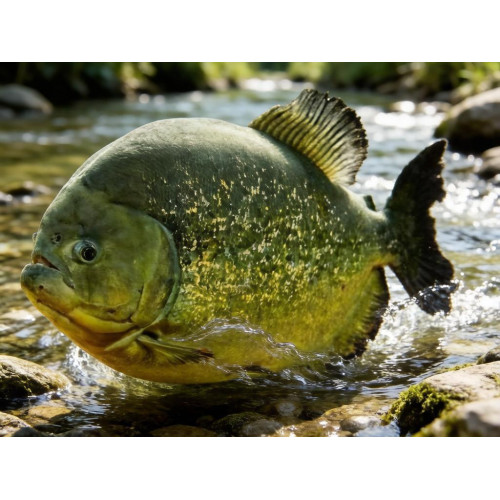
The piraya has a laterally compressed, roughly circular profile typical of piranhas. A distinctive feature is its thick, strong, and protruding lower jaw. Like other members of the genus Pygocentrus, it possesses a single row of sharp, triangular teeth with a strong lower jaw, which allow it to slice and mince prey with ease. The body is robust, and the species is considered one of the largest and most beautiful of all piranhas. In the wild, specimens are known to reach lengths of up to 50 cm. The species is allopatric, meaning it is isolated geographically from other Pygocentrus species.
Features of Fish Fins
The piraya has no spines in its fins, with the fin formula consisting of soft rays only. The dorsal fin is located mid-body, and the species is characterised by a rayed, fibrous adipose fin — a small fin without spines located behind the dorsal fin. The pectoral and pelvic fins are well-developed. The caudal fin is moderately forked. As with all piranhas, the fin structure is adapted for agile swimming and manoeuvrability in the water column.
Fish Colouring
The colouration of the piraya is striking and distinctive. The back and upper sides are typically greyish or silver, while the belly and lower body are orange to yellow — a feature it shares with some southern populations of Pygocentrus nattereri, but not the more famous red-bellied piranha. The eyes are silver. The tail fin is blackish, giving rise to one of its common names, the black-tailed piranha. The body is covered with small, silvery scales.
Distribution
The piraya is endemic to the São Francisco River basin in Brazil. It is found nowhere else in the world in its natural habitat. This species is allopatric with the other two species of the genus Pygocentrus: P. nattereri (which has a much wider distribution across South America) and P. cariba (which is found in the Orinoco River basin). The species has not been reported as introduced elsewhere.
Habitat
This species is a freshwater, pelagic fish that inhabits the tropical waters of the São Francisco River basin. It is found in both the main river channels and its tributaries. The species prefers warm, slow-moving waters and is typically associated with the pelagic zone, where it swims in open water.
Size
The piraya is one of the largest piranha species. In the wild, it can reach a maximum total length of 50 cm (about 20 inches). In standard length (which excludes the caudal fin), specimens have been recorded up to 38 cm SL. The maximum published weight is 3.2 kg (about 7 lb). The species reaches sexual maturity at a length that is not precisely defined in available sources, but like other piranhas, it likely matures at a smaller size.
Behavior
The piraya is a territorial and highly aggressive species, especially when kept in confined spaces. It is generally a poor swimmer and tends to remain inactive, hovering in a particular territory-like location, until provoked or when food is introduced. A study comparing behavior in different aquarium conditions found that in a small tank, the fish remained mostly inactive except during aggressive interactions, retreating, or feeding. The species is known to form a weakly linear dominance hierarchy in groups. Dominant individuals perform more aggressive bouts and fewer retreats than subordinate individuals. When a piraya was moved to a larger aquarium, it exhibited a striking increase in swimming behavior, suggesting that lack of space can cause stress. The species is thought to be primarily diurnal, with activity peaking during the day. It can produce warning calls (sounds) that are species-specific and used in acoustic communication, particularly during frontal displays between individuals.
Food and Feeding Habits
The piraya is an omnivore. Its diet consists primarily of small fish and insects, but it also consumes seeds, aquatic plant material, and other vegetable matter. The species has a strong lower jaw and sharp teeth adapted for slicing and mincing prey, which allows it to feed on a variety of items. When hungry, stressed, or seeking live food, the piraya becomes very aggressive, and this characteristic, combined with its large size, makes it a potential danger to humans. The species plays a key role in its ecosystem by regulating the population of other fish. In aquarium settings, it will attack and eat any fish that is not of the same or a similar piranha species.
Reproduction
Like other members of the genus Pygocentrus, the piraya is a sexual species with external fertilization. Females release eggs into the water column, and males fertilize them externally. The eggs are likely pelagic and drift with the currents. The species does not exhibit parental care, and juveniles are independent from birth. Specific details on breeding season or spawning behavior in the wild are not widely documented, but in captivity, spawning can occur if appropriate conditions are provided. Sexual maturity is reached at a certain size, though exact parameters are not specified in available sources.
Fishing
The piraya is of minor commercial importance but is caught by local fisheries. It is considered a gamefish for recreational anglers due to its large size and aggressive nature. The species is occasionally available as an aquarium fish and may be imported from South America, though it is not generally bred in captivity and can be expensive. It is typically kept in public aquariums or by experienced hobbyists with large tanks. The import of this species is prohibited in some countries due to its dangerous reputation. The species is listed as Least Concern (LC) on the IUCN Red List.
Relationship with a Person
The piraya is classified as a traumatogenic species, meaning it is capable of causing physical injury to humans. While reports of piranha attacks on humans are largely anecdotal and often exaggerated, the combination of this species' large size, powerful jaws, and aggressive tendencies when hungry or stressed makes it a potential danger. In aquarium settings, it should be handled with extreme caution. The species is not recommended for inexperienced aquarists and should only be kept in large, species-specific tanks. Conservation actions include monitoring its population and habitat due to its restricted range in the São Francisco River basin.
| Classification | |
| Phylum | Chordata |
| Class | Chondrichthyes |
| Squad | Characiformes |
| Family | Serrasalmidae |
| Genus | Pygocentrus |
| Species | P. piraya |
| Features | |
| Conservation status | Least Concern |
| Habitat | Pelagic |
| Life span, years | No information |
| Maximum body weight, kg | 3,2 |
| Maximum length, cm | 50 |
| Sailing speed, m/s | No information |
| Threat to people | Edible |
| Way of eating | Omnivore |
Piraya
Tags: piraya