
Latin name
Gnathonemus petersii
Other Names
The Peters's elephantnose fish is also known as the elephantnose fish, Peter's elephantnose, and Ubangi mormyrid. Its scientific name, Gnathonemus petersii, was given by Günther in 1862. The genus name Gnathonemus comes from the Greek words "gnathos" (jaw) and "nema" (filament). The species is named after the German naturalist Wilhelm Peters. Synonyms include Mormyrus petersii and Gnathonemus brevicaudatus.
Identification
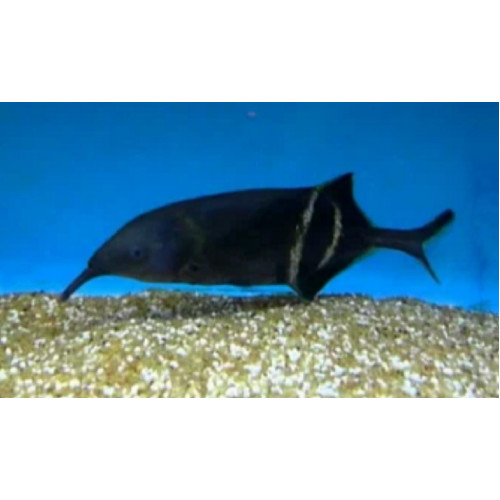
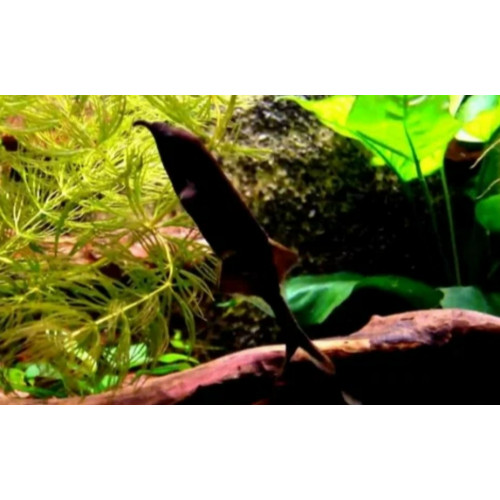
The elephantnose fish has a moderately deep, laterally compressed body with a distinctive sharp, funnel-shaped snout. Its most remarkable feature is the long, fleshy, trunk-like barbel extending from the lower jaw, which is used to probe the substrate for food and to explore its environment. The mouth is terminal and small. The body colour is black to dark brown, often with a yellow sheen in life. Two distinctive white bars are present on the body below the dorsal fin, which serve as a key identification mark. The eyes are relatively small, reflecting the species' reliance on other senses.
Features of Fish Fins
The elephantnose fish has no spines in its fins. The dorsal fin has 25–31 soft rays, and the anal fin has 32–36 soft rays. The dorsal fin originates behind the anal fin origin and ends before the anal fin ends; both fins have concave margins. The pectoral fin is obtusely pointed, originating near the lower half of the gill opening. The caudal fin is pointed with scaled lobes. The species has no pelvic fins. The electric organ is located in the caudal peduncle.
Fish Colouring
The colouration is dark brown to black, sometimes with a yellow sheen in living specimens. The scales on the body have a mottled appearance. The most distinctive feature is the presence of two white bars on the body below the dorsal fin, which are visible on both sides of the fish. The dorsal and anal fins are black, with the outer rays being darker and inner rays yellowish or colourless. The caudal fin has dark outer rays and yellowish inner rays.
Distribution
This species is widely distributed across western and central Africa. Its range includes the Niger to Congo River basins, and it has been recorded in Mali, Benin, Niger, Nigeria, Chad, Central African Republic, Cameroon, Republic of Congo, Democratic Republic of Congo, and Zambia. It has also been reported from Lake Tanganyika. Reports from Angola and Lake Kivu are considered erroneous.
Habitat
The elephantnose fish is a freshwater, demersal species that inhabits the dark, muddy beds of slow-flowing rivers, heavily vegetated areas, and swampy regions. It is a bottom-dwelling fish that uses its long snout to probe the substrate for food. The species prefers a pH range of 6.0–8.0 and a temperature of 22–28°C. It is typically found in areas with soft, sandy or muddy bottoms. It is a tropical species.
Size
The elephantnose fish can reach a maximum standard length of 35 cm (about 13.8 inches). Most aquarium specimens are smaller, typically around 10–14 cm, as they are usually sold as juveniles.
Behavior
The elephantnose fish is a nocturnal and territorial species. It is known to be aggressive towards members of its own species, especially in confined spaces. It uses its electric organ discharge (EOD) for communication, navigation, and territorial defence. The species emits a weak electric field (about 80 pulses per second) to sense its surroundings and detect prey, a process known as electrolocation. It is also a hearing specialist, with auditory abilities in the range of 100–2500 Hz. During aggressive interactions, the fish increases its electric discharge rate significantly. In groups, elephantnose fish maintain stable spatial configurations, especially during the day, and are more active at night.
Food and Feeding Habits
The elephantnose fish is a nocturnal carnivore that feeds primarily on worms, insect larvae, and other small bottom-dwelling invertebrates. It uses its trunk-like barbel to probe the substrate for food. In the aquarium, it accepts live and frozen foods such as bloodworms, tubifex, and brine shrimp, but it typically does not accept dry foods. Its electro-sensory system likely aids in locating prey. The species has high oxygen consumption: about 60% of the oxygen taken in goes to its brain.
Reproduction
Reproduction of the elephantnose fish has not been documented in captivity. Sexually dimorphic characteristics related to electric organ discharge have been observed in the laboratory during the breeding season, but such differences change with time in captivity. Sex differences are not externally visible. In the wild, the species likely uses its electric signals to recognise mates, as different populations may have different "electrical dialects" used in courtship. The species has a minimum population doubling time of 1.4–4.4 years.
Fishing
The elephantnose fish is of minor commercial importance and is used in subsistence fisheries in its native Africa. It is occasionally caught as a food fish. However, its primary value to humans is in the aquarium trade, where it is a popular and commercial species. It is exported from West Africa for the aquarium hobby.
Relationship with a Person
The elephantnose fish is not considered a threat to humans and is classified as harmless. It is a fascinating species due to its unique adaptations, including its electric sense and large brain-to-body ratio. In the aquarium trade, it requires specialised care, including a large tank (minimum 150 cm), soft substrate, dim lighting, and stable water conditions. It is sensitive to deteriorating water quality and some medications. The species is listed as Least Concern (LC) on the IUCN Red List.
Interesting facts
Peters's elephant-nose fish 'sees' the world around it using electricity generated in its tail.
Here is how this unique mechanism works:
The fish uses active electrolocation. It creates electrical signals itself to explore the space around it.
A special electric organ, located at the base of the caudal fin (in the caudal peduncle), generates weak electrical discharges.
Almost the entire skin of the fish is covered with electroreceptors that detect the electrical field it creates.
When the fish emits a discharge, a three-dimensional electrical field forms around it. Any object that enters this field distorts it in its own way, depending on its properties.
Conducting objects (e.g., prey) amplify the signal.
Non-conducting objects (e.g., stones) weaken it.
The electroreceptors on the skin detect these distortions, and the fish's brain processes the information, creating an 'electrical image' of the environment.
This ability is perfectly adapted to the fish's habitat — the murky, dark waters of Central African rivers, where vision is practically useless.
Electrolocation allows the fish to find small insect larvae on the bottom even in complete darkness.
The fish can assess not only the distance to an object but also its size, shape, and the material it is made of.
Electrical 'vision' helps it navigate and remember the location of objects in a familiar environment.
Thus, the 'current generator' in the tail and its reception system allow Peters's elephant-nose fish to successfully survive in conditions where other fish rely on vision.
| Classification | |
| Phylum | Chordata |
| Class | Actinopterygii |
| Squad | Osteoglossiformes |
| Family | Mormyridae |
| Genus | Gnathonemus |
| Species | Gnathonemus petersii |
| Features | |
| Conservation status | Least Concern |
| Habitat | Demersal |
| Life span, years | No information |
| Maximum body weight, kg | No information |
| Maximum length, cm | 35 |
| Sailing speed, m/s | No information |
| Threat to people | Edible |
| Way of eating | Predator |