
Latin name
Macropodus opercularis
Other name
Fork tailed paradisefish, paradise-fish, paradisefish, or paradise gourami.
Identification
This species exhibits sexual dimorphism. Males are larger than females and possess elongated filaments on their dorsal, anal, and caudal fins. Females have a fuller abdomen.
Features of Fish Fins
Females have short fins. Males are distinguished by their sharper and elongated unpaired fins. The species derives its Latin name from the elongated shape of its anal fin.
Fish Coloration
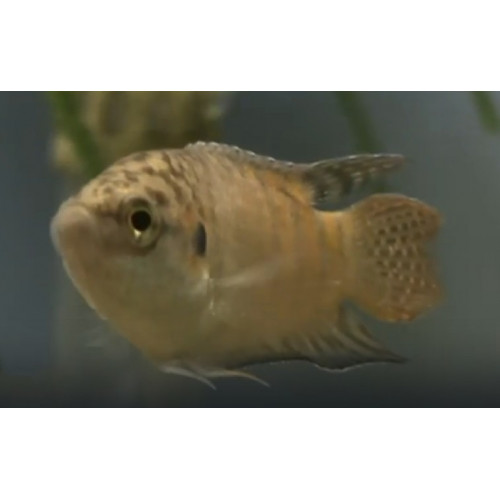
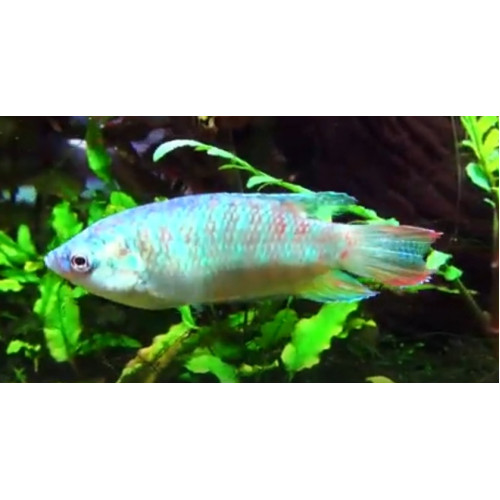
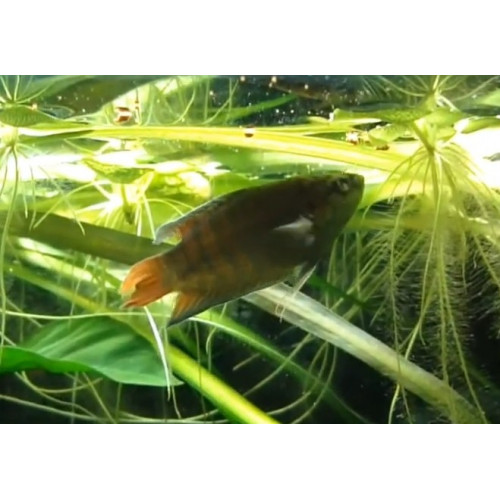
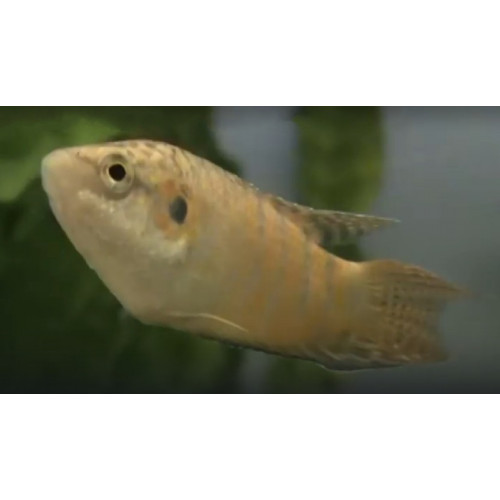
Males are golden-brown in color. Their bodies display dark transverse stripes (beginning on the back and not reaching the abdomen). The dorsal and anal fins are light blue with bright red spots at their tips. Males exhibit more vivid coloration overall. Color intensity increases with rising water temperature and when the fish is excited. Females are more pale. In addition to the wild-type form, selective breeding has produced semi-albinos with pinkish bodies covered only by red stripes and red fins, as well as so-called "black fish" with dark-colored bodies lacking stripes but possessing long, beautiful fins.
Distribution
They are distributed in the Far East—from the Yangtze River to central Vietnam and northern Laos—and have also been introduced to Korea and Japan. The sole mention of their presence in the Amur River waters is attributed to a misidentification of a Round-tailed paradise fish (Macropodus ocellatus). Their native range is China, where they primarily inhabit ditches in rice paddies. They have been selectively bred from species of the family Polyacanthidae.
Habitat
They inhabit freshwater bodies with slow currents. In aquariums, they are hardy and can tolerate short-term water temperature increases up to 35°C. They can even withstand somewhat stagnant water due to their labyrinth organ, which allows them to gulp air bubbles from the surface. However, like other fish, they are sensitive to nitrites and nitrates and therefore require water filtration and aeration.
Size
Females of this species are shorter than males: 6 cm and 8 cm, respectively. They are long-lived among labyrinth fish and, under favorable conditions, can live in aquariums for up to 8–10 years.
Behavior
The male is responsible for caring for the eggs and fry for up to 10 days, regularly maintaining the nest. He rearranges and transfers the eggs, gathering scattered offspring with his mouth and returning them to the nest. In sufficiently spacious aquariums, the female may sometimes assist the male in caring for the offspring. In such cases, the male's behavior is crucial; he can be highly aggressive even toward his mate, forcing her to hide among plants.
In aquariums, many males are quite aggressive toward each other and toward other fish, so it is advisable to keep them as a single pair and house them with larger fish.
Food and Feeding Habits
They are omnivorous but in the wild prefer animal-based food. In aquariums, they consume small invertebrates and help control overpopulation of snails and flatworms.
Reproduction
When spawning time arrives, the male paradise fish begins constructing a nest. He takes air into his mouth and releases it underwater. The bubbles, coated with a sticky secretion, form a floating foam island on the water surface, about 5–6 cm in diameter and 3 cm in height. After one or two days of completing the nest, the male seeks out the female. They then swim beneath the nest and, curving their bodies—sometimes even turning upside down—release the eggs. Any eggs that fall to the bottom are collected by the male and carried back to the nest. Throughout this process, he continuously releases bubbles, so the eggs are enveloped in what resembles an air bell. After 2–3 days, the eggs hatch into larvae. The father continues his care: he returns any straying larvae to the nest and holds sick ones in his mouth. This behavior lasts for about a week, after which the father leaves the fry to fend for themselves.
Fishing
This species is not commercially important.
Relationship with a person
Harmless. Used in aquariums.
| Classification | |
| Phylum | Chordata |
| Class | Actinopterygii |
| Squad | Anabantiformes |
| Family | Osphronemidae |
| Genus | Macropodus |
| Species | M. opercularis |
| Features | |
| Conservation status | Least Concern |
| Habitat | Pelagic |
| Life span, years | 10 |
| Maximum body weight, kg | No information |
| Maximum length, cm | 8 |
| Sailing speed, m/s | No information |
| Threat to people | Not edible |
| Way of eating | Predator |
Paradise fish
Tags: paradise fish