
Latin name
Scaphirhynchus albus
Identification
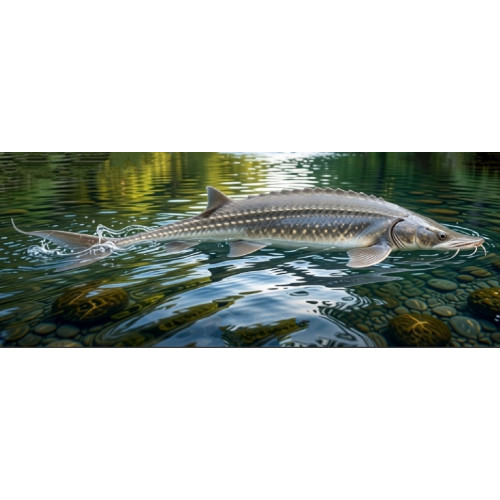
The pallid sturgeon has a distinctive, prehistoric appearance. Its body is elongated, nearly cylindrical, with a long, flattened, shovel-shaped snout. The head ends in a hard, bluntly pointed snout. The mouth is toothless, located on the underside, and is protrusible, acting like a vacuum to suck up prey. In front of the mouth are four barbels (whiskers), with the two inner barbels shorter than the outer two. This feature distinguishes it from the similar shovelnose sturgeon. The body lacks scales; instead, it is protected by rows of hard, bony plates called scutes along the back, sides, and belly. The tail base is long, flattened, and completely covered with bony plates. Its skeleton is made of cartilage, like sharks, rather than bone.
Features of fish fins
The fins have no spines. The pectoral fins are low on the body, and the pelvic fins are located on the rear part of the abdomen. The single dorsal fin is positioned far back near the tail base. The tail fin is slightly concave (not fully forked), with the upper lobe extending to form a long, thin filament.
Fish coloring
The species gets its name from its pale coloration. The back and sides are light to dark brown, gray, or olive, fading to a whitish or lighter underside. It is lighter in color overall compared to its relative, the shovelnose sturgeon.
Distribution
This species is endemic to North America. Its range is nearly restricted to the main channels of the Missouri River and the lower Mississippi River, from Montana down to Louisiana in the USA.
Habitat
The pallid sturgeon is a freshwater, demersal (bottom-dwelling) species. It is adapted to large, deep, turbid (muddy) and free-flowing river channels. It prefers areas with a strong current over firm sand or gravel substrates.
Size
This is one of the largest freshwater fish in North America. They can grow up to 6-7 feet in length and weigh around 80-85 pounds. The maximum recorded length is approximately 200 cm and maximum weight up to 130 kg. They are also exceptionally long-lived, with a maximum reported age of 41 years or more, and some sources suggest they can live up to a century.
Behavior
Pallid sturgeon are potamodromous, meaning they migrate within freshwater systems. They are solitary fish adapted to life on the river bottom, inhabiting the main channel. They are believed to have a preference for turbid (murky) waters.
Food and feeding habits
As opportunistic bottom-feeders, they use their barbels to detect food. Their diet changes with age: young fish feed primarily on aquatic insect larvae (like caddisflies, mayflies, and midges), while adults primarily eat small fish, as well as crustaceans, mollusks, and other invertebrates.
Reproduction
The pallid sturgeon has a very slow and complex reproductive cycle. It reaches sexual maturity very late, between 7 and 20 years of age. Spawning likely occurs in spring, triggered by seasonal high flows ("river pulses") over gravel and sandbars. They do not spawn every year; individuals may require several years between spawnings. Females release eggs into the water column, where they are externally fertilized. After hatching, the larvae have a free-floating (planktonic) stage.
Fishing
The pallid sturgeon is not a target for commercial fishing due to its protected status. Historically, it was caught by anglers, and its meat was considered good-tasting, with its eggs used as caviar. Today, the species is protected by law as it is listed as Endangered under the U.S. Endangered Species Act and as Critically Endangered on the IUCN Red List.
Relationship with a person
This species is not considered dangerous to humans. The primary threat to its survival has been human modification of its habitat, including the construction of dams, channelization of rivers, and habitat loss, which has blocked migration routes and altered the natural flow regimes needed for successful spawning. Conservation efforts are actively underway, including population augmentation through artificial propagation (hatcheries).
| Classification | |
| Phylum | Chordata |
| Class | Actinopterygii |
| Squad | Acipenseriformes |
| Family | Acipenseridae |
| Genus | Scaphirhynchus |
| Species | S. albus |
| Features | |
| Conservation status | Critically Endangered |
| Habitat | Bottom |
| Life span, years | 100 |
| Maximum body weight, kg | 130 |
| Maximum length, cm | 200 |
| Sailing speed, m/s | No information |
| Threat to people | Edible |
| Way of eating | Predator |
Pallid sturgeon
Tags: pallid sturgeon