
Latin name
Osteolepis macrolepidotus
Other Names
Osteolepis macrolepidotus is also known simply as Osteolepis. Its scientific name was given by Agassiz, and it belongs to the lobe-finned fish group (Crossopterygii).
Identification
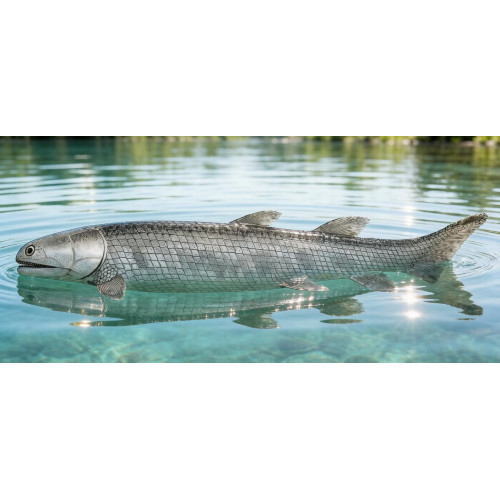
Osteolepis macrolepidotus was a lobe-finned fish (Sarcopterygii) with a broad, flattened head and a tapering body covered with large, bony, rhomboidal scales. The scales were covered with a layer of spongy bone tissue called cosmine, containing sensory canals that connected to cells deeper in the skin. These canals were part of the lateral line system, allowing the fish to sense vibrations and changes in water pressure caused by nearby animals.
Features of Fish Fins
The paired fins of Osteolepis were supported by scale-covered fleshy lobes with an internal bony skeleton. The pectoral fin had a jointed bony axis of 3–5 segments, each bearing a well-developed preaxial radial. The pelvic fin was built on a similar plan with 3–4 axial segments. Osteolepis had two rounded dorsal fins positioned towards the rear and a heterocercal tail fin (where the upper lobe is longer than the lower and contains the vertebral column).
Fish Colouring
The colouration of Osteolepis is unknown, as colour does not preserve in fossils. However, the scales and cranial plates had a thick layer of shiny cosmine, giving the surface a glossy appearance.
Distribution
Fossils of Osteolepis are found in Scotland, particularly in the Old Red Sandstone deposits of the Middle Devonian period. Notable sites include the Sandwick fish beds at Quoyloo, Orkney, and locations in Caithness.
Habitat
Osteolepis was a freshwater fish that lived in the large lake systems of the Middle Devonian period, approximately 370 million years ago. The fish inhabited the ancient Orcadian Lake that covered parts of present-day Scotland.
Size
Osteolepis macrolepidotus reached a length of about 20 centimetres.
Behavior
As a rhipidistian fish, Osteolepis was capable of breathing air using lungs and may have been able to live ashore for periods, 'walking' with its fleshy fins. This ability to breathe air and move on land suggests that it was able to survive in shallow, oxygen-depleted waters and possibly venture onto land for short periods.
Food and Feeding Habits
Osteolepis was a voracious predator. It had sharp, pointed grasping teeth with vertically-grooved surfaces, a feature known as labyrinthodont teeth. The teeth were well suited for catching and holding prey, and the species likely fed on smaller fish and other aquatic animals.
Reproduction
Specific details about the reproduction of Osteolepis are not known from the fossil record.
Fishing
Osteolepis macrolepidotus is an extinct species and has been for over 350 million years. It is therefore not a subject of fishing or commercial activity. The fish is known exclusively from fossil specimens found in Scotland and is of great scientific interest.
Relationship with a Person
Osteolepis is not considered a threat to humans, as it has been extinct for hundreds of millions of years. However, it is one of the most scientifically important prehistoric animals. As a rhipidistian fish, Osteolepis belongs to the group that gave rise to the earliest terrestrial tetrapods (amphibians) and, ultimately, to all land vertebrates, including humans. The study of its anatomy and fossils provides invaluable insights into the evolution of vertebrates.
| Classification | |
| Phylum | Chordata |
| Class | Sarcopterygii |
| Squad | Osteolepiformes |
| Family | Osteolepididae |
| Genus | Osteolepis |
| Species | Osteolepis macrolepidotus |
| Features | |
| Conservation status | Extinct |
| Habitat | Pelagic |
| Life span, years | No information |
| Maximum body weight, kg | No information |
| Maximum length, cm | 20 |
| Sailing speed, m/s | No information |
| Threat to people | Not edible |
| Way of eating | Predator |