
Latin name
Nannostomus unifasciatus
Identification
The name unifasciatus comes from the Latin words uni ("one") and fasciatus ("banded"), meaning "one-banded." The genus name Nannostomus comes from the Greek nannos ("dwarf") and the Latin stoma ("mouth"), referring to the small size of these fish.
This is the very fish that gave the entire genus the name "pencilfish." The term was first used in the 1920s to describe N. unifasciatus due to its striking resemblance to a writing pencil.
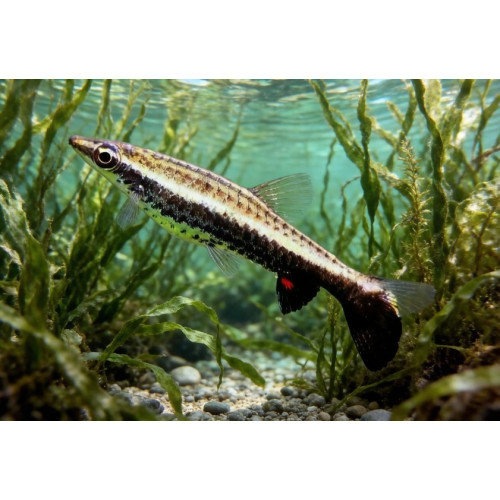
The body of the one-lined pencilfish is elongated, slender, almost cylindrical, with a small terminal mouth. The dorsal profile is straight, the belly slightly convex. The caudal peduncle is thin. This shape, combined with the black longitudinal stripe, creates the perfect illusion of a graphite lead inside a wooden casing.
This species exhibits sexual dimorphism. Males are more slender and more brightly colored, especially during the breeding season. Females are fuller in the belly area and appear more "rounded."
Features of fish fins
Dorsal fin: located approximately in the middle of the back and slightly shifted backward. This fin is small, with an oblique shape. It consists of 2 unbranched (spiny) rays and 8 branched (soft) rays.
Adipose fin: The one-lined pencilfish has an adipose fin, unlike its close relative Nannostomus marginatus, which lacks it.
Anal fin: This fin's structure is a key feature for sex determination (sexual dimorphism). In this species, it consists of 3 unbranched (spiny) and 9 branched (soft) rays. In males, this fin is elongated, enlarged, and modified. The second and third unbranched rays, as well as the first and second branched rays, are expanded and flattened. In females, the anal fin is not enlarged, and the rays have a normal (not expanded) shape.
Caudal fin: has an emarginate (forked) shape. It consists of 10 main rays in the upper lobe and 11 rays in the lower lobe. Interestingly, this fin gives the fish its resemblance to a pencil, as it is often compared to an eraser on the end.
Pectoral fins: consist of 1 unbranched (spiny) and 9–11 branched (soft) rays.
Pelvic fins: consist of 2 unbranched (spiny) and 7 branched (soft) rays.
Fish coloring
Coloration is the main distinguishing feature. As the name suggests, this fish has only one broad black longitudinal stripe that runs from the snout to the base of the caudal fin and even extends onto it. This single stripe gave the species the name unifasciatus (from Latin uni — one and fasciatus — banded).
Upper border: The black stripe is bordered above by a thin metallic golden strip that gives the fish a special sheen.
Caudal fin ("eraser"): transparent or with a reddish tint, which, combined with the black stripe, resembles an eraser on the end of a pencil.
Geographic variability (polychromatism): Due to its very wide range, different populations have their own color variations. Some forms have red or orange pigment in the lower part of the tail. In the Guyanese and Bolivian populations, there is a well-visible light spot (eyespot) on the tail above the black stripe.
The pelvic and anal fins usually have an enamel-blue edge.
Distribution
Widely distributed in South America. It is found in the Amazon River basin (in Bolivia, Brazil, and probably Colombia), in the upper Orinoco River (Venezuela), as well as in the rivers of Guyana. There is also a population on the island of Trinidad, but it is believed to have been introduced by humans.
Habitat
It inhabits slow-flowing streams, small rivers, and swampy areas with dense aquatic vegetation, submerged branches, and leaf litter on the bottom. It is often found beneath floating islands.
Size
This is a very miniature fish. The maximum recorded standard length of this species is 3.8 cm (1.5 inches). However, some sources indicate that individual specimens can reach 8.8 cm (3.5 inches), and in the aquarium trade, a size of 4 to 5 cm (1.6–2 inches) is most commonly cited. In any case, the fish is very small and weighs only fractions of a gram — precise data on its maximum weight is unavailable in accessible sources.
The lifespan of this species is quite long for such a small fish, estimated at 3–5 years. With good care and proper keeping conditions, they can live even longer.
Behavior
In the wild, they stay in schools. The one-lined pencilfish is one of two Nannostomus species (the other being N. eques) that swims in an inclined position — head up at an angle of about 45 degrees. This is their trademark.
Like all pencilfish, it changes its coloration at night — the black stripe "breaks up" into individual dark spots, which serves as protection against nocturnal predators.
Food and feeding habits
In the wild, this species is a micro-predator that feeds on small benthic invertebrates. In an aquarium, it is undemanding and readily eats a variety of foods.
The basis of its diet in the natural environment consists of three groups of animals:
Worms – small aquatic worms that the fish find in the bottom layer.
Crustaceans – tiny crustaceans such as daphnia and cyclops.
Insects – small insects that fall onto the water's surface.
In terms of feeding method, they are classified as "hunting macrofauna" — meaning they actively stalk and grab prey rather than filtering water.
The trophic level (an indicator of position in the food chain) is 3.27 ± 0.40. This value indicates a mixed diet with a clear predominance of animal food.
Reproduction
Breeding the one-lined pencilfish in captivity is an exceptionally challenging task. As of today, there is not a single reliably confirmed case of successful reproduction of this species in home aquariums.
Theoretical spawning (presumably similar to related species) is paired, with eggs laid on the underside of aquatic plant leaves or driftwood. The eggs are adhesive and require very soft, acidic water (pH below 6.0). Parents tend to eat the eggs, so they must be removed after spawning.
All individuals of Nannostomus unifasciatus available for sale are wild-caught.
Fishing
It is a target of commercial fishing for the aquarium trade.
Relationship with a person
These fish are completely safe for humans. They are not consumed by humans and are not edible in a practical sense.
The International Union for Conservation of Nature (IUCN) has assigned the species a conservation status of Least Concern. Despite being caught for aquariums, its wide range and stable populations mean the species is not under threat.
A popular but not the easiest species in the aquarium trade. It is regularly exported from Peru and Guyana.
| Classification | |
| Phylum | Chordata |
| Class | Actinopterygii |
| Squad | Characiformes |
| Family | Lebiasinidae |
| Genus | Nannostomus |
| Species | N. unifasciatus |
| Features | |
| Conservation status | Least Concern |
| Habitat | Pelagic |
| Life span, years | 5 |
| Maximum body weight, kg | No information |
| Maximum length, cm | 8,8 |
| Sailing speed, m/s | No information |
| Threat to people | Not edible |
| Way of eating | Bentophage |
One-lined pencilfish
Tags: one lined pencilfish