
Latin name
Channa argu
Other Names
The northern snakehead is known by several alternative names, including snakehead, blackfish, and in some regions, fishzilla or fish from Hell due to its invasive reputation. Its scientific name, Channa argus, was given by Cantor in 1842. The species belongs to the family Channidae.
Identification
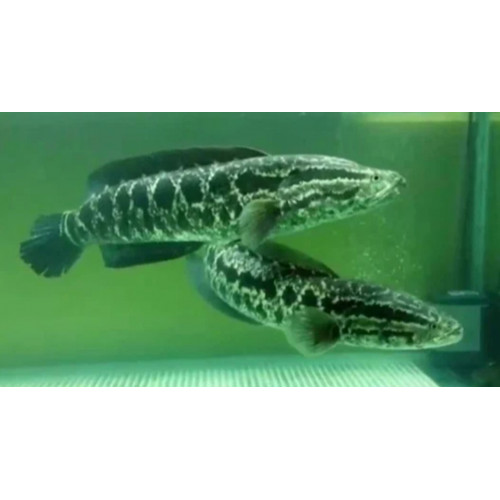
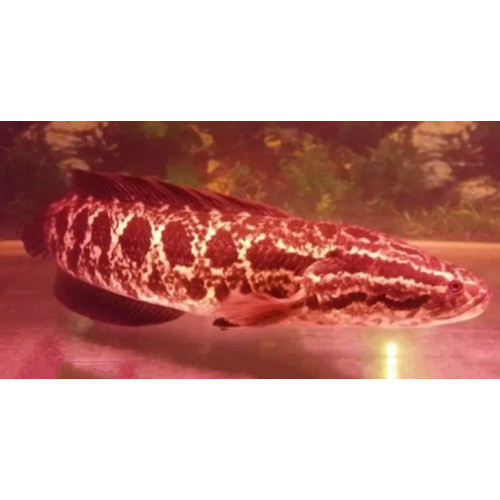
The northern snakehead has an elongated, cylindrical body with a flattened, snake-like head, which gives the species its common name. The mouth is large and extends well behind the eye, equipped with sharp, dagger-like teeth and canine teeth on the lower jaw. A distinctive feature is the presence of tubular anterior nostrils. The body is covered with scales, and the species can be distinguished from similar native fish like the bowfin by its longer anal fin and the absence of a bony gular plate.
Features of Fish Fins
The northern snakehead has a single, long dorsal fin that runs from about the rear of the gill area to almost the tailfin, covering roughly two-thirds of the body length. It also has a similarly long anal fin. All fins are supported by soft rays only, with the dorsal fin containing 49 or 50 rays. This fin structure makes the snakehead a fast and powerful swimmer.
Fish Colouring
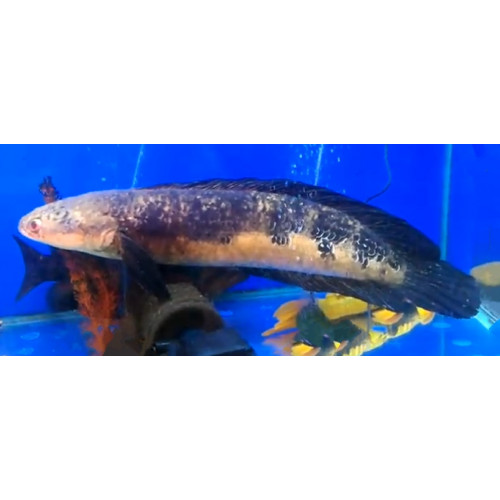
The colouration of the northern snakehead is variable but generally consists of a golden tan to pale brown body with distinctive dark, irregular blotches or mottling along the flanks. The scales on the sides of the body have a mottled appearance. Coloration can vary depending on habitat and water conditions.
Distribution
The northern snakehead is native to temperate East Asia, including the lower Amur River basin in Russia, China (particularly the Yangtze River basin), North Korea, and South Korea. It has been introduced to other parts of the world, including Central Asia and the United States. In the U.S., established populations are found in the Potomac River watershed and its tributaries in Virginia and Maryland, as well as in Delaware, Pennsylvania, New York, New Jersey, and Arkansas.
Habitat
This species inhabits freshwater environments and is typically found in stagnant shallow ponds, swamps, and slow-moving streams and rivers with mud substrate and abundant aquatic vegetation. It prefers water temperatures ranging from 32°F to 85°F (0°C to 29°C) and can survive under ice during winter. Studies in the Potomac River have shown that snakeheads select specific habitats seasonally: shallow water with soft substrate and milfoil beds after spawning, deeper water in winter, and shallow water with cover during pre-spawning and spawning seasons.
Size
The northern snakehead can reach a maximum total length of up to 85–100 cm (about 33–39 inches) and a maximum weight of approximately 8 kg (19 lb). Typical weights in introduced populations range from 2 to 10 kg, with a record of 13.6 kg.
Behavior
The northern snakehead is a highly aggressive and predatory species. It is an obligate air-breather, possessing a suprabranchial organ that allows it to extract oxygen directly from the air. This adaptation enables it to survive in low-oxygen waters and even out of water for up to four days, as long as it remains moist. Juveniles are capable of wriggling over land for short distances to colonise new water bodies, but adults, with their more rounded bodies, are less adept at overland movement. The species is a voracious predator known to consume a wide variety of prey. It is a fast-growing species that can live 8–15 years in the wild.
Food and Feeding Habits
The northern snakehead is a carnivorous predator with a varied and flexible diet that changes throughout its life stages. Young snakeheads feed on zooplankton, but quickly progress to larger prey. Adults consume a wide range of prey, including fish (such as loach, bream, common carp, perch, zander, and grass carp), crustaceans (crayfish), insects (dragonfly larvae), and amphibians (frogs). Its opportunistic feeding habits contribute to its success as an invasive species.
Reproduction
The northern snakehead reaches sexual maturity between one and three years of age. Spawning occurs from April to August, during which time the fish can spawn up to five times, producing over 1,000 buoyant, orange-yellow eggs per spawn, totalling up to 50,000 eggs per year. The species is a guardian, with parents building floating nests from vegetation to protect their eggs and aggressively defending their young for several weeks. This high fecundity and parental care contribute to its ability to establish rapidly in new environments.
Fishing
The northern snakehead has significant commercial value in its native range, particularly in China, where it is a popular food fish with an annual production reaching hundreds of thousands of tons. It is valued for its minimal bone structure and succulent flesh. In the United States, it is considered a highly injurious invasive species and is prohibited from importation and cross-border transport under the Lacey Act. State regulations require that any snakehead caught be killed immediately and not released. Some eradication efforts have included bounties and fishing derbies to encourage anglers to catch and remove the fish.
Relationship with a Person
The northern snakehead is not considered a threat to humans through predation, but it poses a significant ecological threat as an invasive species. Its broad physiological tolerances, predatory nature, and high reproductive capacity allow it to outcompete native fish species and disrupt aquatic food webs. There have been reports of snakeheads defending their young by biting humans who get too close. The species is classified as Least Concern (LC) on the IUCN Red List, but in regions where it has been introduced, it is subject to strict control and eradication measures.
| Classification | |
| Phylum | Chordata |
| Class | Actinopterygii |
| Squad | Anabantiformes |
| Family | Channidae |
| Genus | Channa |
| Species | Channa argus |
| Features | |
| Conservation status | No information |
| Habitat | Benthopelagic |
| Life span, years | 15 |
| Maximum body weight, kg | 13,6 |
| Maximum length, cm | 100 |
| Sailing speed, m/s | No information |
| Threat to people | Edible |
| Way of eating | Predator |
Northern snakehead
Tags: northern snakehead