
Latin name
Anguilla dieffenbachii
Identification
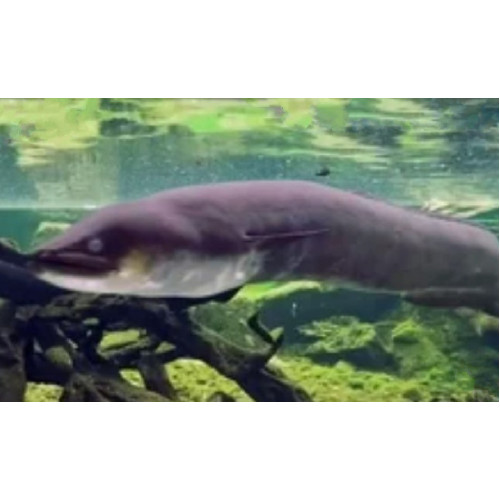
The New Zealand longfin eel possesses a long, slender body with a large mouth filled with rows of small, sharp, white teeth. The mouth extends farther beyond the eyes compared to that of the shortfin eel. When the eel bends, its loose skin distinctly wrinkles within each curve.
Determining the sex of these eels is challenging, as their reproductive organs do not become discernible until they exceed 45 cm in length. Internal examination is the only method for sexing longfin eels, and differentiation becomes straightforward only when the eels mature and prepare for migration.
Features of Fish Fins
The dorsal fin of this species extends for about two-thirds of the body length and originates significantly farther from the head than the anal fin.
Fish Coloration
The coloration of the New Zealand longfin eel ranges from dark brown to grey-black.
Distribution
An endemic species to New Zealand, it is widely distributed throughout the country's lakes and rivers, including the Chatham Islands.
Habitat
These eels are frequently found at considerable distances inland (up to 361 km) along freshwater waterways and in high-country lakes connected to the sea.
Their habitat varies with life stage. As juveniles, they prefer shallow waters (less than 0.5 m deep) with coarse substrate and faster currents (e.g., in riffles). Adult eels are typically found near or under large debris and along undercut riverbanks.
Size
Female New Zealand longfin eels are larger and longer-lived than males. Males average 66.6 cm in length but can reach up to 73.5 cm, with an average lifespan of 23 years (range: 12-35 years). Females are significantly larger, ranging from 73 to 156 cm with an average length of 115 cm.
This is a remarkably long-lived fish, with females reportedly reaching up to 106 years of age and weighing up to 24 kg. They exhibit the slowest growth rate among studied eel species, at just 1-2 centimeters per year.
Behavior
Like other members of the Anguillidae family, the longfin eel has a unique life cycle: they grow and mature in freshwater, then migrate to the sea to spawn. This catadromous reproductive system also facilitates random mating, resulting in a panmictic population.
Their dispersal inland is aided by their climbing ability as juveniles (elvers) less than 12 cm in length. These migratory events often coincide with increased water temperature, flow, and low light levels. At this size, elvers can travel over 130 km inland during a summer and have been observed climbing near-vertical surfaces up to 43 m high.
Food and Feeding Habits
They are omnivorous and opportunistic feeders. Their diet primarily consists of insect larvae, such as dragonfly nymphs (Procordulia grayi). As they grow, eels also actively feed on freshwater snails (Lymnaea) and fish, including galaxiids, bullies, and yearling trout, which are hunted by larger eels. There are reports of these eels preying on small waterfowl like ducklings.
Reproduction
Females reach an age between 20 and 60 years before migrating to sea to spawn.
New Zealand longfin eels reproduce only once at the end of their lives, undertaking a journey of thousands of kilometers from New Zealand to their spawning grounds near Tonga. Their eggs (each female produces between 1 and 20 million) are fertilized by an unknown method, likely in deep tropical waters. The adult eels then die. The eggs hatch into very flat, leaf-shaped larvae (called leptocephali) that drift on major ocean currents back to New Zealand—a journey believed to take up to 15 months. No eggs or leptocephali of this species have ever been recorded. Upon arrival in New Zealand, the larvae undergo metamorphosis into glass eels, which resemble small, transparent adult eels. They reside in river estuaries for their first year, during which they develop pigmentation, becoming elvers that resemble miniature adults. These elvers migrate upstream, where they develop into adults.
Fishing
The commercial fishery for the New Zealand longfin eel was incorporated into the Quota Management System (QMS) in 2000 for the South Island and in 2004 for the North Island. This established minimum and maximum size limits (220 grams and 4 kg) and a Total Allowable Catch (TAC). As of 2007, the TAC had not been reached in any fishing season since the QMS implementation. In recognition of the species' traditional significance, Māori hold 20 percent of the fishing quota.
The harvesting and export of glass eels in New Zealand is prohibited. As of 2022, however, up to 137 tonnes of eels, including longfins, were still being harvested for export—despite the species being officially listed as Endangered on the IUCN Red List.
Relationship with Humans
Several attempts have been made to establish aquaculture for the New Zealand longfin eel. The most common reasons for failure have been economic (high production costs relative to low market price), inconsistent recruitment of glass eels, and high mortality rates in farm conditions.
| Classification | |
| Phylum | Chordata |
| Class | Actinopterygii |
| Squad | Anguilliformes |
| Family | Anguillidae |
| Genus | Anguilla |
| Species | A. dieffenbachii |
| Features | |
| Conservation status | Endangered |
| Habitat | Bottom |
| Life span, years | 106 |
| Maximum body weight, kg | 24 |
| Maximum length, cm | 156 |
| Sailing speed, m/s | No information |
| Threat to people | Edible |
| Way of eating | Predator |
New Zealand longfin eel
Tags: new zealand longfin eel